

A vicious cycle has repeated itself: every time a major credit incident occurs—such as the past LIG Construction and Samboo Construction crisis, or the Dongyang Group collapse—investors shy away from corporate bonds and CP issued by unrelated companies. Recently, this trend of securities firms reducing their handling of non-investment-grade assets has been exacerbated by the financial regulator's strengthened stance on consumer protection.
This is because the risk of regulatory sanctions for improper sales has grown following the Homeplus and Jungang Group incidents. As a result, critics point out that corporate funding channels are effectively blocked, causing collateral damage to innocent companies.
According to the financial investment industry on the 5th, the Financial Supervisory Service (FSS) held a Sanctions Review Committee meeting that day to discuss the level of sanctions against selling brokers regarding improper sales of Homeplus ABSTB (Asset-Backed Short-Term Notes). It is known that a conclusion is highly likely to be reached soon.
The FSS has conducted inspections on Shin Young Securities, which served as both lead underwriter and seller for Homeplus short-term notes, as well as Hana Securities and Hyundai Motor Securities, since December last year. Following these inspections, the regulator opened Sanctions Review Committee proceedings in September of this year, initiating formal sanction procedures.
Industry insiders lament that the burden of regulatory inspections and sanctions has grown as the FSS's consumer protection stance has intensified. In July, the FSS began inspections of lead underwriters and sellers—including Shinhan Investment Corp, Kiwoom Securities, and Hanyang Securities—to verify whether improper sales occurred in connection with Jungang Group corporate bonds. This followed remarks by Lee Chan-jin, Governor of the FSS, in June, who stated, "From the investors' perspective, it is extremely unfair," adding, "It appears that corporate bonds were issued and underwritten right up until the brink of default, and then sold to retail investors."
The FSS is reportedly examining whether securities firms issued corporate bonds despite adequately confirming risks of financial deterioration, and whether they properly disclosed related risks to investors—given that these bonds carried high risk due to low credit ratings—and provided guidance tailored to investor profiles.
Critics note that this shift in atmosphere has a significant market impact not merely because it amounts to "picking on securities firms," but because it affects corporate fundraising. Indeed, as the risk of FSS sanctions has come into focus, securities firms have significantly reduced their handling of non-investment-grade assets with relatively low credit ratings since the Homeplus and Jungang Group incidents.
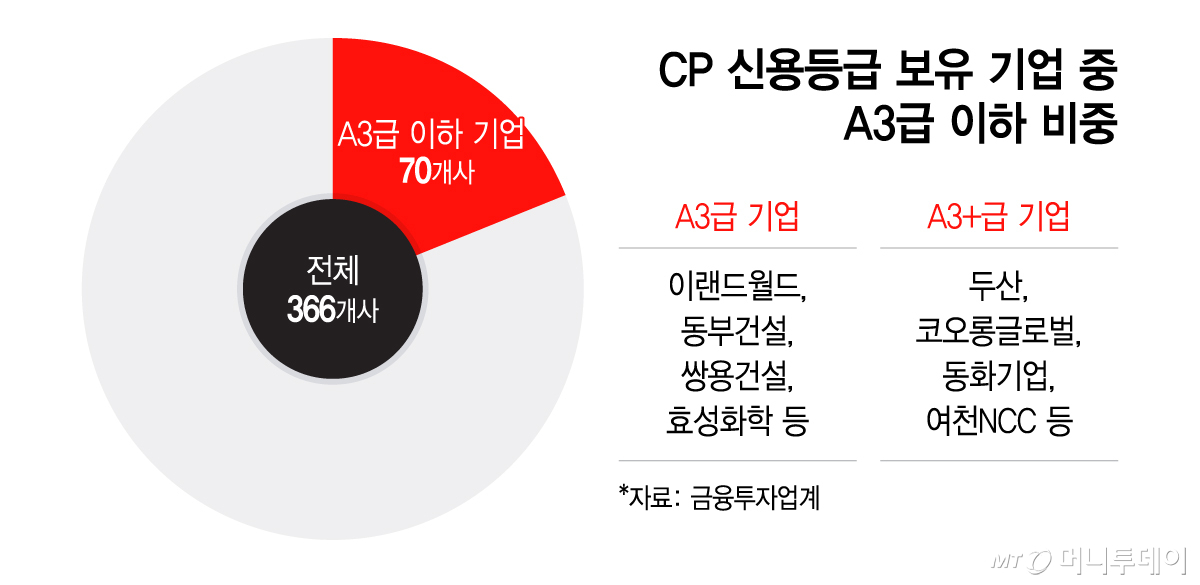
Accordingly, industry sources explain that even companies with relatively sound financial conditions are finding it difficult to raise funds. CP is a negotiable instrument with a maturity of less than one year, issued by corporations based on their own credit to secure short-term funding. Credit ratings for CP are classified in the order of A1, A2, A3, B, C, and D. Among these, A3-grade and above are considered investment-grade. According to the financial investment industry, as of last month, 70 out of 366 companies holding CP credit ratings were rated A3 or lower—a relatively non-investment-grade tier—accounting for 19% of the total. Companies in the A3+ grade include Doosan, Kolon Global, Donghwa Enterprise, and Yecheon NCC, while those in the A3 grade include E-Land World, Dongbu Construction, Ssangyong Construction, and Hyosung Chemical.
A securities industry official said, "Following the Homeplus and Jungang Group incidents, as the risk of regulatory sanctions has risen, securities firms have successively halted their handling of A3-grade non-investment-grade assets." The official added, "Unlike Homeplus, these companies have good financial conditions, yet fundraising for A3-rated firms is becoming difficult, directly impacting the market."

Similar cases have repeated themselves in the past. In 2011, CP issuance by construction firms plummeted following the LIG Construction and Samboo Construction crisis. This was because LIG Construction and Samboo Construction issued CP just before filing for court receivership, causing significant losses to investors and causing confidence in CP from all construction firms to collapse.
In the first quarter of 2011, CP issuance by construction firms was approximately 1.3 trillion won, averaging about 400 billion won per month. However, following the LIG Construction and Samboo Construction crisis, issuance remained at just 70 billion won through mid-April. New CP issuance also became difficult for non-investment-grade construction firms rated A3+ or lower. Among construction firms rated below A-grade, similar to LIG Construction and Samboo Construction, some companies that had attempted to issue corporate bonds or CP ended up halting their efforts.
The Dongyang Group crisis in 2013, two years later, was no different. In that incident, the Dongyang Group concealed default risks while issuing large amounts of corporate bonds and CP, causing losses to investors. Subsequently, overall investment sentiment for corporate bonds froze, allowing only some companies, such as major conglomerate affiliates with high credit ratings of AA or above, to issue corporate bonds.
In the financial investment industry, there are also calls to alleviate the regulatory burden that shrinks securities firms' product handling, alongside policy finance support. In particular, there is a strong voice arguing that losses due to the credit risk of issuing companies must be distinguished from the liability of selling brokers for improper sales. It is argued that only when clear criteria are established for judging liability based on whether a securities firm fulfilled its duties of appropriate credit review and disclosure can the phenomenon of uniformly halting product handling solely on the grounds of the possibility of a credit incident be reduced.
A financial investment industry official said, "While I understand the trend toward financial consumer protection, it is true that from the perspective of securities firms, there is a heavy burden stemming from the thought, 'If one blows up, don't we have to cover everything else?' and the stigma of being labeled as a bad broker." The official added, "Ultimately, since this has a negative impact on the market, the financial regulator must present clear criteria regarding improper sales and other issues."

 in STOCK

