

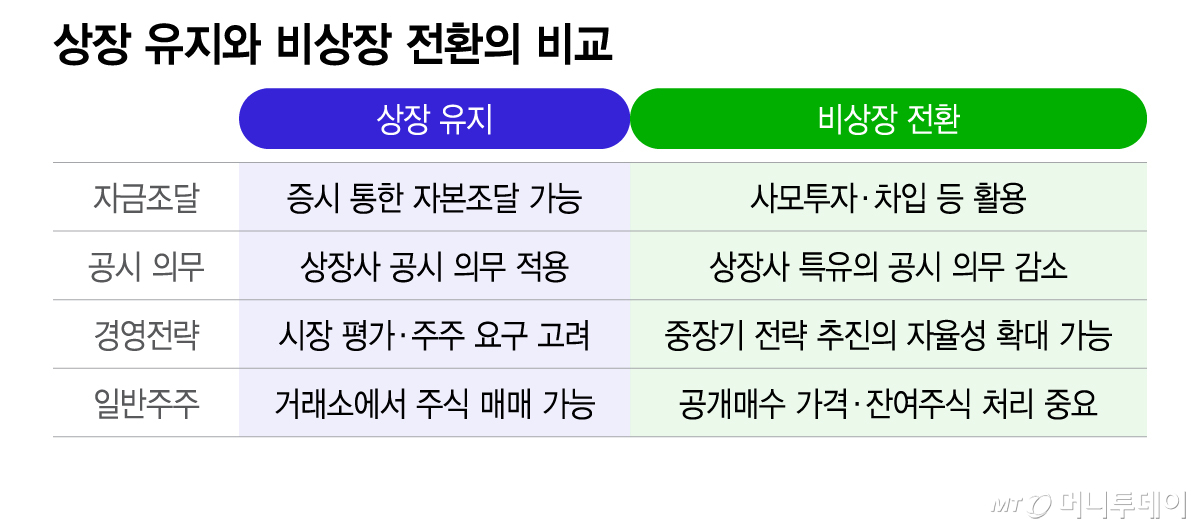
As the government's policy to enhance corporate valuation for low price-to-book ratio (PBR) firms enters full implementation, undervalued companies in the stock market are seeking changes such as expanding shareholder returns and restructuring their management strategies. In this process, analysts say that going private may become an option for companies instead of remaining listed. In the past, there have been cases in Korea where private equity funds converted listed companies into unlisted ones through tender offers and other means. Recently, global consulting firm Roland Berger also analyzed that listed companies may choose to go private to reduce short-term earnings pressure and disclosure and regulatory burdens, and to pursue long-term management strategies.
According to the financial investment industry on the 11th, Korea Exchange first disclosed a list of 151 listed companies with persistently low PBRs on the 2nd. This includes 96 companies in the KOSPI market and 55 in the KOSDAQ market. Initially, 185 companies met the low-PBR criteria, but 34 of them were excluded from the list after disclosing corporate valuation enhancement plans that included PBR improvement measures. The exchange plans to provide customized consulting to the disclosed companies starting next year and to encourage improvements in capital efficiency and expansion of shareholder returns.
Companies can work to resolve undervaluation through measures such as increasing dividends, canceling treasury shares, and restructuring their business structure. However, some may pursue going private after considering factors such as the controlling shareholders' equity structure, management strategy, and the costs associated with remaining listed. Going private refers to a process in which a listed company restructures its shareholder composition through tender offers or other means and then undergoes delisting procedures to become an unlisted company. This can be done by the company voluntarily applying for delisting or by utilizing corporate restructuring procedures such as comprehensive share exchanges.
In Korea, there have been cases where private equity funds converted listed companies into unlisted ones through tender offers. Hanwha Capital Group pushed forward a tender offer for the remaining shares of Ssangyong C&E in 2024, and Ssangyong C&E was delisted in July of the same year. MBK Partners also proceeded with going private after launching a tender offer for Connect Wave in 2024. In 2023, Hanwha Capital Group pursued delisting through a tender offer for Luvonic.
These cases share the commonality that private equity funds acquired additional shares of companies where they had already secured management control to convert them into unlisted entities. These transactions are examples where going private was achieved through private equity funds securing management control and expanding their shareholdings, with differences in management strategies and investment purposes at the time of the transaction varying by company.
Global management consulting firm Roland Berger analyzed the economic incentives for going private in its report "Public-to-private transactions," released on the 6th. The report explained that listed companies may face constraints in pursuing long-term management strategies due to market expectations for quarterly earnings and disclosure and regulatory burdens. Conversely, it analyzed that unlisted companies can reduce short-term earnings pressure and focus on business restructuring and medium- to long-term investments.
The abundant investment funds of private equity funds were also cited as a factor supporting going private. According to PitchBook data cited by Roland Berger, European private equity funds' uninvested capital reached approximately $430 billion in 2025, recording an all-time high. Roland Berger analyzed that for companies whose stock prices remain persistently undervalued or whose strategic investments are delayed due to market demands for short-term earnings, going private can enhance the flexibility of long-term management.
However, during the process of going private, conflicts of interest may arise between the acquirer and existing shareholders regarding price. Roland Berger analyzed that while the acquirer seeks a price that ensures an investment return rate, existing shareholders expect a price with a certain level of premium added to the stock price, which can lead to difficulties in negotiations. In Korea as well, during the tender offer for Connect Wave, some minority shareholders took collective action, such as pooling their shares, in protest against the purchase price and other terms.
Past domestic cases of going private and Roland Berger's analysis show that undervalued companies have options other than remaining listed. A financial investment industry official said, "The decision on whether to remain listed is a variable that affects not only companies' management plans but also the rights of minority shareholders," adding, "Depending on whether a company chooses to remain listed or go private, conditions such as funding methods, disclosure burdens, and the ability of general shareholders to dispose of their shares may differ."

 in STOCK
