

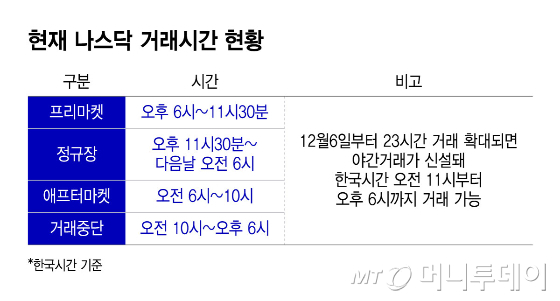
As U.S. NASDAQ is set to support 23-hour daily stock trading starting early next month, domestic brokerages have moved to fill the remaining one-hour trading gap. The plan is to leverage U.S. Alternative Trading Systems (ATS) to build a trading environment that is effectively close to 24 hours a day.
According to the financial investment industry on the 12th, major brokerages including Toss Securities, Kiwoom Securities, Meritz Securities, Shinhan Investment Corp, Mirae Asset Securities, and Samsung Securities are pushing to extend trading hours using U.S. ATS in line with NASDAQ's introduction of a 23-hour trading system. Some brokerages have decided to introduce the service, while others are reviewing specific operational methods.
These brokerages plan to fill approximately 50 minutes of the one hour during which NASDAQ halts trading with ATS transactions. An ATS is a system that intermediates stock trades separately from regular exchanges such as NASDAQ or the New York Stock Exchange (NYSE). Domestic brokerages are already supporting domestic investors' U.S. stock daytime trading through local U.S. ATS platforms such as Blue Ocean and Moon.
NASDAQ plans to expand daily stock trading hours from 16 to 23 hours starting on the 6th of next month (local time). This will be achieved by adding overnight trading to the existing regular session, pre-market, and after-market sessions. As a result, U.S. stocks will be tradable on NASDAQ from 11 a.m. to 6 p.m. Korean time.
However, trading is suspended for one hour each day for system checks and date transitions. In Korean time, this corresponds to 10 a.m. to 11 a.m. Domestic brokerages aim to connect ATS trading during this period to create an environment where U.S. stocks can be bought and sold for up to 23 hours and 50 minutes a day. This is particularly expected to enhance investor convenience as it overlaps with the regular session of the domestic stock market.
The brokerages' extension of ATS trading hours also aims to reduce investor inconvenience caused by unfilled orders. Currently, if an order received via ATS is not executed by the end of trading, it is automatically canceled, requiring investors to place a new order in the pre-market session.
However, as NASDAQ trading hours expand to 23 hours, there is a possibility that a system will be established to link trading hours between ATS and regular exchanges and carry over unfilled orders to the next trading session. In this case, it would reduce the inconvenience of investors having to submit new orders every time.
An official in the securities industry said, "I understand that the introduction of a system for automatic order deferral has not been confirmed," adding, "Some brokerages are reviewing related services in preparation for the possibility of building an order deferral system in the future."
Until now, competition among domestic brokerages' overseas stock services has centered on fee reductions, favorable exchange rates, and expanded trading hours. Going forward, how much trading gaps can be reduced is expected to emerge as a new competitive factor.
However, expanded trading hours are not necessarily advantageous for investors. During periods with low trading volume, the spread between buy and sell quotes widens, making it difficult to trade at desired prices, and stock prices can fluctuate significantly even with small trading volumes.
An official in the financial investment industry said, "The service competition among brokerages will become more intense with the expansion of U.S. stock trading hours," adding, "While enhancing trading convenience, how effectively investors manage risks during periods of low liquidity will determine competitiveness."

 in STOCK
