

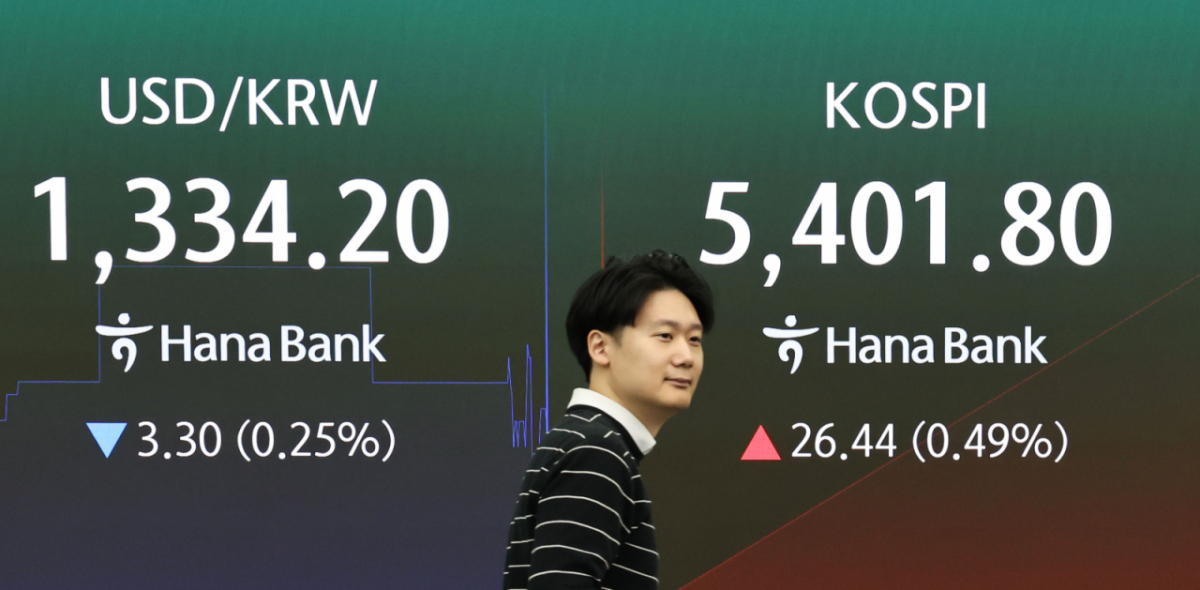
The KOSPI is engaged in a tug-of-war over the 5,400 mark on Thursday, as CoreWeave, a U.S. AI cloud company, delivered "surprise earnings" while reports emerged of plans to dismiss Nvidia CEO Jensen Huang.
U.S. tech stocks rose across the board overnight, buoyed by CoreWeave's surge, but investor sentiment in semiconductor stocks wavered after reports surfaced that the Nvidia board was preparing to dismiss CEO Huang following the market close. With the options expiration date also falling on this day, experts advise caution regarding intraday supply and demand volatility.
As of 1:22 p.m. on Thursday, the KOSPI is trading at 5,379.18, up 3.82 points (0.07%) from the previous session. After fluctuating between a slight gain and a slight loss immediately after the opening bell and rising to over 1 percent, the index has since narrowed its gains and is moving in the flat range.
Overnight in the U.S., a tech-led rally emerged, driven by CoreWeave's strong earnings and robust demand forecasting for Anthropic's IPO (initial public offering). On the 11th (local time), the S&P 500 index closed at 7,619.38, up 98.45 points (1.31%) from the previous close, while the NASDAQ Composite Index rose 400.31 points (1.60%) to finish at 25,466.19. The Dow Jones Industrial Average closed at 52,486.49, up 254.60 points (0.49%).
On the 11th, CoreWeave surged 24.7%, recording its largest one-day gain in over three months. The company announced that its third-quarter revenue reached $3.661 billion, a 168% increase year-on-year. It raised its full-year revenue forecast to between $13 billion and $13.3 billion and projected a transition to profitability in the first half of 2028.
The reason the KOSPI remained in the flat range despite the strength in U.S. tech stocks is negative news surrounding Nvidia. According to foreign media outlets such as The Wall Street Journal (WSJ) and The New York Times, CEO Huang, who has been embroiled in controversy over an affair with a woman identified as a Chinese spy, is also suspected of having had an affair with a female executive at his own company.
On this news, Nvidia shares gave back all their gains in after-hours trading, falling by more than 8%. Concerns spread through the market that if the company had circumvented regulations to export GPUs (graphics processing units) to China, it could face sanctions, and that Huang's departure could hinder AI infrastructure investments he has been promoting.
However, analysis suggests that the negative news regarding NVIDIA will not spread across the entire AI industry.
Lee Sang-yeon, a researcher at Shin Young Securities, stated, "While Nvidia fell 7 to 8 percent in after-hours trading, other custom chip (ASIC) companies such as AMD and Broadcom rose 3 to 4 percent, indicating that this is not acting as a risk for the AI industry as a whole."
He added, "Since Samsung Electronics, SK hynix, and Micron dominate the supply of memory semiconductors to ASIC manufacturers, the impact on these companies' fundamentals will also be limited."
On the supply and demand front, attention is focused on foreign trading trends as the KOSPI 200 options expiration date arrives today. Foreign investors, who made net purchases for two consecutive trading sessions, have bought a net amount of 255.3 billion won based on Korea Exchange data so far today.
However, including the Alternative Trading System (NXT), they are in a net sell position of 16 billion won. Experts unanimously advise caution regarding volatility until market close, as trading volume tends to be high on options expiration days.
Han Ji-young, a researcher at Kiwoom Securities, noted, "The domestic stock market today faces supply and demand pressure due to some profit-taking after the sharp rise over the past two trading sessions and the impact of the options expiration date. Additionally, the fact that Nvidia shares fell by about 8 percent in after-hours trading on news from foreign media that the board is preparing to dismiss CEO Jensen Huang could act as a burden."
However, she added, "The rally effect in AI stocks, including U.S. semiconductors, driven by CoreWeave's strong earnings and the successful demand forecasting for Anthropic's IPO (initial public offering) will maintain risk-on sentiment, leading to stock price movements that are neutral or better."

 in STOCK
