

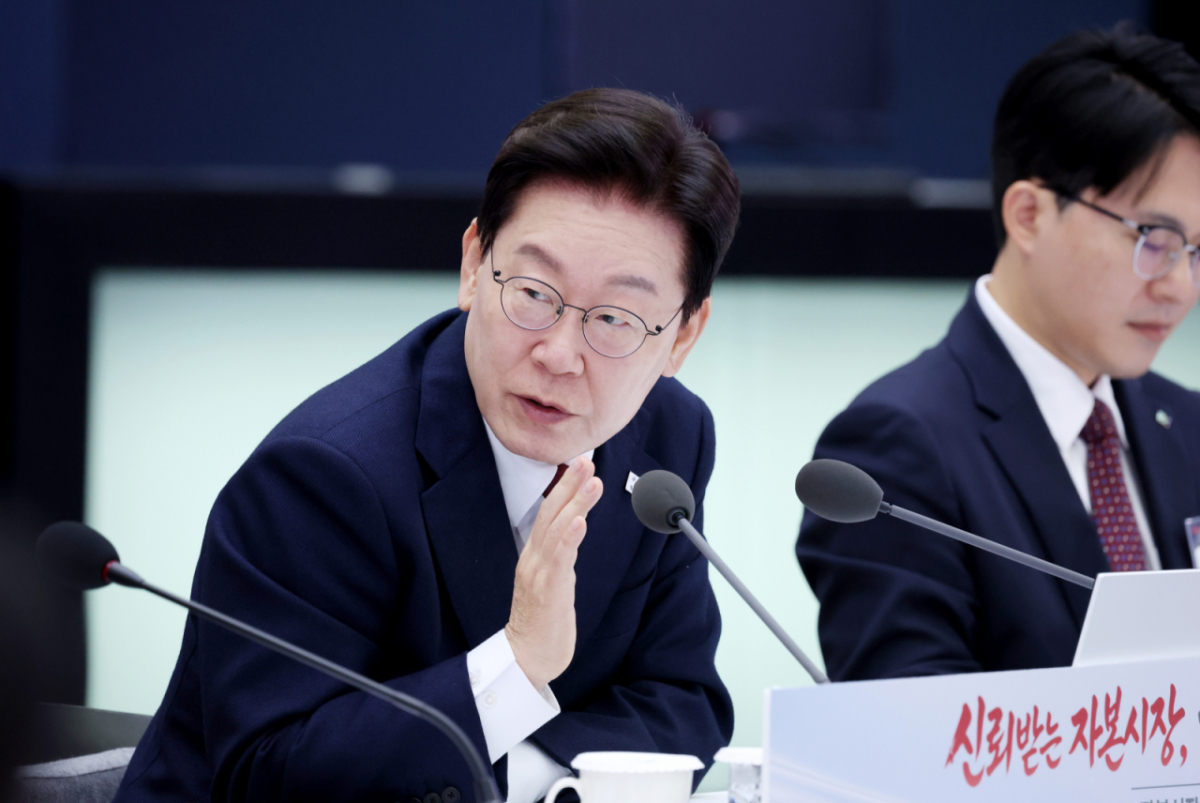
President Lee Jae Myung criticized KOSDAQ-listed companies for their passive approach to investor relations and called for institutional improvements. The Korea Exchange foreshadowed that it would mandate IR at least once a year.
Presiding over the "Capital Market Policy Roundtable" at the Korea Exchange in Yeouido, Seoul, Lee said, "I question whether they have the right to remain in the market. It seems that supplementation is needed."
He made the remarks in response to a point raised by Lee Gun-jae, head of the KOSDAQ Research Center at IBK Investment & Securities, regarding the large number of KOSDAQ-listed companies that do not conduct IR or refuse visit requests.
According to a survey by IBK Investment & Securities, the proportion of listed companies disclosing their IR activities last year was only 33% in the KOSPI market and 26% in the KOSDAQ market. During the same period, approximately 80% of listed companies in the United States were found to have conducted IR disclosures.
The center head said, "There are many companies that do not conduct IR, which makes it difficult to prepare reports on the KOSDAQ market," and added, "While there are domestic companies that engage in IR without disclosure, there is a difference compared to the United States."
President Lee said, "If you have put your company's stock out there, the essence is to make an effort to sell it at a fair price or even higher," and noted, "Refusing visits and not doing IR or promotion is the same as listing just for profit and then leaving it alone."
In response, Chung Eun-bo, chairman of the Korea Exchange, said, "We are considering changing the listing maintenance requirements to mandate that companies conduct IR at least once a year during the period their listing is maintained. We plan to reflect this in the listing maintenance requirements."
This is intended to expand the IR obligation, which is temporarily applied after KOSDAQ listing, into an annual requirement. Under current exchange listing contracts, listed companies are required to hold IR at least once a year for two years from the listing date to explain management content, plans, and future outlooks.
The exchange had also announced on the 6th, at a Korea Financial Accounting Association symposium, that it could impose IR obligations on KOSDAQ-listed companies. Sanctions for non-compliance with IR mentioned included penalty fees, disclosure penalty points, and inclusion in the "management group" after the introduction of the segment system, while incentives mentioned included granting bonus points for index inclusion.
During a discussion surrounding disclosures, President Lee also remarked, "I keep hearing that there are no IR materials in foreign languages." Chairman Chung said, "We already plan to expand English disclosures from KOSPI-listed companies to KOSDAQ-listed companies."
The roundtable on the 13th was attended by government and related agency officials, including Lee Hyoung-il, Deputy Prime Minister for Economy, and Lee Eui-woon, Chairman of the Financial Services Commission, as well as figures from the financial investment industry and academia. Presentations followed on enhancing corporate valuation, redesigning venture investment and the KOSDAQ market, and expanding the foundation for long-term investment.
Regarding the KOSDAQ market, experts emphasized the need to resolve delays in delisting while activating secondary markets to alleviate the burden of capital recovery for venture investors prior to initial public offerings (IPOs). Some also voiced opinions that a government-level long-term market reform roadmap and consideration measures for stocks with insufficient market capitalization but possessing technological competitiveness are necessary.
Lim Hyeong-jun, Research Fellow at the Financial Research Institute, stated, "With the surge in venture capital funds in the early 2020s, listing pressure expanded, and immature listings led to high price volatility for newly listed stocks," and added, "The characteristic that investment by institutional investors is limited due to the large number of small-cap stocks has also been linked as a factor in the vicious cycle of decreasing valuation and liquidity within the KOSDAQ market."
Hwang Hyun-young, Research Fellow at the Capital Market Institute, stated, "The UK has the Kay Report, Japan has the Ito Report, and Taiwan announced its capital market roadmap and corporate governance roadmap long ago," and added, "If we also draw a long-term picture for structural issues and push forward with details, the effect will be much greater."
Song Byung-jun, Chairman of the Venture Company Association, stated, "For companies in the lower tier of market capitalization, it becomes increasingly difficult to buy their stocks because they worry about 'won't we be delisted?' as their market cap approaches the delisting criteria (KOSPI 30 billion won, KOSDAQ 20 billion won)," and added, "Unsound companies and companies with low stock prices are not necessarily the same. Please look into the difficulties of venture companies."

 in STOCK
