

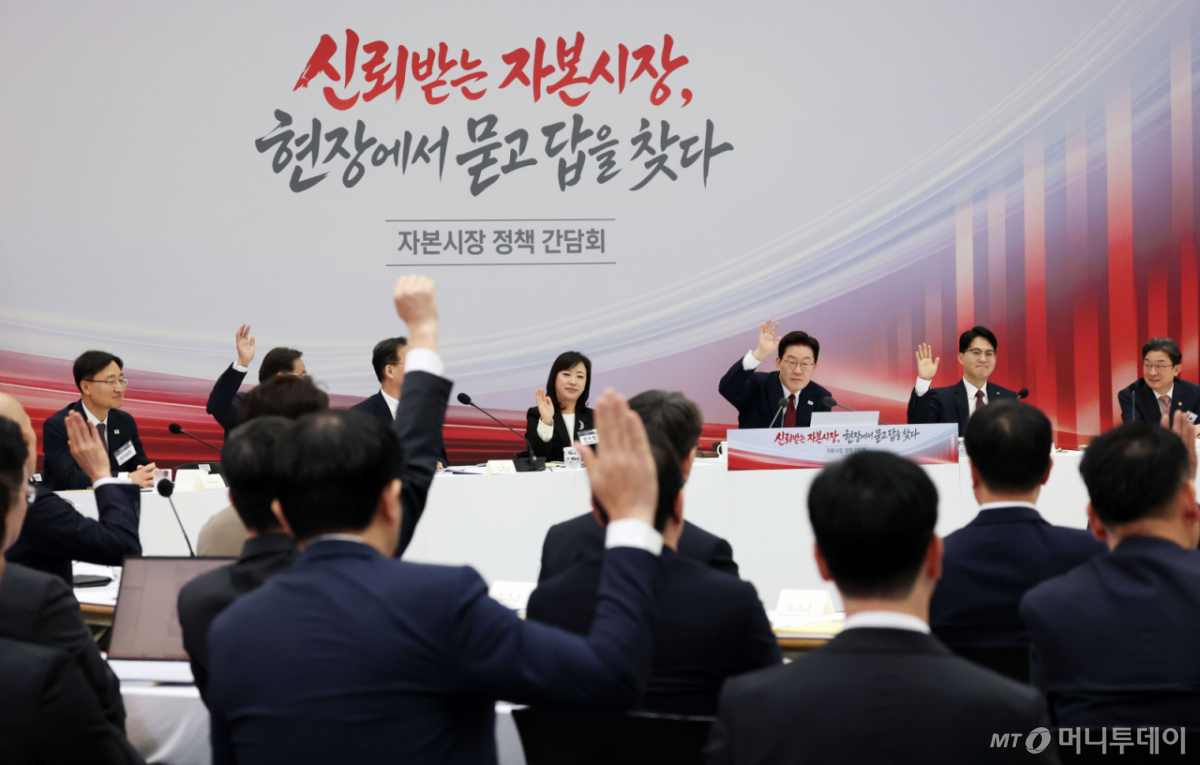
As a mandatory tender offer bill requiring the acquisition of retail investors' shares when acquiring control of a company fails to clear the National Assembly, a debate erupted at a capital market policy roundtable chaired by President Lee Jae-myung over whether the buyout ratio should be set at '50%+1 share' or expanded to 100%. Arguments that making all shares subject to tender offers would increase acquirers' financial burden and stifle M&A (mergers and acquisitions) clashed with counterarguments that premiums concentrated on major shareholders would decrease, resulting in only a modest cost increase.
At the capital market policy roundtable held at the Korea Exchange in Yeouido, Yeongdeungpo-gu, Seoul on the 13th, President Lee stated, "We must activate M&A so that it becomes easy and frequent; only then can we resolve the abnormal undervaluation of the Korean stock market," urging the National Assembly to process the mandatory tender offer-related bill.
A mandatory tender offer is a system requiring acquirers of control in listed companies to publicly buy out retail investors' shares above a certain ratio. It aims to provide minority shareholders with an opportunity to benefit from the control premium. The related amendment to the Capital Markets Act passed the National Assembly's Committee on Political Affairs and the Committee on Legislation and Justice last September, but did not reach the plenary session.
The amendment applies in cases where a shareholder becomes the largest shareholder with a combined stake of 25% or more through share acquisition, including shares held by special relationship parties. It involves publicly buying out remaining shares until reaching '50%+1 share,' including stakes already secured by the acquirer. However, criticism emerged that allowing major shareholders to be acquired first limits the sale opportunities for retail investors.
At the roundtable, President Lee inquired about the controversy over buyout ratios where the interests of major and minority shareholders diverge. "It is a matter of policy judgment whether to focus on fairness and require 100% acquisition, or to make it easier with 50%+1 shares," President Lee said, asking participants for their opinions. A show-of-hands vote was also conducted on site.
Park Byung-geon, CEO of Daesin Private Equity and Chairman of the Private Equity Fund Association, pointed out that expanding the tender offer target to 100% could reduce transactions due to the burden of acquisition funds. "Mandatory 100% tender offers have good intentions, but because the financial burden increases, I believe M&A will be significantly stifled in practice," Park said. Unlike the United States, which has a large financial market scale and ample funding capacity, it is argued that PEFs and corporate acquisitions could decrease domestically.
Conversely, Kim Woo-chan, a professor of Business Administration at Korea University, argued that the buyout ratio should be expanded to 100% to guarantee sale opportunities for all shareholders. He emphasized that a 100% tender offer does not force all shareholders to sell, but means buying out all shares from shareholders who wish to sell.
When President Lee asked, "If the financial burden increases and M&A itself becomes impossible, won't minority shareholders lose the opportunity (to sell) entirely?" Professor Kim replied, "Given that acquisition finance is well-developed, it is difficult to understand a situation where one cannot acquire due to insufficient funds." He explained, "Because control premiums previously offered at levels of 100% or 200% to major shareholders will decrease, acquisition costs will not rise significantly." This explanation notes that even if the volume of shares purchased increases, the per-share acquisition price decreases, so total costs do not increase proportionally.
Park Se-ik, CEO of Chesley Investment Advisory, also argued for expanding the acquisition ratio to 100%. "In companies where major shareholders' stake is less than 50%, control can be acquired if retail investors respond to the tender offer," Park said, emphasizing that minority shareholders should also be able to share the control premium concentrated on major shareholders.
While emphasizing market normalization through M&A activation, President Lee stated that further discussion was needed. "M&A must be activated so that the entire market normalizes, allowing all shareholders to benefit," he said. "The ruling party should continue to discuss it, but I hope there is no excessive delay," urging swift consensus-building.
Meanwhile, the roundtable was held under the theme 'A Trusted Capital Market: Asking in the Field and Finding Answers.' Attendees included over 50 people from government and related agencies, including the Deputy Prime Minister for Economy, the Financial Services Commission Chairman, the Minister of SMEs and Startups, the Governor of the Financial Supervisory Service, and the Korea Exchange Chairman, as well as representatives from the National Assembly, financial investment industry, corporate sector, and experts.

 in STOCK
