

As demand for artificial intelligence data centers (AI DCs), dubbed “electricity and water guzzlers,” has surged globally, South Korea’s electricity supply—capable of providing stable, low-cost power without blackout concerns—has emerged as a competitive advantage. In particular, with the possibility of extended operation for halted nuclear power plants, the country has secured enough power to operate six semiconductor factories and 19 data centers on a scale of 100 megawatts (MW).
U.S. faces two hours of blackouts annually; South Korea just nine minutes… ‘K-Electricity’ in focus in the AI era
Subtitle: [K-Growth Engine ‘AI Infrastructure’] <2> ① Global “War for Electricity”: Stable power supply 24/7… Core competitiveness in the AI era. Blackouts occur once every 10 years… Power loss rate remains in the 3% range
# Microsoft recently canceled its contract with Enscale, a UK AI infrastructure company, to build an AIDC (data center) on a 50-megawatt scale in Essex, England. The project was originally targeted for operation in 2027, but the timeline was pushed back to 2030 due to aging power equipment.
# Masden Hanna, Google’s climate policy head, pointed to the U.S. power grid as a bottleneck for its data centers earlier this year. She stated that the aging grid and stringent new transmission permits are hindering AI development.
With the surge in AIDC demand in the AI era, major countries around the world have entered a race to expand their power infrastructure. Their common voice is that stable power must be secured by improving aging grids and expanding public acceptance to operate AIDCs smoothly. South Korea has also kicked off three mega-projects to leap into becoming a core supply chain nation for AIDCs. High-quality electricity supplied stably 24 hours a day, 365 days a year, is gaining attention as a key competitive advantage.
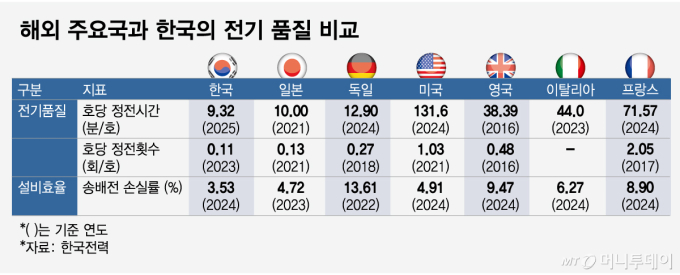
According to KEPCO on the 2nd, South Korea’s average blackout time per household last year was 9.32 minutes. This is one-fourteenth of the more than two hours (131.6 minutes, based on 2024) that U.S. households experience annually. It is overwhelmingly shorter than France (71.57 minutes) and Italy (44 minutes). The number of blackouts also remains at just 0.11 times per year. The power loss rate is 3.53%, one-fourth the level of major countries such as Germany.
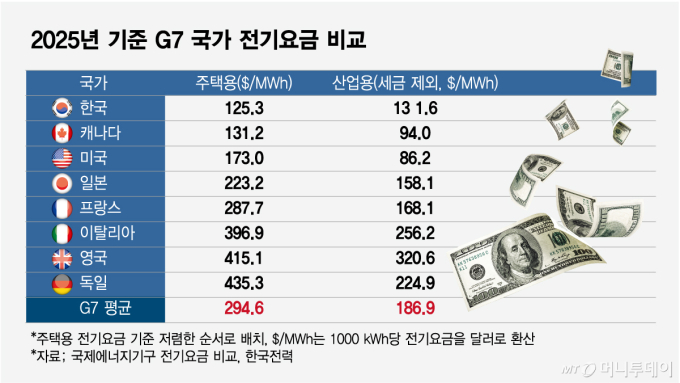
Electricity rates are also low. As of the end of 2025, South Korea’s residential electricity rate is $125 per megawatt-hour (MWh), and the industrial rate is $132. This is more than half the price compared to major OECD countries, where residential rates range from $300 to $400 and industrial rates from $200 to $300.
Based on this power competitiveness, the government has moved to attract AIDCs. Through the three mega-projects (semiconductors, AIDC, and physical AI) announced in June, it plans to secure 18.4 gigawatts (GW) of AIDC capacity by 2035 through public-private cooperation and leap into becoming a production hub for “tokens,” the currency of the AI era. The plan also includes building AIDCs domestically that are needed by overseas AI companies.
Demand from U.S. big tech (large IT firms) for establishing AIDCs is overwhelming, but domestic construction is difficult due to aging infrastructure and opposition from local residents. It is known that 70% of the U.S. power infrastructure is more than 25 years old, with over 25% exceeding 50 years. Consequently, moves are observed to build AIDCs in Asia, where power supply is stable.
The International Energy Agency (IEA) emphasized in its electricity report published this year that global power grid investment must increase from $400 billion (approximately 529 trillion won) last year to $700 billion annually (approximately 927 trillion won) by 2030. This is because AIDC power consumption is expected to nearly double from 485 terawatt-hours (TWh) in 2025 to 950 TWh in 2030, and global total power consumption is projected to rise from 28,200 TWh to 33,600 TWh over the same period.
The government has also stepped up investment in power equipment. With the mega-projects announced in June adding plans for large-scale semiconductor production bases and AIDC construction, adjustments to the power supply-demand plan have become unavoidable. Among these, it is focusing on expanding renewable energy such as solar and wind power.
Experts advise that, alongside increasing power generation, investment in transmission grids and small modular reactors (SMRs) must be increased together to resolve bottlenecks. Professor Choi Kyung-jin of Gachon University stated, “To export AIDCs, significant expansion of power capacity is needed, and stabilizing the supply chain so electricity can be used efficiently is important.” He added, “We build data centers in less populated areas to avoid local opposition, so we need to expand transmission grids to ensure smooth power use, as well as allow Power Purchase Agreements (PPAs) and SMRs.”
South Korea, hub for HBM production, the core memory of the AI era… Becoming an AIDC center
Subtitle: [K-Growth Engine ‘AI Infrastructure’] <2> ② HBM, the “rice” of the AI industry: Expanding from the capital region hub to the whole country to maintain global leadership. Building 10 fabs in Yongin… Plans for hundreds of trillions of won investment in the southwest and Chungcheong regions
Global competition is fierce to secure HBM (High Bandwidth Memory) supply, a strength of South Korea in the AI era. Accordingly, the government’s strategy through its three mega-projects is to expand the semiconductor hubs of Samsung Electronics and SK hynix nationwide to maintain global leadership in AI semiconductors.
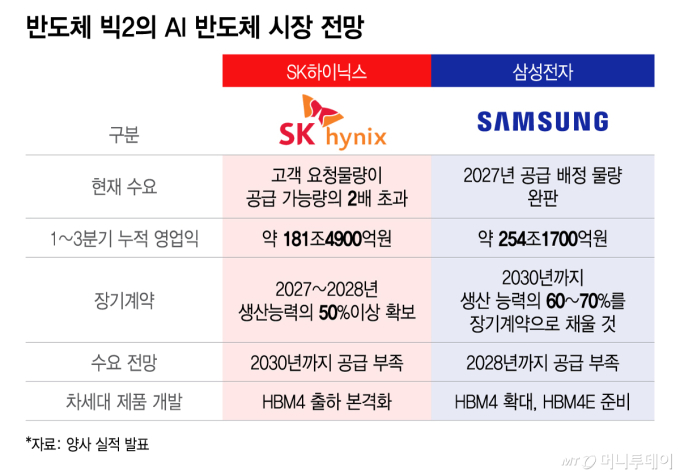
According to industry sources on the 2nd, Samsung Electronics opened the era of 100 trillion won in quarterly operating profit for the first time in the third quarter this year. SK hynix also recorded its highest-ever results with sales of 105 trillion won and an operating profit of 83 trillion won. The two companies’ cumulative operating profit for the third quarter reached 435.7 trillion won, exceeding half of the government’s 2027 budget proposal (821 trillion won).
The situation where AI memory demand from both companies exceeds supply is expected to continue for two to three years. HBM, which stacks multiple DRAMs vertically to enhance data processing speed and power efficiency, determines the performance of AI accelerators. As big tech firms develop their own AI chips and national-level AI infrastructure investments spread, HBM demand will increase, and expanding domestic production hubs is an opportunity for South Korea to maintain dominance in the AI semiconductor supply chain. This is why the government is proceeding with a mega-project to expand the semiconductor industry’s production base from the capital region to the whole country. The project is centered on Yongin, the southwest region, and the Chungcheong region.
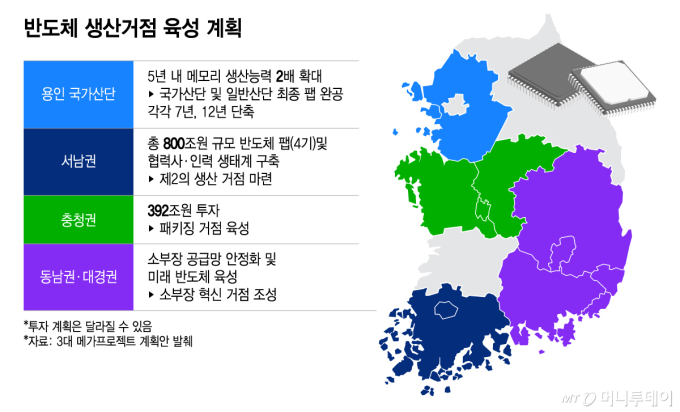
First, Yongin aims to double memory production capacity within five years by advancing the completion date of its fabs (fab·production lines). The Yongin Semiconductor National Industrial Complex began construction work for Zone 1 last month.
The southwest region, where four memory fabs worth 800 trillion won will be built, is also accelerating the creation of a second production hub. The government is in final negotiations with the United States over the relocation of the Gwangju military airport near the fab site and is formulating support plans for a task force (TF) to compensate Muan County.
In the Chungcheong region, investment scale has increased more than fourfold from the initial 81 trillion won to 392 trillion won as corporate investment was added to the government’s semiconductor packaging investment. On the 15th of last month, Samsung Electronics broke ground on expansion work at its Onyang plant.
The expansion of the semiconductor production base is expected to grow regional industrial ecosystems and contribute to balanced national development. This is because large-scale investment occurs during the construction phase of fabs, and after operation begins, they create demand for partner companies and specialized personnel.
The challenge is securing infrastructure. Semiconductor fabs must receive stable supplies of massive amounts of power and process water. If AIDCs (data centers) are built alongside them, power demand will grow even larger. For investment plans to translate into actual production capacity expansion, securing sites is not enough; transmission grids, generation equipment, and water supply systems must be established first. Ensuring that the results take root in the region through talent development linked with local universities and securing transportation networks are also challenges.
Lee Jun, a senior research fellow at KIET (Korea Institute for Industrial Economics and Trade), stated, “Individual large-scale investment projects must be transformed into common demand, technology, and investment platforms for national industries.” He added, “It is necessary to link the demand and technological outcomes generated through mega-projects with growth engines in seven regions to build a virtuous cycle of investment and growth.”
>>>Nuclear plants moving again… Powering six semiconductor factories and 19 AI DCs
Subtitle: [K-Growth Engine ‘AI Infrastructure’] <2> ③ Seven nuclear plants awaiting extended operation review… “Operation must not stop”
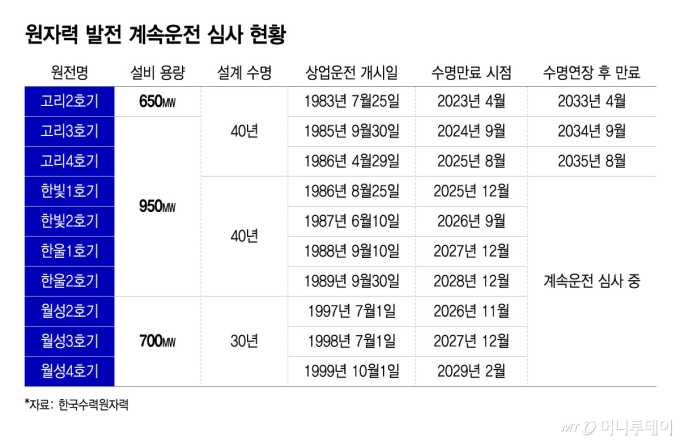
With the Nuclear Safety and Security Commission (hereinafter NSSC) permitting the extended operation of Units 3 and 4 of the Gori Nuclear Power Plant located in Gijang, Busan, up to an additional 1,900 megawatts (MW) of power will be secured from the first half of 2027. This is enough power to operate six semiconductor factories and 19 data centers on a scale of 100 MW. The AI and semiconductor industries, which must respond to surging power demand, welcomed the news.
According to nuclear and industry sources on the 2nd, it is widely interpreted that the NSSC, which had previously taken a cautious stance on extended operations, decided on its second extended operation permit with the AI era’s power demand and the government’s “three mega-projects” in mind.
To build AI competitiveness in the global market, high-performance model development alone is not enough; AIDCs (data centers) are needed, and semiconductor equipment to build them must also be increased. Ultimately, securing a stable power source is the first homework that must be solved.
In fact, Goldman Sachs, a global investment bank, reported that U.S. data center power demand will increase by 38% this year and in 2027, respectively, and expressed concern about power issues due to △ expansion of substations and transmission lines, △ delays in grid connection permit procedures, and △ construction delays for new gas and nuclear power plants. Jason Tofsky, head of the global digital infrastructure investment banking division at Goldman Sachs, emphasized in a recent report titled “Securing Power in the AI Era” that while big tech firms can buy GPUs (Graphics Processing Units) with massive funds, ultimately it is power that determines whether they can turn on those servers.
The industry’s position is that the seven nuclear plants currently awaiting extended operation review should continue operating without stopping. Previously, Gori Units 2, 3, and 4, which received extended operation permits after their design lifespans expired, experienced temporary power supply interruptions due to delays in extended operation reviews and maintenance deadlines required for restarts, ultimately failing to fully utilize the 10th-year extended operation period allowed.
[Production Support: Ministry of Culture, Sports and Tourism Public-Centered Communication Activation Project]

 in TECH


