

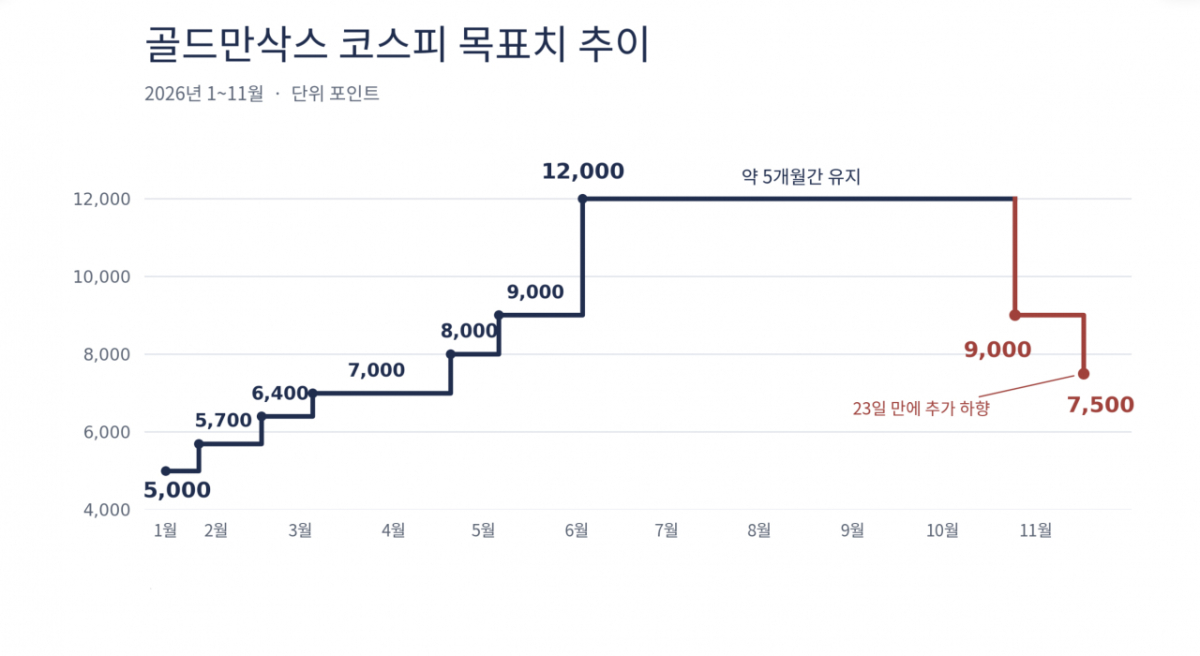
Goldman Sachs lowered its KOSPI target from 9,000 to 7,500. This comes less than a month after it cut the target from 12,000 to 9,000 at the end of last month. The bank judged that investor doubts over how long the memory semiconductor boom will last could constrain a rebound.
In a report released on Nov. 17 (local time), Goldman Sachs set its 12-month KOSPI target at 7,500, a 16.7% reduction from its previous level. This is about three weeks after it lowered the target from 12,000 to 9,000 on the 25th of last month.
Goldman Sachs had maintained the KOSPI target at 12,000 for approximately five months after setting it on June 3. With this adjustment, Goldman Sachs' KOSPI target is now 37.5% lower than the peak of 12,000 set in June.
John Kwon, a researcher at Goldman Sachs, said, "Volatility in the Korean stock market has increased in the second half of this year, and the pace of upward revisions to earnings forecasts has slowed. We lowered the KOSPI target considering that the market is still hesitant to fully reflect corporate fundamentals in share prices."
Goldman Sachs pointed out that the projected EPS (earnings per share) growth rate for Korean companies, excluding Samsung Electronics and SK hynix, has fallen below recent highs.
The projected EPS growth rate for Korean companies excluding memory semiconductor firms rose from 28% in January to 84% last month, but slightly decreased to 81% this month. The forecast for 2027 also rose to 20% in July and August before dropping to 18% in September and 15% in October.
Goldman Sachs believes that the memory semiconductor supply shortage will continue into 2028 and may persist until 2030. It projected that the EPS growth rates for Samsung Electronics and SK hynix would slow from 64% and 47%, respectively, in 2027 to 5% and 13% in 2028.
However, Goldman Sachs diagnosed that market anxiety over the possibility of the semiconductor boom ending sooner than expected is capping the upside for the Korean stock market.
"If investor doubts about how long the memory semiconductor boom will last continue, share prices may fall below levels supported by corporate profitability," he said.
The global sell-off in AI stocks that began last month intensified after this month's U.S. midterm elections as uncertainty over data center investments grew.
The KOSPI fell below the 5,000 mark intraday on the 6th and closed at 4,968.48 on the 17th, down 132.02 points (2.59%) from the previous trading day. This marks the first time in about nine months that the closing price has fallen below the 5,000 line.
Nevertheless, Goldman Sachs maintained its overweight recommendation, stating that the Korean stock market remains significantly undervalued. Applying the market's earnings forecasts, the forward PER (price-to-earnings ratio) corresponding to a KOSPI level of 7,500 is 4.9x, and the PBR (price-to-book ratio) is 1.18x.
Goldman Sachs analyzed that even if the KOSPI reaches 7,500, it would remain more than 40% below fair value levels, based on the historical relationship between the expected ROE (return on equity) of 24% and PBR.
Kwon said, "Even applying a conservative valuation to the KOSPI target of 7,500, we expect the 12th-month projected total return of the KOSPI in dollar terms to be around 50%." The target of 7,500 is 51.0% higher than the KOSPI closing price on Nov. 17 (4,968.48).
Goldman Sachs viewed that concerns over deteriorating earnings have been excessively reflected in memory semiconductor stocks due to recent corrections. While the domestic semiconductor index fell 54% from its June peak, earnings estimates actually rose.
"Current memory stock prices reflect a scenario where the 2027 earnings consensus estimate (market forecast) is revised down by 70%," Kwon said. "Given recent corporate announcements that DRAM and HBM (high-bandwidth memory) volumes have been sold out through 2029, this level of pessimism is excessive."
Corporate governance reforms, such as the Commercial Act amendment, mandatory share buyback cancellation, and the value-up program, were also cited as additional factors for further gains.
In the Asia Corporate Governance Association's (ACGA) assessment this year, South Korea improved by 5.7 points compared to 2023, marking the largest improvement among surveyed markets. Its ranking rose from 8th place to a joint 5th place with Malaysia. Australia ranked first, Japan second, and Singapore and Taiwan shared third place.
Kwon predicted, "Next year's regular general meeting of shareholders season and expanded shareholder returns will serve as a catalyst for alleviating the Korea discount." He added, "The total shareholder return yield of the Korean stock market is expected to rise from about 5% this year to about 8% next year."
Domestic securities firms are also in a mood to lower their KOSPI forecasts. Daishin Securities, which had set the KOSPI's upper limit for the year at 11,500 in June, presented an expected range of 5,200 to 6,700 for the fourth quarter in a report on the 26th of last month.
DB Securities lowered its expected upper limit for the KOSPI in the fourth quarter from 11,700 to present a range of 5,000 to 7,300. KB Securities, which had seen the KOSPI's upper limit for the second half of this year at 12,000 in July, presented an expected range of 5,100 to 9,000 for next year.

 in STOCK
