

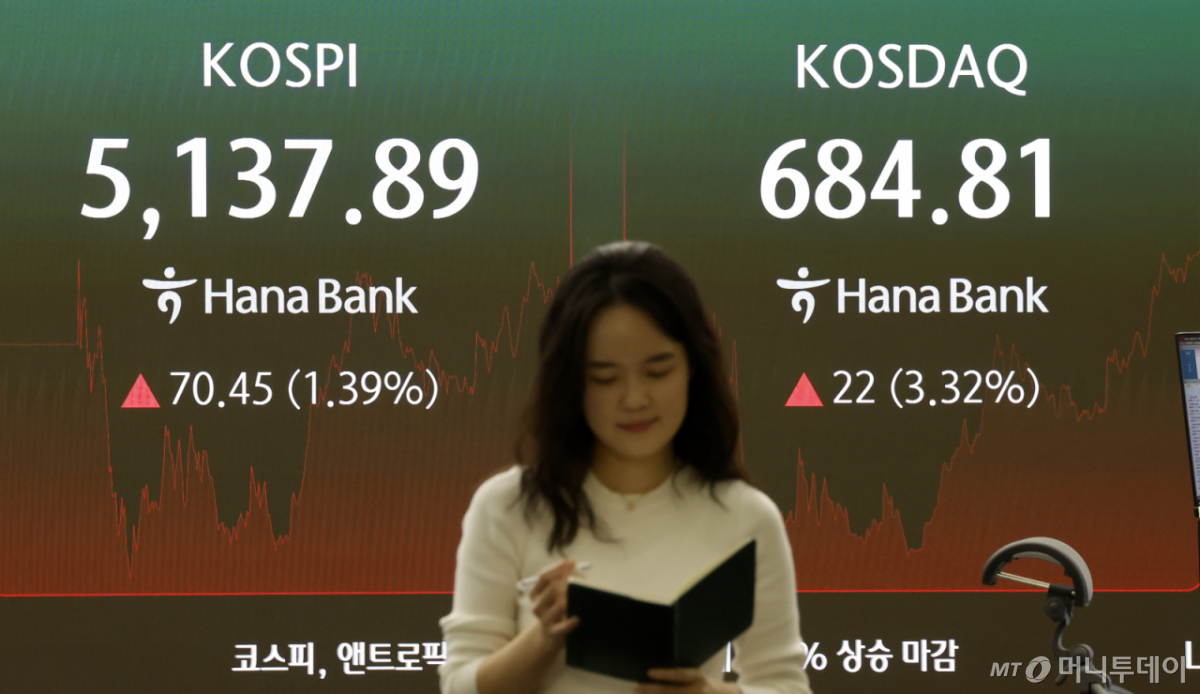
As Korea's two major stock markets closed higher, attention is turning to whether the rebound driven by continued AI (artificial intelligence) investment will persist. In the securities industry, it is seen that Anthropic's IPO (initial public offering), the largest in history with its price finalized early this morning, could lead to a recovery in AI investment sentiment.
On the 19th, the KOSPI closed regular trading at 5137.89, up 70.45 points (1.39%) from the previous day. The KOSPI opened at 5090.04, up 22.60 points (0.45%), and after fluctuating around the flat line, it solidified its upward trend from 3 p.m. The KOSPI also fell below 5000 during intraday trading.
The KOSDAQ closed at 684.81, up 22.00 points (3.32%) from the previous day. The KOSDAQ opened at 668.31, up 5.50 points (0.83%), and showed mixed trading.
Foreigners withdrew from both major markets. In the KOSPI, foreigners and institutional investors made net sales of 458 billion won and 2.3 billion won, respectively. In the KOSDAQ, foreigners made net sales of 188.7 billion won.
The securities industry expects Anthropic's listing to lead to a recovery in AI investment sentiment and a revaluation of related companies' valuations. According to Reuters, Anthropic's offering price was finalized at $83 per share. Anthropic plans to raise approximately $81.31 billion through this IPO. As the offering price increased and the number of shares offered grew, it surpassed the base offering amount ($75 billion) of SpaceX, which listed in June.
Researcher Tae Yoon-sun at KB Securities diagnosed that global market investment sentiment has contracted due to valuation burdens on AI tech stocks and concerns about investment profitability. He stated, "Anthropic's successful listing could serve as an opportunity to reaffirm capital markets' demand for the AI industry and growth expectations."
He added, "While market assessments may change depending on post-listing stock price movements, Anthropic's IPO will act as a positive catalyst promoting the recovery of investment sentiment in AI companies and future fundraising and corporate valuation revaluation for AI firms."
Researcher Choi Jae-won at Kiwoom Securities explained that doubts about the profitability of large-scale AI investments were highlighted again with Big Tech's third-quarter earnings releases, and concerns over strengthened regulations related to data centers were added after the U.S. midterm elections.
He analyzed, "Rather than funds leaving the stock market, they moved to defensive sectors and regions with low AI exposure, leading to active rotation trading below the index." He advised, "In a situation where high volatility in AI-related stocks continues, it is necessary to examine which countries and sectors have served as safe havens for tactical responses."

 in STOCK
