

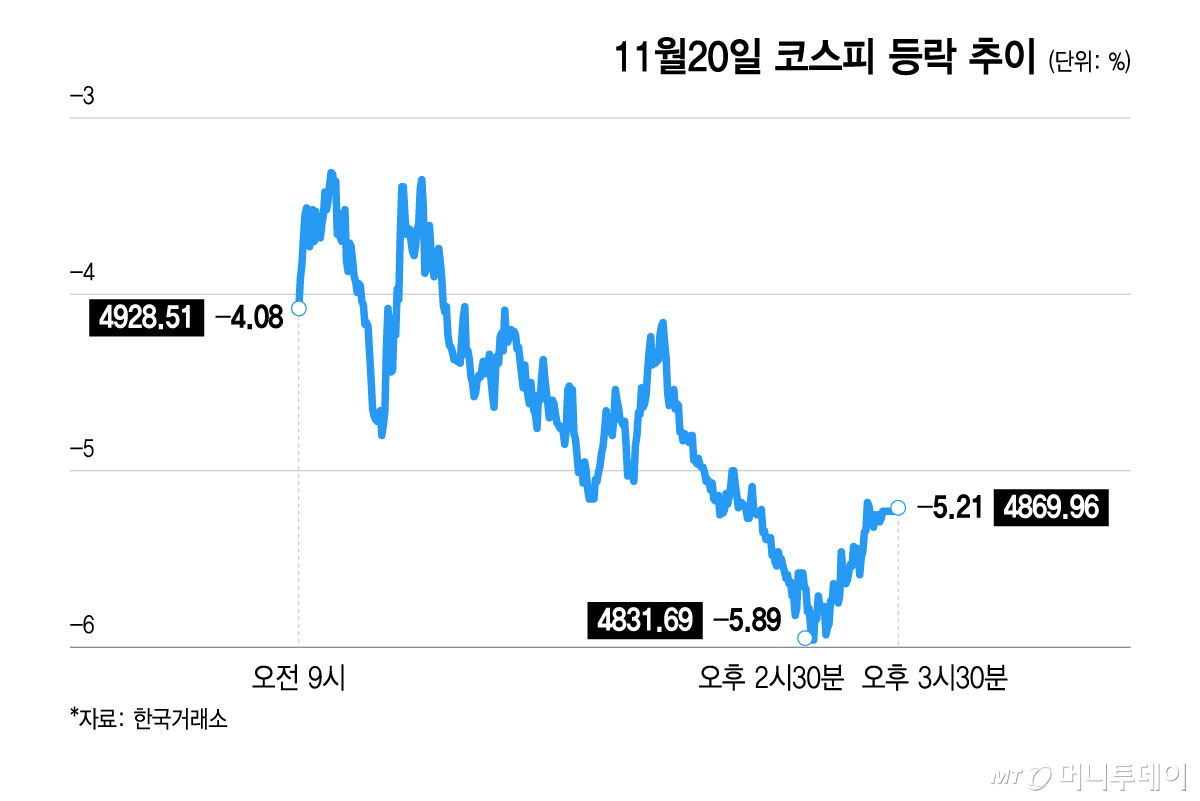
South Korea's stock market plunged on Friday, with the KOSPI falling below 4,900 and the KOSDAQ slipping under 650. Concerns over funds flowing into Anthropic following its U.S. IPO, potential AI regulations and tighter monetary policy combined to trigger sell-sidecars in both markets.
Experts pointed to earnings from U.S. technology companies and inflation data as key near-term indicators.
The KOSPI index closed at 4,869.96, down 267.93 points (5.21%) from the previous trading session. Retail investors made net purchases of 2.3159 trillion won, while other legal entities made net purchases of [missing value] won. Foreign investors made net sales of 1.5880 trillion won, and institutional investors made net sales of 1.2420 trillion won.
A sharp drop in semiconductor stocks exerted downward pressure on the market. Samsung Electronics closed regular trading at 182,500 won, down 14,400 won (7.31%), and SK hynix closed at 1,105,000 won, down 78,000 won (6.59%).
Samsung Electro-Mechanics fell in the 12% range, SK Square in the 8% range, and Samsung Life Insurance in the 7% range, with all top 10 stocks by market capitalization declining.
However, non-semiconductor stocks narrowed their losses, with LG Energy Solution closing down in the 1% range and KB Financial Group ending nearly flat.
The decline in the three major U.S. indices (Dow Jones 30, S&P 500, NASDAQ) that accompanied Anthropic's listing on Nov. 19 (local time) heightened concerns before the opening of the domestic stock market. Domestic and global securities firms interpreted this as large-scale selling of other tech stocks to fund purchases of Anthropic.
A report by short-selling institutional investor Hunter Brook alleging that AMD violated U.S. export restriction regulations on China, along with foreign media reports that Samsung Electronics and TSMC had halted shipments to some Chinese customers, also shook the market. Concerns over additional base rate hikes surrounding the Federal Reserve (Fed) were also cited as a negative factor.
Analyst Jo Ah-in at Samsung Securities said, "The decline in the domestic stock market is due to uncertainty in artificial intelligence investment and deteriorating supply and demand conditions."
She added, "From a fundamentals perspective, the medium- to long-term investment appeal of our market remains valid, but volatility may persist for some time due to domestic and international uncertainties."
Jo also said, "Rather than aggressive position expansion, it is necessary to maintain a conservative stance while seeking opportunities for split purchases centered on high-quality stocks that have fallen excessively relative to their earnings."
Analyst Han Ji-young at Kiwoom Securities said, "Even though positive factors such as NVIDIA's surprise earnings and the successful listing of Anthropic emerge intermittently, stock prices continue to plunge sharply. The most significant cause is that the willingness to buy among the majority of market participants has weakened."
She continued, "It is a market environment where figures such as valuation and earnings are completely ineffective, but from the perspective of the magnitude of price drops and technical indicators, simply holding on is the alternative for now."
The KOSDAQ index closed at 645.68, down 39.13 points (5.71%) from the previous day. Retail investors made net purchases of 346.7 billion won, while foreign investors made net sales of 226.6 billion won and institutional investors made net sales of 112.2 billion won.
Lino Co. and Iotech recorded declines in the 14% range, Simtech in the 11% range, Jusung Engineering in the 9% range, Robotis in the 8% range, Ecopro in the 6% range, and Ecopro BM in the 5% range. Among the top 10 stocks by market capitalization, only Alteogen closed with a slight gain.
Researchers Im Jeong-eun and Tae Yoon-sun at KB Securities said, "Given that concerns over external variables have been largely reflected in stock prices, we judge that market pessimism regarding Samsung Electronics and SK hynix is approaching its peak."
However, they added, "It is necessary to be mindful of increased stock market volatility ahead of major events next week, including Dell's earnings, the U.S. Personal Consumption Expenditures (PCE) price index, and the Bank of Korea Monetary Policy Board meeting."
Researcher Shin Eol at Sangsangin Securities said, "Because stock market volatility has risen again due to the absence of major supply and demand entities recently, we must keep open the possibility that the market will react sensitively even to small events."
He added, "It is necessary to view positively the fact that the stock market is in the process of establishing a bottom while reflecting negative factors."

 in STOCK
