

Driven by factors such as the IPO (initial public offering) of AI company Anthropic, the aftermath of former NVIDIA CEO Jensen Huang's resignation, and heightened AI regulatory risks, the KOSPI slid to the 4,800 level for the first time in 10 months. As AI investment sentiment deteriorated, semiconductor bellwether stocks, as well as materials, components and equipment (materials, components and equipment) names such as LS PetaSys and Daeduck Electronics, plunged during the third week of November (the 16th–20). In contrast, beneficiary stocks in entertainment, aviation, and cosmetics surged on expectations that China's "Hanhanling" (anti-Korea order) would be lifted.
According to Korea Exchange data on the 21st, the KOSPI closed at 4,869.96 during the third week of November, down 420.57 points (7.95%) from Jeonju (5,290.53). AI-related headwinds hit the market hard during this period. The aftershocks of former CEO Huang's resignation persisted, fueling growing market doubts about the sustainability of the AI ecosystem. In this context, funds flowed into Anthropic after the company listed on NASDAQ on the 19th (local time).
Amid deteriorating supply and demand conditions, U.S. short-selling investment firm Hunter Brook Capital raised suspicions that AMD's latest firmware was supplied to IEIT Systems, a Chinese server manufacturer subject to U.S. government sanctions. This sparked concerns over export control violations involving not only NVIDIA but also AMD, spreading worries about stricter regulations across the semiconductor sector. Additionally, the possibility of a U.S. base rate hike is growing.
During this period, Samsung Electronics and SK hynix fell by 11.12% and 8.47%, respectively. Samsung Electronics preferred shares and SK Square also declined by 15.37% and 11.15%, respectively.
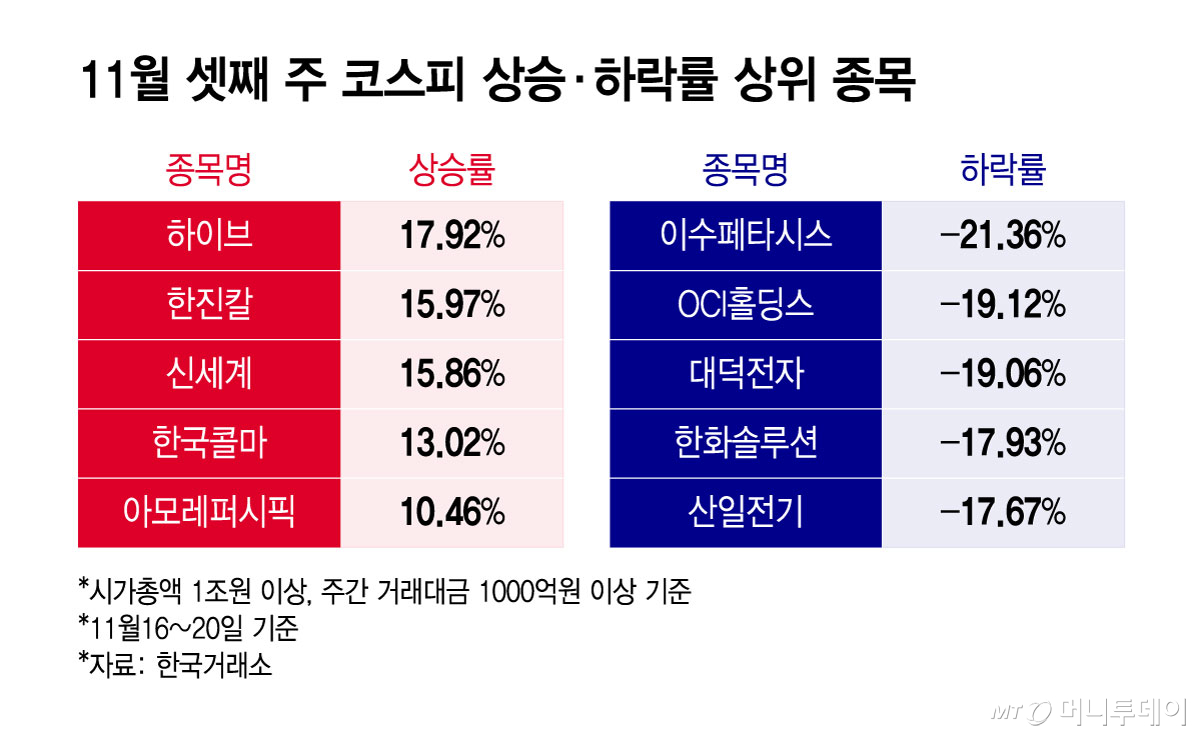
Notably, the decline in semiconductor materials, components and equipment stocks was steep. Among KOSPI-listed stocks (market capitalization of over 1 trillion won and weekly trading volume of over 100 billion won), LS PetaSys recorded the largest drop, plunging 21.36%. Daeduck Electronics, a substrate maker, also fell 19.06%. DB Hitek and Hanmi Semiconductor declined by 16.05% and 15.35%, respectively. Having risen more sharply than semiconductor bellwethers in the past, these stocks experienced a significant crash.
Kiwoom Securities lowered its target price for LS PetaSys from 190,000 won to 130,000 won on this day, reflecting a downward adjustment of the applied multiple due to share price declines among global peers. "Considering the strong trend in global ASIC market share and the company's unique domestic position and rising performance, we maintain our Buy recommendation," said Kiwoom Securities analyst Kwon Min-gyu, while adding, "We are lowering the target price due to a downward adjustment of the applied multiple resulting from share price declines among global peers."
In addition to Kiwoom Securities, Meritz Securities, DB Securities, Hana Securities, and SK Securities also lowered their target prices for LS PetaSys.
Power equipment stocks also fell due to deteriorating investment sentiment in AI stocks. In particular, Sanil Electric, which recorded an earnings shock in the third quarter, plunged 17.67%. Doosan Enerbility (-13.02%), LS ELECTRIC (-11.03%), and Hyosung Heavy Industries (-7.08%) also saw their share prices drop across the board.
Renewable energy stocks, which had risen on expectations of a "Blue Wave" in which the U.S. Democratic Party would capture both houses of Congress, also declined. It is interpreted that profit-taking selling emerged as the stock market plunged. OCI Holdings and Hanwha Solutions fell by 19.12% and 17.93%, respectively.
On the other hand, beneficiary stocks in entertainment, aviation, and cosmetics rose. This was due to growing expectations that China's "Hanhanling" would be lifted following the summit between President Lee Jae-myung and Chinese President Xi Jinping ().
The top gainer during this period was HYBE, which jumped 17.92%. Hanjin Kal (15.97%), Shinsegae (15.86%), Kolmar Korea (13.02%), and Amorepacific (10.46%) followed in order to occupy the top spots in returns.
Forecasts suggest that domestic singers' performances in China will become active again and Chinese tourists will increase due to the lifting of the "Hanhanling." There is also analysis that department stores and cosmetics companies will benefit from the rise in Chinese tourists. However, as it will take time for Chinese tourist numbers to increase significantly, beneficiary stocks of the "Hanhanling" lift are expected to show volatility for the time being.


 in STOCK

