

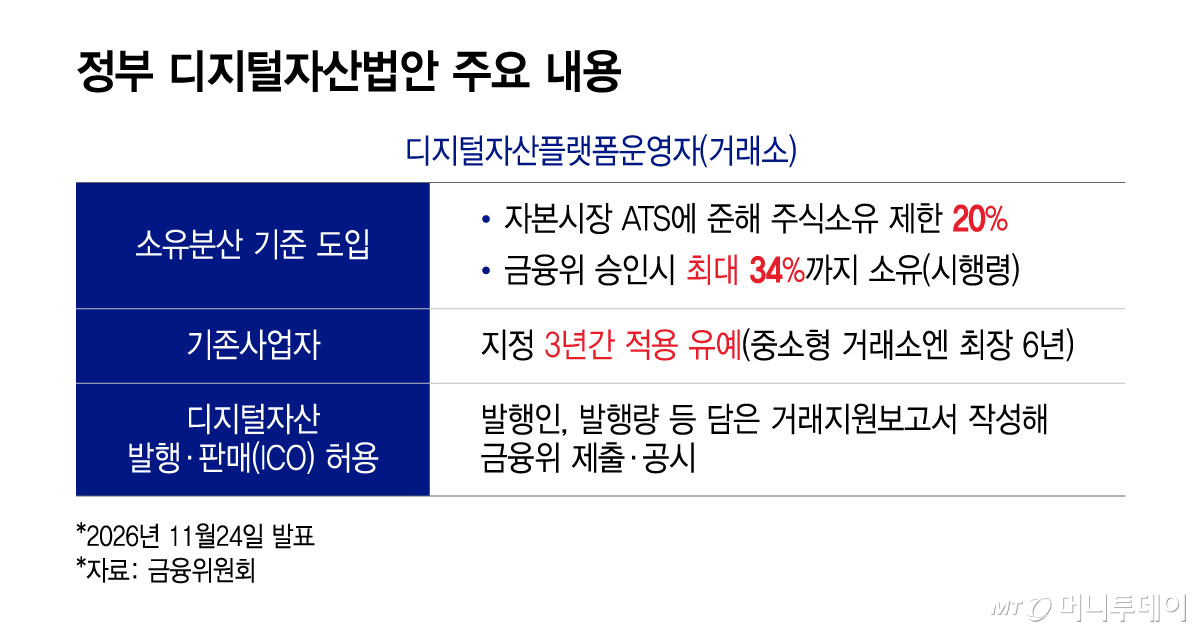
Shareholding caps for major exchange shareholders, bank-priority stablecoin issuance, and high barriers to initial coin offerings (ICOs). These are points that have left the virtual asset industry in a state of shock over the government bill for the Digital Asset Industry Act released by the Financial Services Commission on the 24th. While the bill opens the door to won-denominated stablecoins and ICOs, it is assessed that the high-intensity regulations long feared have been fully incorporated.
The government bill for the "Act on Innovation in the Digital Asset Industry and Protection of Users" (Digital Asset Industry Act; previously tentatively called the Digital Asset Basic Law before release), released by the Financial Services Commission on the 24th, caps the shareholding limit for major exchange shareholders at a principle of 20%, with a maximum of 34% upon exceptional approval, and restricts the voting rights of excess shares. As the government formalizes the shareholding ratio limits that had been rumored since late last year, virtual asset exchanges, the industry's largest sector, are unable to hide their shock.
An industry official who requested anonymity said, "Shareholding ratio limits for exchanges are rare in major overseas countries," adding, "If domestic exchanges face restrictions on major shareholders' voting rights while also being blocked from market participation by foreign and corporate investors, they will inevitably be placed in an even more disadvantaged position in global competition."
In its announcement on the 24th, the authorities stated that among stablecoin consortiums, those in which banks hold a majority stake would be permitted to issue first, formalizing bank priority. This is why concerns have grown among non-bank startups and fintech companies preparing for the issuance and circulation of won-denominated stablecoins. The industry believes that, given the precedent of Tether (USDT), issued in 2014, which dominated the dollar stablecoin market, the party issuing first has a high probability of gaining a first-mover advantage.
The government bill allows domestic ICOs for the first time after their complete ban in 2017, but attaches conditions such as white paper filing and acceptance, requiring "sufficient information disclosure." The industry forecasts that white paper review and disclosure standards will act as a significant barrier. This interpretation follows from the fact that the authorities have effectively operated the filing and acceptance procedure for virtual asset service providers (VASPs) as a licensing system.
Critics also point out that while the government bill introduces functional separation of financial investment business sectors, such as trading, brokerage, custody, and operation, it focuses on checking existing exchanges. It is assessed that regulatory burdens have increased, including no-fault damage compensation in case of hacking and punitive surcharges, while measures to activate the market are insufficient.
Some expectations are also felt regarding the newly established operation business and the allowance of over-the-counter trading and liquidity providers (LPs). This is because it could serve as an institutional foundation for the launch of new financial products such as virtual asset spot ETFs (exchange-traded funds) and participation by institutional investors. However, uncertainty in the field remains, as core standards are largely delegated to enforcement decrees.
An industry official stated, "After legislation, it is a point of interest whether exchanges can concurrently handle non-brokerage businesses such as infrastructure and custody if they meet certain requirements," adding, "If the authorities provide clear signals regarding the enforcement decree, operators will also be able to prepare effectively."
There are also strong voices saying that the legislation itself has been too late. The initial timing for releasing the government bill was mentioned as one year ago, but it took over a year just for review. In the meantime, the virtual asset market entered a full-blown downturn, with Bitcoin giving up the $60,000 line. Operators who had preemptively expanded personnel and organizations expecting an expansion of corporate trading are ultimately rolling back some of those efforts.
Another official stated, "While 'regulatory consistency'—the need to keep pace with trends in major countries—has served as a driving force for legislation, domestic legislation could slow down again because the U.S. CLARITY Act bill, aimed at the largest market, has stalled due to the aftermath of midterm elections," adding, "Unlike the United States, which first incorporated stablecoin issuance and circulation regulations into the GENIUS Act and passed it, Korea lacks any related laws, so rapid legislation is still necessary."

 in STOCK
