

The Korean and U.S. stock markets have alternately plunged, leading to a difficult-to-predict trading environment. After the two markets fell sharply on the same day, the domestic market has experienced both further declines and rebounds, showing divergent directions. The flow of the stock market is expected to vary depending on supply and demand from foreign investors and institutional investors, listed companies' earnings, and macroeconomic conditions such as interest rates and oil prices.
KOSPI swayed by semiconductor stocks… Volatility expands
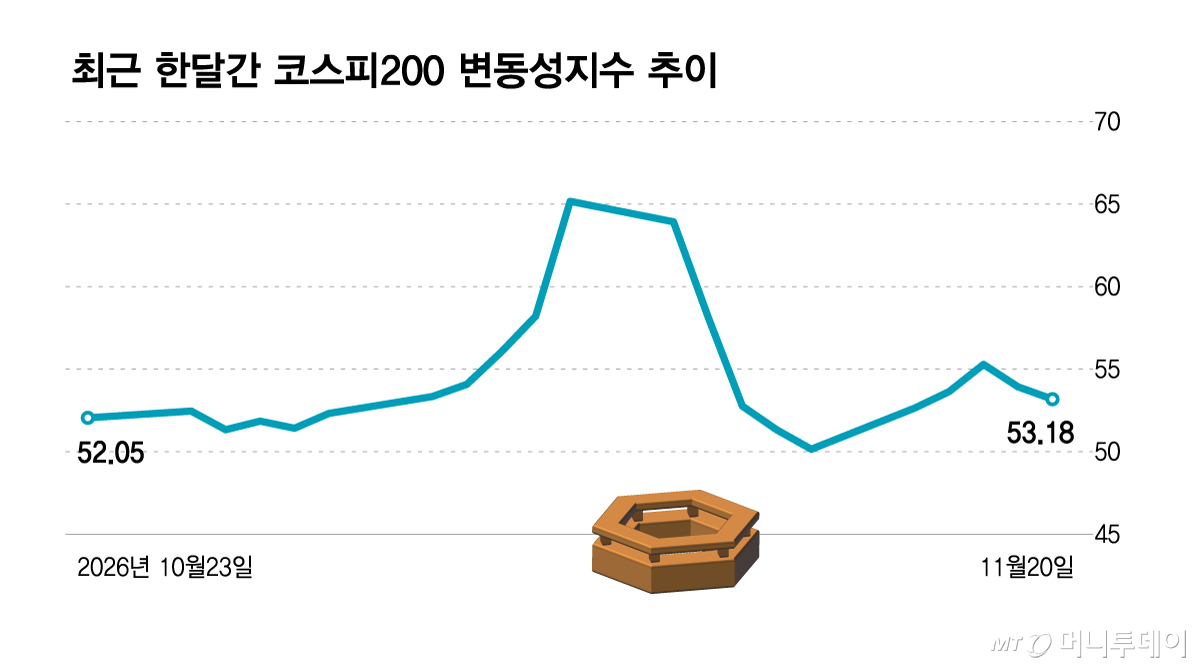
According to the Korea Exchange on the 22nd, the KOSPI 200 Volatility Index (VKOSPI) rose by 3.03 points (6.04%) from Jeonju to 53.18 based on the closing price on the 20th. This is the highest level since the 2nd of last month. Generally, a higher VKOSPI is interpreted as indicating a larger expected stock price volatility and stronger investor anxiety.
The securities industry believes it will be difficult for the VKOSPI to fall rapidly. This is because the volatility in the stock prices of Samsung Electronics and SK hynix, which account for a large share of the total KOSPI market capitalization, can impact the entire KOSPI index.
Samsung Electronics and SK hynix account for 68% of the decrease in KOSPI market capitalization compared to this year's peak. The two stocks currently make up 49% of the total KOSPI market capitalization. This is lower than at this year's peak (59%) but remains a high level compared to June last year (24%).
Recently, the domestic stock market has shown sluggish trends alongside the U.S. market. Expectations for improved earnings from domestic companies due to expanded artificial intelligence (AI) investment and rising memory semiconductor prices have weakened, spreading anxiety among domestic and foreign investors.
Further declines or rebounds after simultaneous sharp drops in Korea and the U.S.
The flow of the domestic stock market has diverged after simultaneous sharp drops in the Korean and U.S. markets. The KOSPI fell by 3.48% on the 30th of last month. Stock prices for Samsung Electronics and SK hynix dropped due to the impact of a sharp decline in U.S. tech stocks. That same night, the NASDAQ Composite Index fell by 2.86% and the Philadelphia Semiconductor Index dropped by 7.20% on the New York stock market. However, the KOSPI rebounded by 2.24% on the next trading day, the 2nd of this month.
The KOSPI also fell by 5.28% on the 5th of this month. Concerns over AI infrastructure regulations spread due to a "Blue Wave" victory for the Democratic Party in the U.S. midterm elections, leading to panic selling. The KOSPI 200 futures index plunged, triggering a sidecar (futures market circuit breaker). That same night, the NASDAQ Composite Index also dropped by 5.52%.
The KOSPI fell again on the 6th of this month due to the impact of the NASDAQ plunge. The decline over the two days of the 5th and 6th exceeded 10%. At the time, the securities industry analyzed that the shock from the Blue Wave was continuing. However, that same night, the NASDAQ Composite Index rebounded by 1.09%. The Philadelphia Semiconductor Index also rose by 4.21%.
The KOSPI fell by 3.59% on the 16th of this month as well. Samsung Electronics and SK hynix recorded declines in the 4th% and 7% ranges, respectively, dragging down the index. Following a scandal involving NVIDIA's former CEO (Chief Executive Officer), Jensen Huang, major investment banks (IBs) and research institutional investors successively lowered their target prices for NVIDIA, which also dampened investor sentiment toward domestic semiconductor stocks.
On the same day, Morgan Stanley released a positive outlook stating that the KOSPI could surpass the 10,000 mark within the next 3 to 5 years and settle at a "sustainable level." However, the KOSPI fell by 2.59% on the following day, the 17th. That same night, the U.S. stock market showed mixed trends, with the NASDAQ Composite Index and the Dow Jones Industrial Average falling slightly and the Philadelphia Semiconductor Index rebounding slightly.
On the 20th of this month, the KOSPI plunged by 5.21%. That same night, the NASDAQ Composite Index also fell by 5.28%. Concerns are emerging that the domestic stock market may see further declines on the 23rd, as the magnitude of the drops in both countries' markets is similar to that on the 5th.
However, the securities industry believes it is difficult to definitively predict further declines. This is because the timing at which negative news is reflected in stock prices varies depending on interest rates, oil prices, major companies' earnings and dividend policies, and buying pressure from institutional investors, funds, and individual investors also acts as a variable.
Interpretations of macroeconomic conditions are also divided. Lee Jae-man, a researcher at Hana Securities, said, "There is a coexistence of views that we can escape the tight financial environment and that expectations for reduced corporate cost burdens may form, and views that concerns over a contraction in domestic semiconductor exports and profit cycles could be highlighted if the growth rate of investment in the U.S. tech sector slows." He added, "Technical rebounds from Samsung Electronics and SK hynix could lead the index rebound until the first quarter of next year, but there is also a possibility of a change in leading stocks."
Kim Seong-no, a researcher at BNK Investment & Securities, said, "Some macro factors such as oil price stability and valuation are positive," while adding, "Since the Iran war, the OECD (OECD) G20 (Group of 20) Leading Economic Index has continued to slow down, beginning to deviate downward from the baseline, which is having a negative impact on the stock market."

 in STOCK
