

The won-dollar exchange rate could fall to 1,280 next year, according to a Goldman Sachs forecast. The outlook is based on expectations that South Korea will continue to post a current account surplus amid sustained AI investment and that easing global inflation will put downward pressure on the exchange rate.
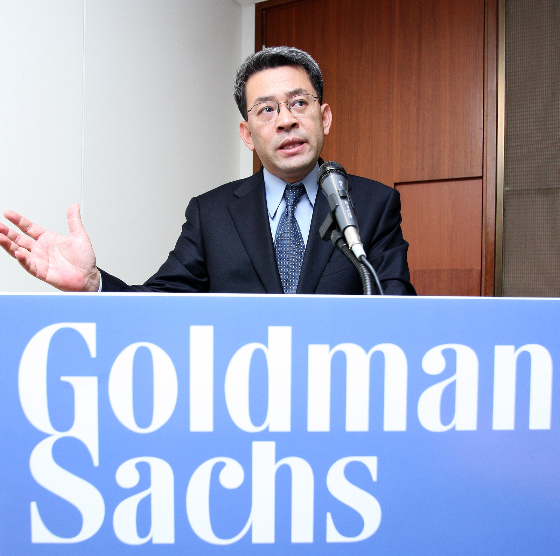
Kwon Gu-hoon, a senior economist and managing director covering Asia at Goldman Sachs, presented the outlook during a media briefing on South Korea's 2027 macroeconomic prospects at the investment bank's Seoul office in Jongno District on Monday.
Kwon forecast that the U.S. dollar would weaken next year while Asian currencies, including the Korean won and Taiwan dollar, would strengthen.
"The recent strength of the dollar was driven by a rally in U.S. technology stocks, particularly on the Nasdaq, which attracted significant inflows of European capital," he said. "If technology stocks weaken, that capital could flow back to Europe, potentially pushing the dollar lower rather than higher."
He identified South Korea's current account surplus as a key factor supporting the won.
"South Korea is expected to post a record current account surplus again next year," Kwon said. "Major Korean companies need to convert dollars into won to pay wages and taxes and distribute dividends."
He estimated that demand for the won next year would exceed 10 percent of gross domestic product (GDP), three to four times this year's level and equivalent to about half of the projected current account surplus for next year. The increased demand for the local currency is expected to provide a buffer for stability in the foreign exchange market.
Against this backdrop, Kwon forecast that the won-dollar exchange rate would fall below 1,300.
"We expect the exchange rate to reach 1,280 won per dollar," he said. "If the dollar weakens and the Chinese yuan strengthens, it could fall below 1,250 won."
He also predicted that easing inflation would bring a shift in the global trend of interest rate hikes next year. Kwon said the recent increase in global import prices has been more limited than during the COVID-19 pandemic and that inflationary pressures from oil prices and tariffs are expected to weaken next year.
"Excluding the effects of oil prices and tariffs, there are no underlying factors likely to fuel inflation," he said. He forecast that the United States would deliver additional rate hikes in December this year and March next year, setting a terminal rate of 4.25 percent to 4.5 percent in the second quarter of 2027.
"There is no reason for South Korea's terminal policy rate to exceed 3.5 percent," he added.
However, it remains uncertain whether the Bank of Korea will cut its policy rate next year. If the AI boom continues for an extended period, South Korea's economy could maintain growth of around 3 percent, while the benefits of the semiconductor boom could spread to domestic demand and consumption, making rate cuts more difficult. The timing and scale of any rate cuts will depend on how long the AI boom lasts, according to the analysis.
Goldman Sachs also forecast that South Korea's economy would grow 3.2 percent next year. Although this would be slower than the projected growth rate of 3.8 percent this year, the economy is expected to maintain solid growth. However, the recovery in domestic demand is likely to remain sluggish.
"Even when exports increase, it takes time for the benefits to trickle down in manufacturing-based economies," Kwon said. "In South Korea's case, the excess profits generated by rising semiconductor prices have been concentrated at Samsung Electronics and SK hynix."
"Samsung Electronics does not pay more to its suppliers simply because semiconductor prices have risen," he added. "Only about 1 percent of the workforce is employed in semiconductor-related industries."

 in STOCK
