

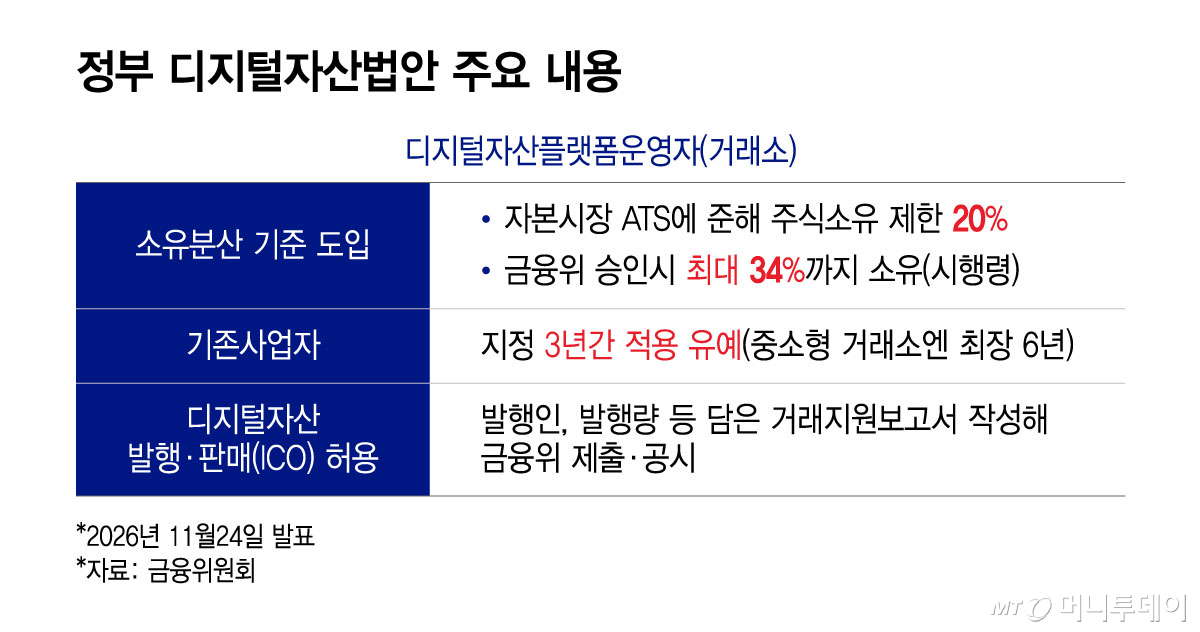
The Financial Services Commission (FSC) on Tuesday unveiled a government bill on the Digital Asset Industry Act that would initially allow bank-led consortia to issue won-denominated stablecoins and cap major shareholders' stakes in cryptocurrency exchanges at 20 percent in principle, with an upper limit of 34 percent.
The bill would also permit domestic digital asset issuance and sales through initial coin offerings (ICOs), provided sufficient information is disclosed. Key issues, including whether the ownership restrictions should also apply to parent companies, will be left to parliamentary discussions and enforcement decrees.
The bill establishes a legal framework for issuing won-denominated stablecoins. It defines stablecoins as "digital assets designed to maintain stable value by reference to a single currency and used primarily as a means of payment," and gives them the legal designation "digital payment tokens."
Issuance will initially be permitted for consortia in which banks hold a majority stake and which have at least 5 billion won in equity capital. Fintech and technology companies may also participate as the largest shareholder.
The FSC said that once the system is established, it will delegate specific shareholder composition requirements to an enforcement decree to allow non-bank consortiums to issue stablecoins.
Foreign issuers under the supervision of their home country's regulatory authority can also issue and redeem stablecoins domestically after establishing a domestic branch and registering with the Financial Services Commission.
For example, U.S.-based Circle would be able to establish a Seoul branch and issue USDC after completing registration and notification with the Financial Services Commission. Foreign stablecoins such as Tether (USDT) will also be permitted for domestic circulation if they meet the requirements and are reported to the Financial Services Commission.
Virtual asset exchanges such as Upbit and Bithumb are expected to have their maximum shareholding ratio per shareholder limited to 34% as digital asset platform operators going forward.
The government draft sets a legal cap on stock ownership at 20%, in line with regulations for alternative trading systems (ATS) in the capital market, but an enforcement decree will allow exceptions permitting ownership up to 34% with FSC approval.
The following is a Q&A session with Yoo Young-jun, Director of Digital Financial Policy at the FSC, and Seo Na-yoon, Head of the Virtual Asset Division.
- There was also an analysis by the National Assembly Legislative Research Service suggesting that regulations on the dispersion of ownership in virtual asset exchanges may be unconstitutional.
▶ We have thoroughly reviewed the potential unconstitutionality, which is why we included a grace period. We determined that this is a critical time for the public interest and neutrality of virtual asset exchanges and digital asset businesses. Since more than 10 million accounts have been opened at virtual asset exchanges and many citizens are using them, we judged that ownership dispersion regulations are necessary to enhance public interest and neutrality.
- How will voting rights be restricted for shares exceeding the ownership dispersion regulation (maximum 34% under the enforcement decree)? What penalties will an exchange face if it holds more than 34%?
▶ Regarding voting rights restrictions, any excess holdings remain in a state of legal violation. The regulations stipulate that excess holdings must be resolved. However, there is no provision for forced sale orders in the current government bill. Nevertheless, the law provides that we can issue corrective orders if shares exceeding the regulatory limit are held. To obtain other licenses or permits, any legal violations must be resolved.
- If an exchange is controlled by a holding company structure or is a 100% subsidiary, which entity does the ownership dispersion regulation apply to?
▶ Our bill looks at the major shareholders of the exchange. It examines the owning shareholders of the exchange. While it is difficult to mention specific companies related to Dunamu and Naver Financial, we will review up to major shareholders and parties with special relationships. Regarding friendly shares such as co-founders, we will precisely define those relationships when enacting the enforcement decree.
- What is the reason for setting the ownership dispersion regulation limit at a maximum of 34%?
▶ A stake of 34% allows for blocking special resolutions at shareholders' meetings, and internet banks are also regulated to allow ownership up to 34%, so we set the provision based on that example. Legally it is 20%, but we are considering allowing ownership up to 34% for some shareholders who have received Financial Services Commission approval.
- The ownership dispersion regulation has a three-year grace period. Does this three-year grace apply to both new and existing operators? Will small and medium-sized exchanges, excluding the top two companies, be given a maximum six-year grace period?
▶ The three-year grace period applies after being designated as a digital asset platform operator (exchange). The criteria for determining small and medium-sized operators will be decided by agreement with the National Assembly, industry, and others based on market share.
- Initially, only bank-majority consortiums can issue stablecoins. What timeframe is assumed for "initially," and are there any shareholding ratio limits for technology or fintech companies?
▶ We have not considered a specific period; we will consider the next stage once initial stablecoin issuance, circulation, and redemption are carried out stably. There are no provisions regarding the shareholding of a single technology or fintech company within the consortium.
- Compared to global markets, will DeFi (Decentralized Finance), derivatives trading, and prediction markets also be brought into the regulated sector?
▶ Since there are no specific provisions for DeFi and prediction markets in the bill, we will review and establish them through detailed subordinate regulations and enforcement decrees.
- Is the designation of important digital payment tokens (stablecoins) limited to overseas tokens only? What about the circulation of overseas stablecoins?
▶ Foreign digital payment tokens like Tether are permitted for domestic circulation if they meet certain requirements and are reported to the Financial Services Commission. The specific reporting requirements, etc., will be detailed in the enforcement decree. Regarding important digital payment tokens, we plan to designate them through a consultation body without limiting to domestic or overseas issuance.
- How will the principle of separating financial and virtual asset businesses (financial-virtual separation) be applied going forward?
▶ Regarding financial-virtual separation, we will continue to review how to set policy directions considering the situation where the bill is introduced and discussed.
- Will the content of real-name verified deposit/withdrawal accounts, which is a reporting requirement under the Act on the Use of the Financial System for Purposes of Money Laundering Prevention (Special Financial Information Act), also apply to this industry act?
▶ Issues related to real-name accounts will be separately reviewed by the FIU (Financial Intelligence Unit) once the bill is introduced. Currently, there are no separate provisions regarding real-name accounts.
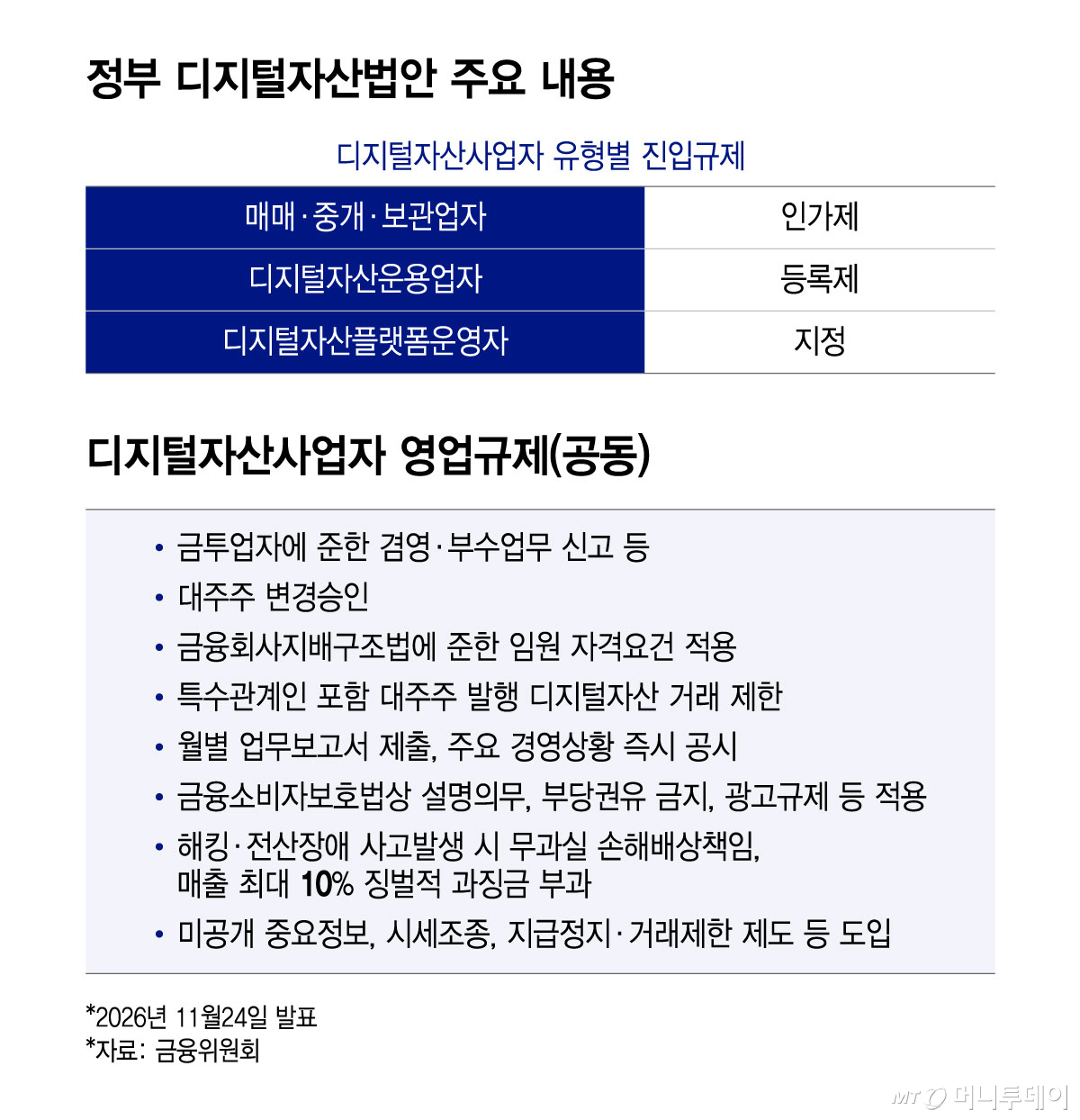
- A punitive surcharge system will be introduced in the event of hacking or computer system failure incidents. Does this apply stronger regulations than existing financial institutions?
▶ We discussed this content with the industry, and there were no major disagreements on this matter.
- Why was the guideline regarding corporate coin trading not reflected in the law?
▶ That content will be determined by guidelines. Regarding virtual asset trading by corporations, we will continue to review it in connection with the bill discussion process.
- Entry regulations for each type of digital asset business have been organized. Do existing operators also all need licenses or registration? What are the transitional measures?
▶ Existing operators must obtain a license according to the business they wish to operate under the current bill. Provisions regarding transitional measures are included in the bill. Virtual asset businesses currently operating must apply for a license from the Financial Services Commission within a specified period.
- Under the current Banking Act, bank investment stakes in non-financial subsidiaries are limited to 15%. Is there a possibility of changing this?
▶ It is correct that it is 15% under the current Banking Act, and (regarding investment stakes in stablecoin consortiums) we cannot make a definitive statement. We will look at it on a case-by-case basis.
- Regarding the 15th% investment limit under the Banking Act, are there cases where banks hold a majority while a fintech company is the largest shareholder? After the bill passes, when is the earliest stablecoin issuance possible?
▶ For example, there could be a case where four banks each hold 15%, totaling 60% of shares, with a fintech company owning 30% and other companies owning the remaining 10%. The timing for stablecoin issuance is one year after the promulgation of the law, and since it must go through issuer licensing and issuance approval thereafter, it seems difficult to state definitively.

 in STOCK

