

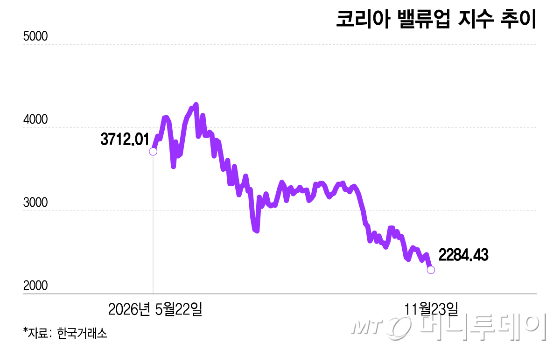
The Korea Value-Up Program Index and the KOSPI 200 Heavy Industry Index will no longer be classified as "narrow-based indices" under U.S. regulations starting next month, thereby escaping additional regulation by the U.S. Securities and Exchange Commission (SEC). As the chronic concentration of the domestic stock market in large-cap stocks eases somewhat, access for U.S. investors to index derivatives is also expected to improve. However, the atmosphere is one where it is difficult to interpret this purely positively, as the change stems not from the emergence of new leading stocks but from the weakness in share prices of existing leaders such as semiconductors.
According to Korea Exchange (KRX) and financial investment industry sources on the 24th, the exchange recently distributed a circular to its members regarding this matter. Both indices appear to have seen a reduction in the combined weight of their top five stocks, and they are set to transition to broad-based indices on the 7th and the 2nd of next month, respectively.
The United States classifies an index as a Narrow-Based Index if a single stock accounts for more than 30% of the index or if the combined weight of the top five stocks exceeds 60%. Even if an index is composed of numerous stocks, it is managed separately from general broad-based stock indices if the influence of certain stocks is excessively large. Futures related to narrow-based indices are subject to regulation by both the U.S. Commodity Futures Trading Commission (CFTC) and the SEC.
During this year's domestic stock market rally, major indices were successively classified as narrow-based. Following the Korea Value-Up Program Index and KOSPI 200 in the first half of the year, the KRX300, which is composed of 300 high-quality stocks from the KOSPI and KOSDAQ and was considered a relatively balanced index, also became a narrow-based index in September. This case illustrates how high the domestic stock market's dependence on certain large-cap stocks, such as semiconductors, has become.
A decrease in reliance on specific stocks is generally positive from the perspective of market stability. However, domestic securities industry officials express disappointment because, this time, the gap in market capitalization was not narrowed by rising share prices of previously overlooked stocks, but rather by a relatively significant decline in the share prices of leading stocks, which reduced the weight disparity among stocks within the indices.
In fact, Samsung Electronics and SK hynix, which hold substantial weights in the Korea Value-Up Program Index comprising 100 stocks, have seen their upward momentum stall since the second half of the year, exposing them to significant volatility. This is why it is difficult to view the market's growth foundation as having expanded, despite the numerical reduction in concentration.
The securities industry believes that for the domestic stock market to grow sustainably, a virtuous cycle must be formed where other sectors support the index when existing leading stocks undergo correction. In other words, the corporate earnings growth concentrated in certain sectors like semiconductors needs to spread to other industries.
Lee Jae-man, a research analyst at Hana Securities, stated, "We are paying attention to the possibility that leadership will spread to non-semiconductor sectors after a technical rebound in semiconductors from year-end through the first quarter of next year," adding, "Attention is focused on secondary batteries, where an earnings rebound is expected, and pharmaceuticals and biotechnology, where the sustainability of earnings growth is being highlighted."

 in STOCK
