

As the KOSPI index, which had reached the 9,300 level intraday, showed volatility by hitting the 4,500 range for the first time in about five months, securities firms are lowering the lower bound of their index forecasts for next year. Until last month, the lower bound for the KOSPI was mainly formed in the 5,000 to 6,000 range, but recently, figures as low as the early 4,000s have been mentioned. However, this does not assume that an additional sharp decline will actually occur. It is an extreme scenario assuming a recurrence of shock at the level of the Financial Services Commission era.
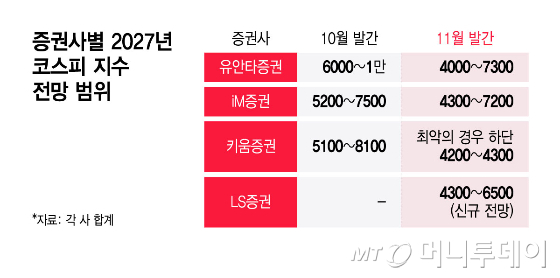
According to the financial investment industry on the 24th, Yuanta Securities, iM Securities, and Kiwoom Securities, among others, opened up the lower bound of the KOSPI index to the early 4,000s, lower than their previous forecasts, on the previous day. Factors cited for pulling down the outlook include △doubts about the profitability of the AI (artificial intelligence) industry △foreign selling pressure △and deteriorating investor sentiment. Analysis also emerged that while the KOSPI's earnings consensus estimate (market forecast) has not yet been significantly damaged, it is expected to be sharply revised downward, and this is being priced in advance into stock prices.
Yuanta Securities lowered its next year's KOSPI forecast range from the previous 6,000 to 10,000 to 4,000 to 7,300 on the 23rd of last month. This reflects not a deterioration in companies' future fundamentals (basic strength), but the fact that market environments such as stock prices, valuation (value), and supply and demand are irrational. The lower bound was set considering that in the worst case, next year's net profit could decrease by 15% from current forecasts and the target PER (price-to-earnings ratio) could be only 3 times.
iM Securities also presented a lower bound of 5,200 for next year's KOSPI last month, but opened it up to 4,300 in its report on the previous day. It applied the low point of the 12th-month forward PBR (price-to-book ratio) during the downturn in the memory semiconductor industry. In other words, applying the 2008 low of 0.81 times to the KOSPI index's 12-month forward BPS (book value per share) calculates the KOSPI index at 4,335. It predicted that if next year's second-half earnings forecast is significantly lower than expected, the index low could drop even further.
Kiwoom Securities also analyzed on the previous day that since the KOSPI's forward PBR is 0.91 times, the KOSPI index could be pushed down to the 4,200 to 4,300 range, corresponding to the PBR low during the Financial Services Commission era. This is a lower forecast than the 5,100 presented last month. However, it judged that the likelihood of an actual decline to that level is small, given that the current KOSPI has entered a historically extreme oversold zone and there is also the possibility of the government activating the Securities Market Stabilization Fund.
In its annual outlook report released on this day, LS Securities presented a next year's KOSPI forecast range of 4,300 to 6,500. The lower bound of 4,300 is a figure applying 34%, which approaches the lowest deviation from the 200th-day moving average line at that time, based on the judgment that the current market is similar to the case during the 2000 IT bubble collapse when stock prices fell by up to about 35% below the 200th-day moving average line. It diagnosed that this corresponds to an extreme undervaluation zone when reviewing valuation and return on equity (ROE).
In summary, the early 4,000s presented by securities firms are interpreted as close to a worst-case scenario applying the low point from the Financial Services Commission era. A researcher at a securities firm explained, "It means that if it goes from an oversold zone to a systemic crisis, it could drop to that extent," and "It is calculated based on past cases and does not mean that it will actually go down to the early 4,000s."
Although management uncertainty that had endangered the KOSPI index due to CEO Jensen Huang's return to NVIDIA overnight has been partially resolved, analysis suggests that this will make it difficult for the KOSPI index outlook to change. Another securities firm researcher said, "Expectations have arisen again that NVIDIA's technology development and funding support for AI companies will continue with Jensen Huang's return, but uncertainties remain, such as the U.S. Securities and Exchange Commission (SEC)'s accounting investigation and export controls to China."

 in STOCK
