

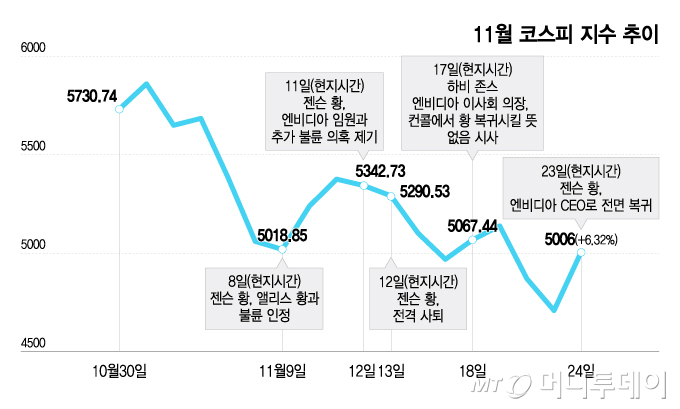
As investment sentiment in AI recovered following the return of Jensen Huang, CEO of NVIDIA, foreign investors returned to net buying on KOSPI after eight trading days. The CEO's return eased concerns surrounding AI investments and long-term supply contracts.
However, securities industry officials advised that this cannot be definitively called a trend reversal, noting that supply and demand changes driven by shifts in the global macro environment should be monitored until year-end.
On Tuesday, KOSPI closed at 5006.03, up 297.49 points (6.32%) from the previous trading day. The index opened at 4880.16, up 171.62 points (3.64%), and widened its gains, rising more than 7% intraday to reach as high as 5065.74. However, with retail investors' net selling increasing toward the close, the index settled for holding above the 5000th mark.
In the KOSPI market, foreigners made net purchases of 739.1 billion won and institutional investors made net purchases of 869.2 billion won, while retail investors made net sales of 2 trillion 43 billion won. Foreigners halted their net selling streak that had continued for seven trading days.
Lee Kyung-min, head of the FICC Research Division at Daishin Securities, stated, "While foreign inflows leading the rebound are a positive factor in a situation where large-scale net selling by foreigners had been driving domestic stock market declines amid the absence of a clear buying force, it is necessary to confirm whether foreign net buying will continue."
All sectors rose in the KOSPI market. News that Samsung Electronics would unveil a humanoid robot at CES 2027, scheduled for next January, drove up robotics-related sectors: transportation equipment and parts rose in the 9% range, machinery and equipment in the 7% range, and manufacturing in the 6% range.
Benefiting from the effect of the CEO's return, electrical and electronics rose in the 7% range, and IT services in the 6% range. The securities sector also rose in the 5% range, driven by the KOSPI rally.
Top stocks by market capitalization all rose as well. Driven by strength in robotics, Samsung SDI rose in the 13% range, Hyundai Motor in the 11% range, and Kia in the 10% range. LG Energy Solution also rose in the 7% range on expectations of robot-related battery adoption. In semiconductors and MLCCs (multilayer ceramic capacitors) and substrates, Samsung Electro-Mechanics rose in the 10% range, SK Hynix and Samsung Electronics in the 6% range, and SK Square in the 5% range. Samsung Trading rose in the 7% range on the strength of Samsung Electronics.
The securities industry expects that uncertainty driven by the macro environment will ease somewhat after year-end. In particular, with forecasts favoring a 0.25 percentage point rate hike at the FOMC (Federal Open Market Committee) meeting scheduled for the 9th of next month (local time), concerns about a correction phase have grown.
Research analysts Im Jeong-eun and Tae Yoon-seon from KB Securities forecast, "While the December FOMC meeting and winter energy supply instability in Europe could increase stock market volatility, as related uncertainties ease after year-end and expectations shift regarding the pace of global tightening and policy responses, these factors are expected to become key drivers leading a stock market rebound."
KOSDAQ closed at 665.88, up 30.43 points (4.79%) from the previous trading day. KOSDAQ also opened at 654.31, up 18.86 points (2.97%), and widened its gains intraday. Investment sentiment concentrated on robotics-related stocks lifted the index.
In the KOSDAQ market, foreigners made net purchases of 118.8 billion won and institutional investors made net purchases of 206.5 billion won, while retail investors made net sales of 308 billion won.
All sectors rose except textiles and apparel. Machinery and equipment, and transportation equipment and parts rose in the 8% range; finance in the 7% range; electrical and electronics in the 6% range; manufacturing in the 5% range; distribution, non-metals, and chemicals in the 4% range; metals, medical and precision instruments in the 3% range; construction, IT services, telecommunications, food and tobacco, and paper and wood in the 2% range; transportation and warehousing, other manufacturing, publishing and media reproduction, pharmaceuticals, and entertainment and culture in the 1% range.
Among top stocks by market capitalization, Robotis rose in the 19% range, Rainbow Robotics in the 17% range, Ecopro BM in the 11% range, HPSP and Ecopro in the 10% range, Wonik IPS in the 9% range, Rino Industrial in the 8% range, Simmtech and Iotech in the 6% range, Jusung Engineering in the 5% range, PSK Holdings in the 4% range, and HLB in the 3% range. Alteogen fell in the 5% range.
In the Seoul foreign exchange market, the won/dollar exchange rate closed daily trading at 1,342.4 won, down 3.5 won from the previous trading day.

 in STOCK
