

The KOSPI, which had surged by more than 6% in the previous session on news of NVIDIA CEO Jensen Huang's return, gave back most of its gains within a single day. This contrasts with U.S. semiconductor stocks overnight, which only returned a portion of their earlier gains. Securities firms analyzed that caution regarding further sharp volatility remained high, as trading volume declined while the VKOSPI (KOSPI 200 Volatility Index) rose to the 60th level intraday even as the KOSPI recovered the 5,000 mark the previous day.
As of 11:03 a.m. on the 25th, the KOSPI stood at 4,752.83, down 253.20 points (5.06%) from the previous trading session. This represented a reversal of approximately 85% of the previous day's gains. As the index plunged, the selling sidecar (futures market circuit breaker) was triggered early in the session.
Samsung Electronics and SK hynix, which had both risen by more than 6% the previous day, were falling by more than 8% and 7%, respectively. Foreign investors, who had made net purchases on the Korea Exchange for the first time in eight trading sessions on the 24th, turned to net selling again on this day. At the same time, foreign investors were making net sales worth 1 trillion 56.1 billion won.
In the U.S., the Philadelphia Semiconductor Index, which had risen 14.03% on the 23rd (local time) on news of CEO Huang's return, fell 7.88% on the 24th. Over the same period, NVIDIA surged 31.48% before dropping 5.86%. Combining the fluctuations over the two days, the Philadelphia Semiconductor Index rose 4.2%, while NVIDIA gained 23.8%.
Securities firms believe that with low trading volume and a rising volatility index, the KOSPI's ability to withstand declines has weakened. The KOSPI closed at 5,006.03 on the 24th, up 6.32%, driven by simultaneous net purchases from foreign investors and institutional investors. Buying momentum spread from semiconductors to robotics and automobiles, lifting all sectors.
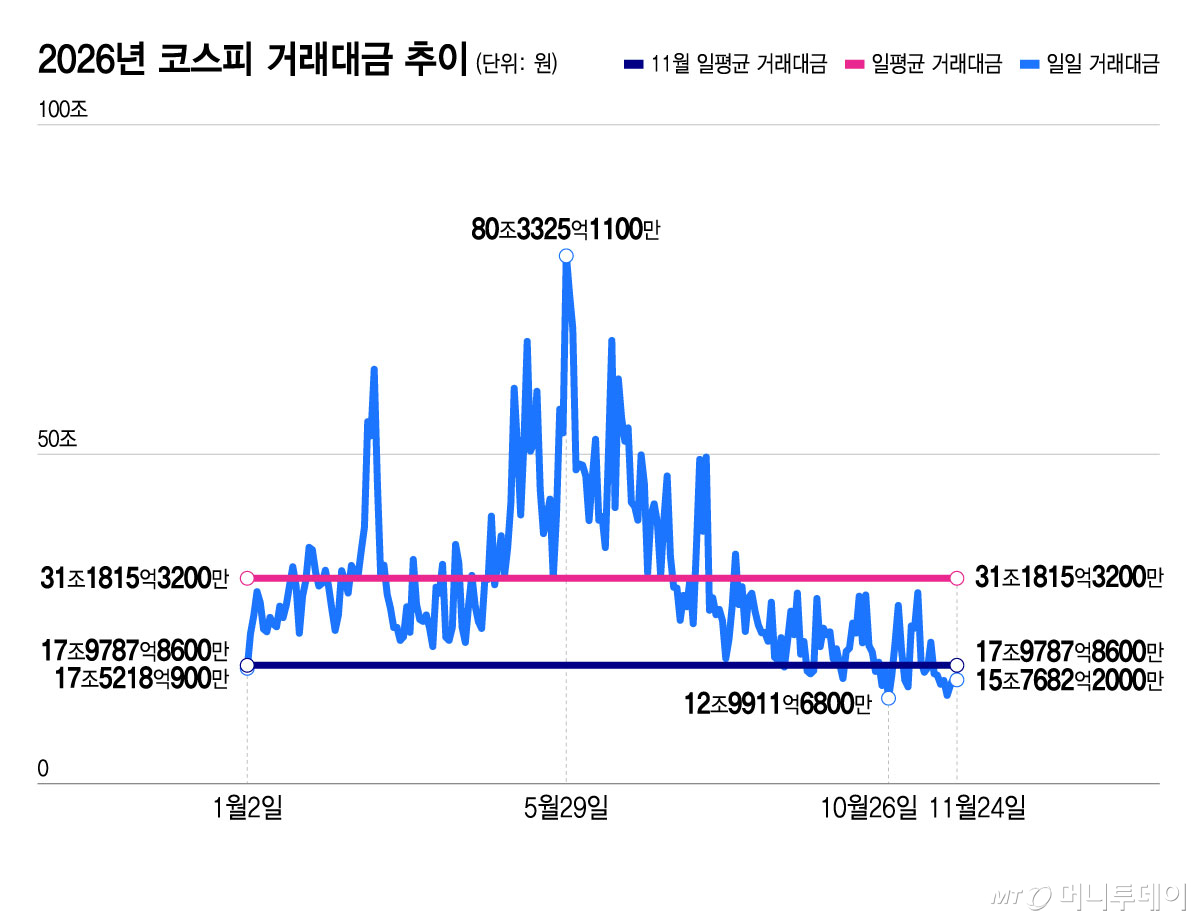
However, trading volume on this day was 15 trillion 768.2 billion won, a 1.8% decrease from the previous session. This is about half of the daily average trading volume for the year (January 2 to November 24) of 31 trillion 181.5 billion won. It was also 12.3% lower than the November daily average of 17 trillion 978.8 billion won.
Even without high trading volume, the index can rise significantly. If there is little selling pressure near current prices, buy orders will absorb that supply and execute at higher prices. When stocks with large market capitalization weights, such as Samsung Electronics and SK hynix, see their share prices jump, the magnitude of the index's increase also expands.
However, for the index rebound to continue, follow-up buying is needed to absorb selling pressure at higher price levels. On the 24th, trading volume actually decreased even as the index rose by more than 6%, making it difficult to sustain the gains. The New York Stock Exchange was different. According to MarketScreener, while the Philadelphia Semiconductor Index rose on CEO Huang's return, the index's trading volume increased by 1.84%.
Jung Hee-chan, a researcher at Samsung Futures, pointed out that "KOSPI trading volume has again approached the year-to-date low recorded on the 17th, just before NVIDIA's earnings release," adding that "it is necessary to keep in mind that the rise occurred without accompanying trading volume."
In addition, the VKOSPI, which reflects expected volatility priced into KOSPI 200 options, rose for two consecutive days, touching the 60th level intraday. Even as the index surged, the market was preparing for further sharp volatility.
Researcher Jung interpreted the shift of foreign investors—who had heavily bought KOSPI 200 futures during the session on the 24th—to net selling near the close as partial profit-taking. He explained that open interest (outstanding futures contracts in the market) also decreased at the same time, suggesting a possibility that existing long positions were being unwound.

 in STOCK
