

Going forward, Vodafone operators will also offer data peace-of-mind options (QoS, 400k) tariff plans. They will also be able to establish their own communication facilities and launch independent tariff plans and services.
The Ministry of Science and ICT announced the 'Vodafone Revitalization Plan' containing these contents at the Gyeong Je-gwan-gye (Minister)Meeting and Special Management Task Force on Livelihood Prices held on the 31st.
This plan focuses on nurturing excellent Vodafone operators that own their own communication facilities and launch independent services, thereby reducing communication costs for consumers and enhancing user trust. The average tariff for existing Vodafone was 17,570 won, which is 48.7% lower than the average tariff of major carriers (36,050 won), playing a significant role in lowering household communication expenses; however, cutthroat competition among operators and declining service quality have persisted.
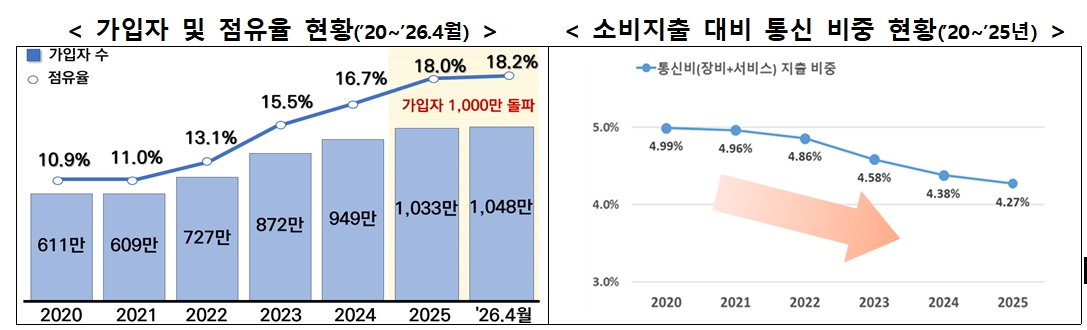
Accordingly, the government will apply the data peace-of-mind option (QoS, unlimited internet at 400Kbps speed after data exhaustion) to Vodafone operators as well. The existing wholesale-provided tariff plans (RS) totaling 91 types will have QoS applied without additional costs, and wholesale rates for 5G tariff plans (17 types) will be reduced by 1 to 3 percentage points starting in August. The discount rate for radio wave usage fees for small and medium-sized Vodafone operators will also be expanded from the current 50% to 90%. Through this, the government expects the Vodafone industry to save approximately 25 billion won annually.
The enrollment process will become easier, and the range of terminal choices will expand. In line with the increasing volume of secondhand smartphone transactions, the government plans to activate certification for secure secondhand phone trading and reduce the burden of purchasing terminals through the operation of a consortium for mid-to-low-priced and self-provided terminals. In fact, the total transaction volume of secondhand phones last year reached approximately 14.15 million units. Additionally, amendments to the eSIM interconnection regulations will facilitate instant online activation, and customized tariff plan comparison and recommendations based on My Data will be provided.
Furthermore, institutional improvements, investment support, and permission for shared infrastructure (MVNE) will be provided to enable existing Vodafone operators to secure their own facilities and grow into 'Service-type (Partial MVNO)' and 'Standalone (Full MVNO)' Vodafone models. The obligation for network interconnection will be expanded to all three major carriers, and Vodafone infrastructure resale (MVNE) will also be permitted to reduce the burden of infrastructure construction for new operators. Through this, the goal is to nurture at least three Vodafone operators with their own facilities.
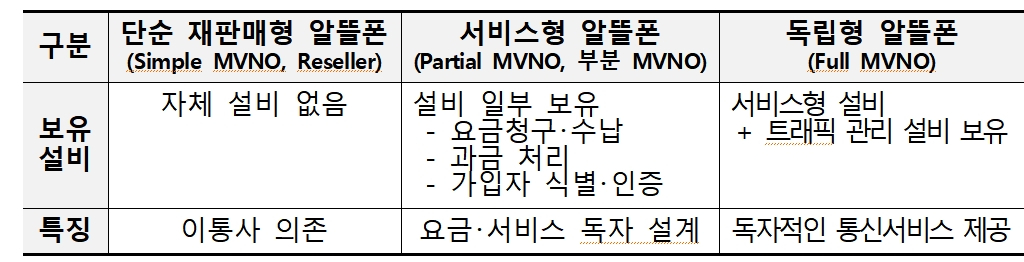
Additionally, consumer protection and market stability will be pursued. By raising staffing standards for customer service and conducting regular evaluations of call centers, chronic inconveniences will be improved. Through comprehensive inspections, a management and exit system for underperforming operators will be established and implemented.
These measures were introduced because Vodafone operators have been caught in a vicious cycle of cutthroat competition amid structural limitations, leading to deteriorated profitability, insufficient investment, declining services, and exposure to issues such as fake phones and voice phishing. According to actual government data, among the total of approximately 60 operators, 53 are small-scale operators with fewer than 100,000 subscribers (including 6 companies scheduled to close).
Going forward, the Ministry of Science and ICT plans to vigorously promote the 'Vodafone 2.0 (3+)' policy so that citizens can experience services that are more (+) affordable, more (+) diverse, and more (+) trustworthy.

 in TECH

