

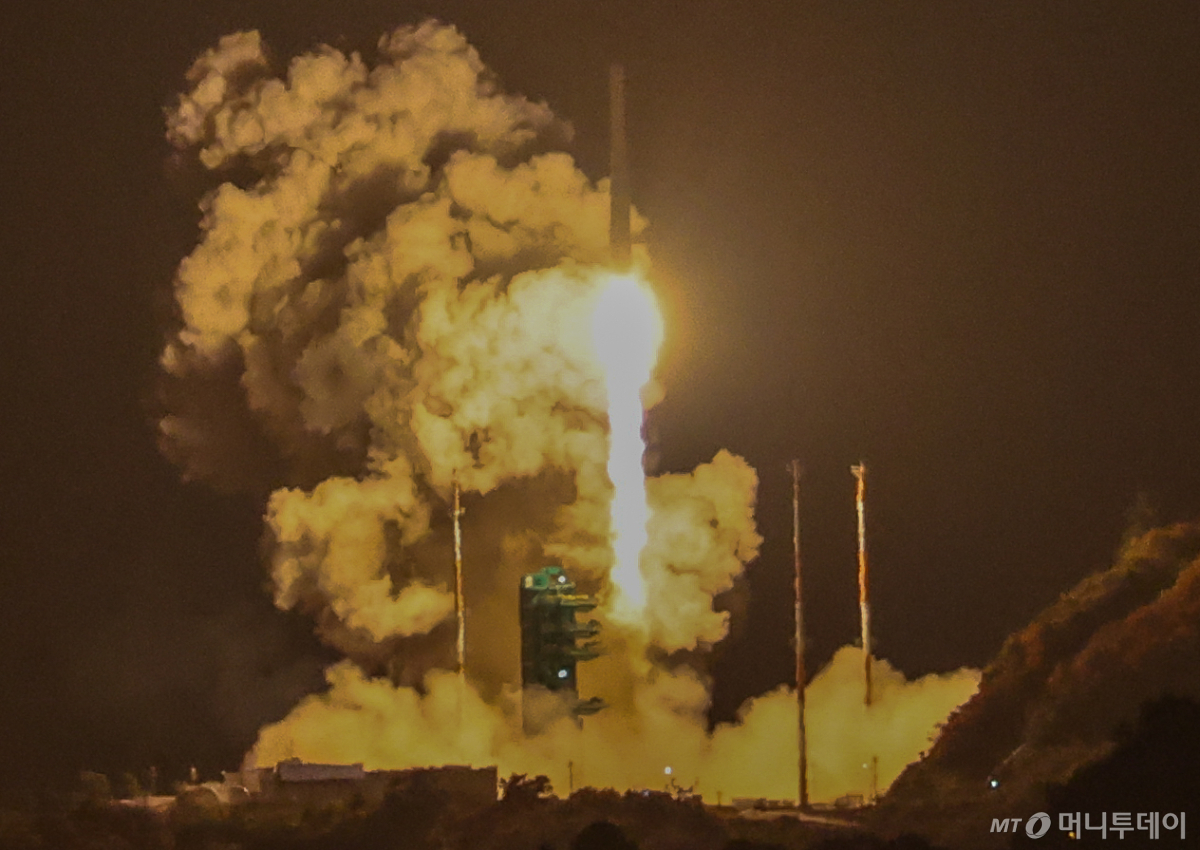
The fifth launch of the Korean launch vehicle 'Nuriro' is expected to be postponed from the originally planned September to October.
According to the Korea Aerospace Administration (KAA) on the 2nd, the Nuriro fifth launch is highly likely to take place after early October. The launch schedule was changed because the thrusters for the primary payload satellites, the ultra-small cluster satellites No. 2 through No. 6, had to be replaced.
Ultra-small cluster satellites are a group of satellites that conduct precise surveillance over the Korean Peninsula and surrounding waters at least three times daily. Each satellite weighs less than 100 kg, classifying them as 'ultra-small.' The KAIST Satellite Research Center and domestic satellite company Setrak AI were responsible for their design and manufacturing. The KAA plans to launch 12 satellites by 2027. Following the prototype No. 1 in 2024, the first Yangsan satellite verification unit was launched in January last year.
However, after operating the prototype and verification units in actual space environments, opinions were raised that the performance of the satellite 'thrusters' needed improvement. Thrusters are key devices used to maintain a satellite's target altitude and position. The lead institutional investor replaced the thrusters for cluster satellites No. 2 through No. 6, making additional testing unavoidable.
A KAA official stated, "The thrusters for satellites No. 2 through No. 6 on the fifth launch have been upgraded to products with better performance than before, and most tests are already completed." Only some final tests remain.
This situation arose because the global space industry ecosystem has not yet matured enough to consistently supply components suitable for each satellite's size and characteristics. A KAA official explained, "Unlike multi-ton satellites, there are almost no manufacturers capable of producing thrusters for satellites under 100 kg (such as ultra-small cluster satellites). Among them, we selected products from the company with the most accumulated 'space heritage.'" Space heritage refers to operational experience in actual space environments.
Meanwhile, in addition to the primary payload of ultra-small cluster satellites, a total of 10 secondary payload satellites will also be carried on the Nuriro fifth launch. A KAA official in charge of space transportation said, "Development and manufacturing of the secondary payload satellites are proceeding without any issues."
The KAA plans to hold a 'Launch Management Committee' meeting at the end of this month to finalize the launch window (the period during which launch is possible) for the Nuriro fifth launch, considering various preparation statuses.

 in TECH
