

SK Telecom announced its Q2 results, which have recovered to pre-personal data breach (hacking) levels last year. With a continued recovery in mobile subscriber numbers and backed by the new growth engine of AI data centers (AI DCs), profitability has significantly improved.
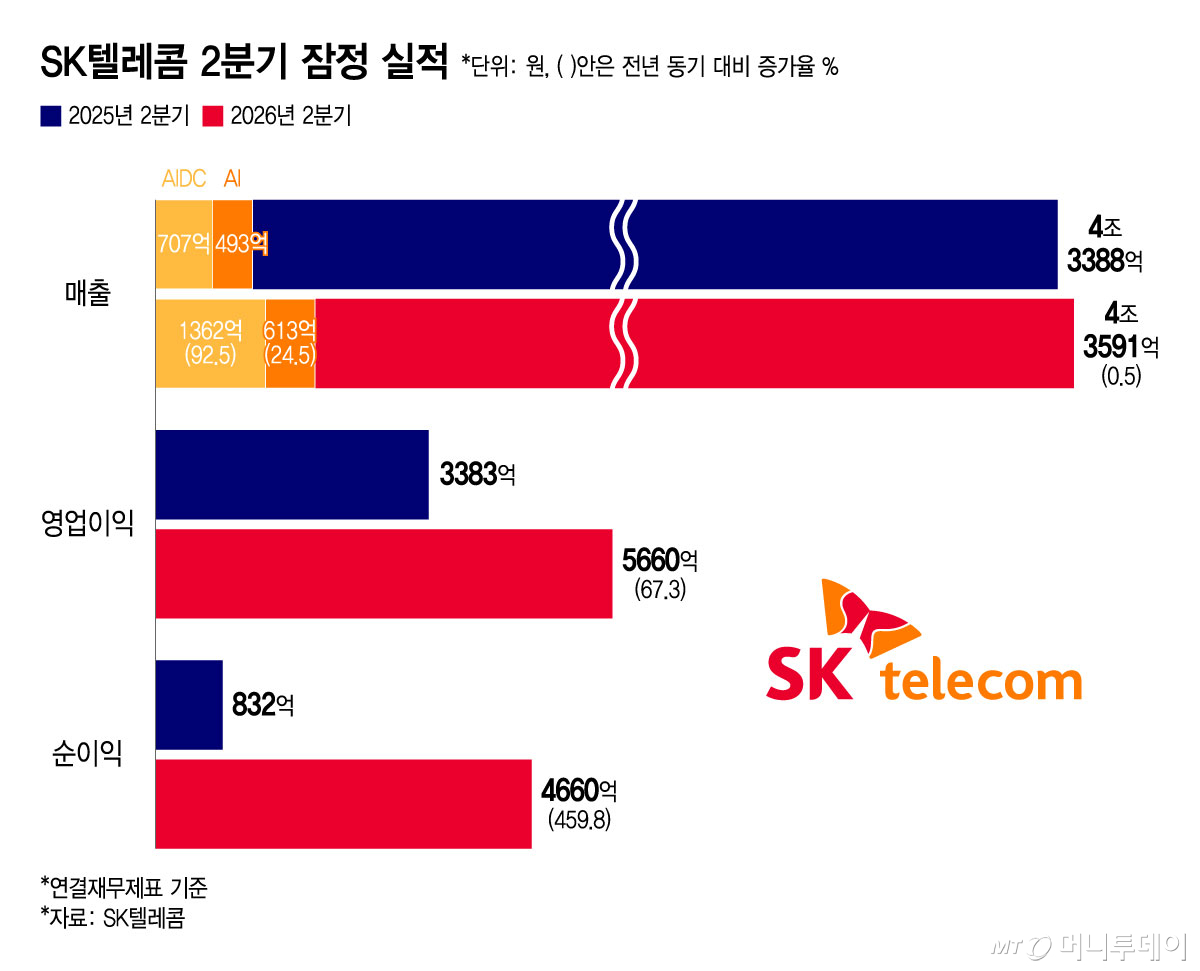
On the 5th, SK Telecom stated that its consolidated operating profit for Q2 this year was preliminarily calculated at 566 billion won. This represents a 67.3% increase compared to Q2 last year. Revenue during the same period rose by 0.5% to 4.3591 trillion won, while net income expanded by 459.8% to 466 billion won.
Compared to Q1 last year’s operating profit of 567.4 billion won—before the large-scale personal data breach occurred—the difference is only 1.4 billion won (0.2%). Given that Q1 last year’s operating profit was the highest ever since the introduction of IFRS (International Financial Reporting Standards), it is evaluated that SK Telecom has recovered from the shock of the hacking incident. Additionally, Q2 operating profit exceeded market consensus estimates by approximately 4%. According to F&Guide, three or more securities firms had estimated SKT’s Q2 operating profit at 545.8 billion won.
Base Effect from One-Time Costs Last Year, Including SIM Card and Agency Compensation… AI DCs Also Contribute Significantly
There are two main reasons for the improvement in results. First, a base effect occurred due to large-scale SIM card replacement costs caused by last year’s hacking incident, and mobile subscriber numbers have also recovered. Furthermore, the new growth driver of AI DCs has bolstered performance.
SK Telecom reflected one-time costs totaling 250 billion won—including SIM card replacement expenses and agency compensation resulting from the April hacking incident—in its Q2 results last year, creating a base effect in this year’s Q2 results. Mobile subscriber numbers have gradually recovered, reaching 21.97 million by the end of Q2, nearly matching the 21.98 million recorded in the same period last year.
The most notable trend is the growth of the AI DC business. Revenue from the AI DC segment reached 136.2 billion won in Q2, a 92.5% increase year-on-year, driven by expanded data center operations and contributions from submarine cable projects. Additionally, revenue from AI B2B (business-to-business) and B2C (business-to-consumer) businesses increased by 24.5% to 61.3 billion won, influenced by an expansion in cloud orders.
SK Telecom plans to build a total of 15 gigawatts (GW) of AI data centers by 2035. Currently, it is operating 137 megawatts (MW) of capacity by converting existing Internet Data Centers (IDCs) built in Seoul and the metropolitan area into AI DCs, which alone has delivered impressive results.
Last month, SK Telecom established a subsidiary dedicated to its AI DC business, named 'SK Hyper.' The company plans to proactively secure key elements such as land and power while attracting global customers. It aims to gradually operate 5 GW of AI data centers by 2029 and expand this capacity to 15 GW by 2035.
SK Broadband, the subsidiary responsible for SK Telecom’s AI DC operations, also recorded Q2 revenue of 1.1603 trillion won and operating profit of 132.5 billion won, driven by growth in its data center business. These figures represent increases of 3.6% and 44.3%, respectively, compared to the same period last year.
Park Jong-seok, SK Telecom’s CFO (Chief Financial Officer), stated, “We are strengthening our fundamentals based on stable revenue from telecommunications services in the first half of the year while laying the groundwork for rapid expansion of our AI data center business.” Lee Jae-shin, SK Telecom’s Executive Vice President in charge of AI Business Development, said during today’s SKT conference call regarding the recent surge in demand for AI infrastructure: “This is not a temporary phenomenon but a structural change driven by growth in the inference market and expansion across public and industrial sectors.” He added, “SK Telecom is currently discussing specific AI infrastructure demands with global big tech companies.”

 in TECH

