

The government will nurture advanced technologies that will be responsible for South Korea's food sources in 10 years, focusing on SMRs (small modular reactors), quantum computers, and lunar landers.
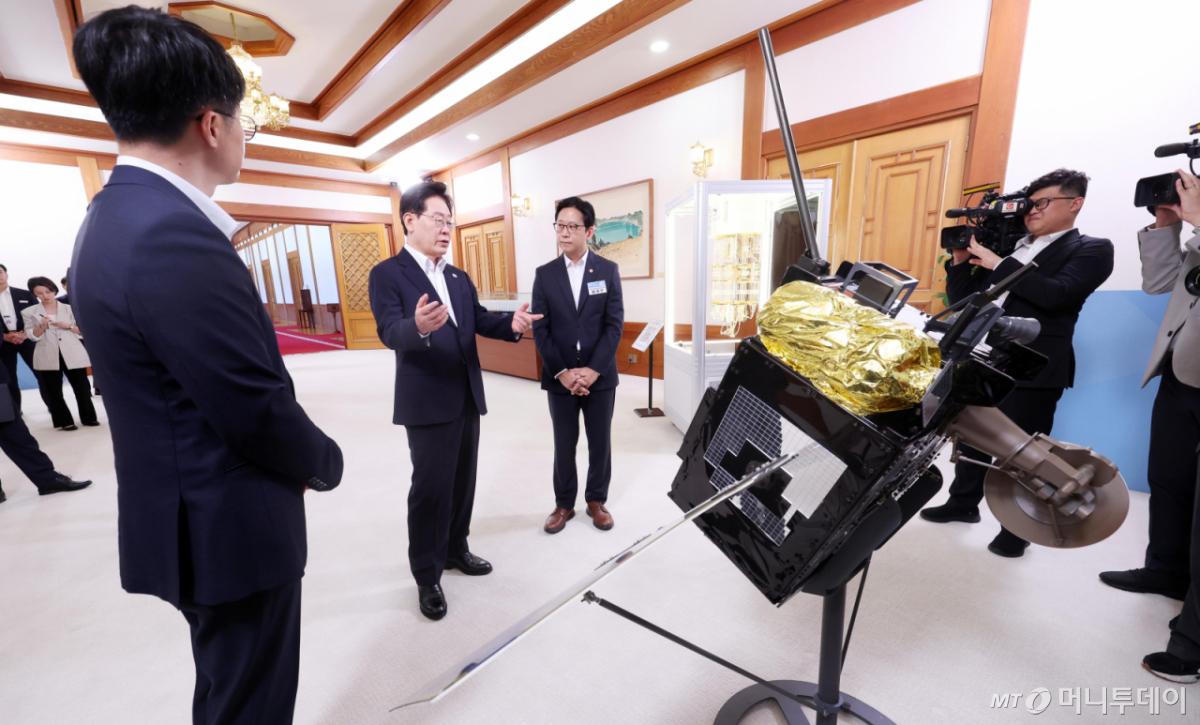
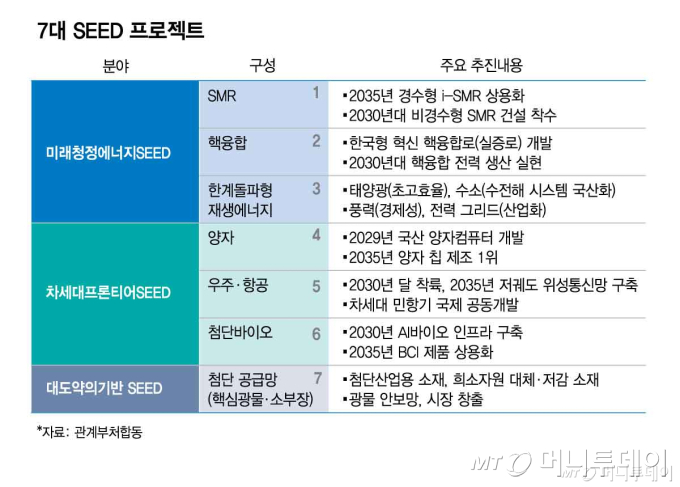
The Ministry of Science and ICT announced the 'Seven SEED Projects' with other relevant ministries at the Chungmu Room in Cheong Wa Dae on the 12th. The projects are divided into three major areas: Future Clean Energy Seeds, Next-Generation Frontier Seeds, and Advanced Materials & Mineral Seeds, each containing seven specific tasks. The goal is to identify advanced technologies targeting 10 to 20 years ahead and cultivate them as core assets for the economy and national security.
If the three mega-projects (semiconductors, physical AI, and AIDC) released in June this year were a 'short-term' prescription for South Korea's low-growth trend, then this Seven SEEDs project carries the meaning of a 'long-term' structural improvement prescription.
Deputy Prime Minister and Minister of Science and ICT Bae Gyeong-hoon emphasized at the project briefing that "the Seven SEEDs project is a collection of advanced technologies that will make Taekwon V, which we imagined and dreamed of, into its completed form," likening it to the advanced technology that moves Robo Taekwon V.
The composition of the Seven SEEDs projects focuses on preparing the soil for the advanced technology industry and securing new industrial technologies. First, 'Future Clean Energy Seeds,' which include a power response strategy, are composed of three areas: SMRs, nuclear fusion, and breakthrough renewable energy. The plan aims to commercialize next-generation SMR reactors while harmonizing with renewables such as solar, hydrogen, and wind power to respond to surging electricity demand.
Through 'Next-Generation Frontier Seeds,' the government will focus on cultivating quantum technologies, space and aviation, and advanced biotechnology. By 2029, it aims to secure a 100-qubit-level QPU (quantum processor) capable of error correction and establish the QPU Yangsan system by 2035, challenging for 'world No. 1' in quantum computer manufacturing capabilities. By 2029, it plans to send lunar orbit communication satellites, and by 2030, launch a 700kg-class small lunar lander led by the private sector. The BCI chip, which connects the brain and computers, is planned for commercialization by 2035.

 in TECH

