

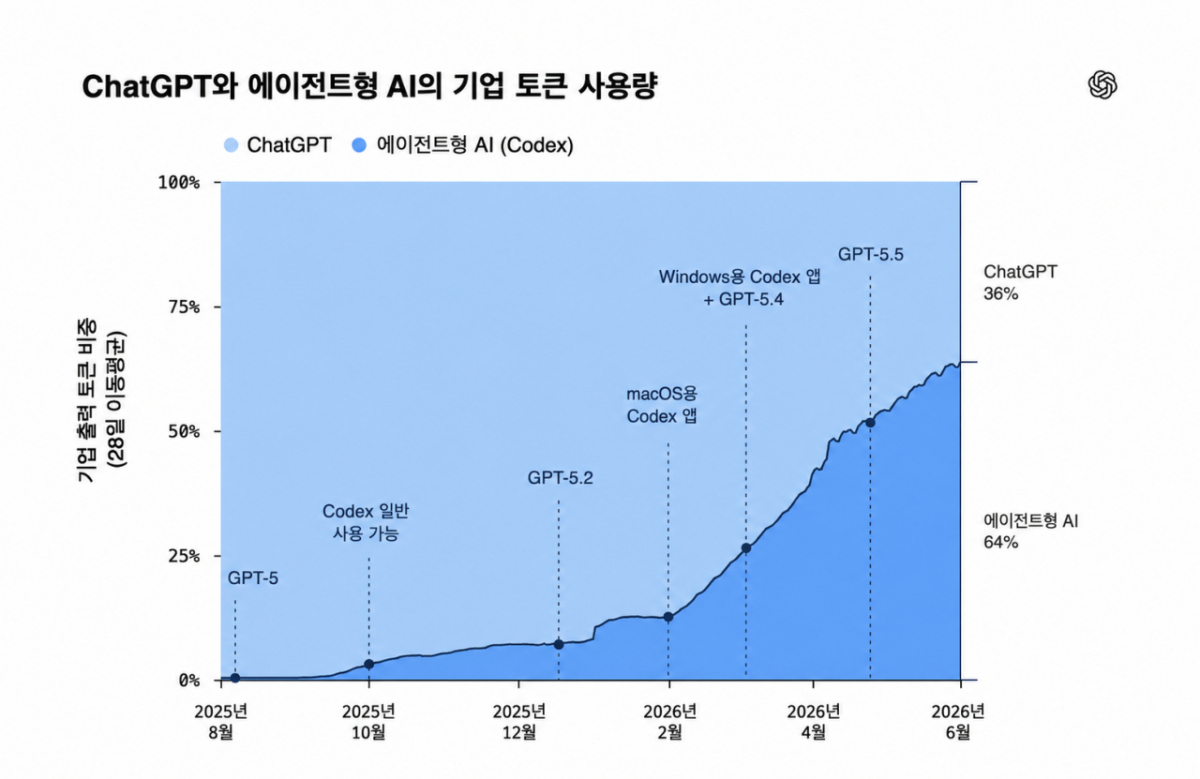
Corporate use of AI is evolving from simple document creation or information search to entrusting complex tasks. The gap in AI utilization between companies that heavily use AI and those that do not is also widening rapidly.
OpenAI announced on the 13th that it released a report titled "Enterprise Signal," analyzing the current state of corporate AI adoption.
The report analyzes that enterprise AI is evolving from an "assistant" that answers questions to an "agent" that performs multi-step tasks. AI agents autonomously or under human supervision carry out complex tasks such as searching for information and modifying files using a company's computers and business tools.
OpenAI presented CodeX and ChatGPT Work as representative agent-type AI products. While CodeX has spread primarily in the software development sector, its scope of use is recently expanding to knowledge work across legal, sales, recruitment, marketing, and more.
Since February, weekly active users of CodeX in the legal field have increased 108-fold. Usage in sales and recruitment fields rose by 41 times and 26 times, respectively, while marketing saw a 26-fold increase. The increase in the engineering sector over the same period was five times.
As of June, CodeX accounted for 64% of all output tokens generated by CodeX and ChatGPT for corporate customers. Agent-type AI may require more computation and output than general question-and-answer interactions because it performs long-duration tasks across multiple steps.
The gap between companies actively utilizing AI and ordinary companies has also widened. The "frontier companies," which make up the top 10% of monthly AI usage, generated 8.3 times more output tokens per active user than general companies as of June. This gap, which was 2.6 times in January, expanded significantly within five months.
The industry-specific gap was largest at 11.7 times in the information and technology sector. Manufacturing showed a relatively smaller gap of 5.3 times. However, output token counts do not directly reflect corporate business performance or the value created by AI. OpenAI utilized this as an indirect indicator to gauge how much work companies are delegating to AI.
Frontier companies also more actively used advanced features that connect AI with internal data and business tools. Among weekly active users, 21% of frontier companies used plugins compared to 9% of general companies. Skill usage rates were recorded at 19% and 3%, respectively. Internally at OpenAI, it was found that 95% of active employees use plugins weekly.
Analysis of over 100,000 messages revealed that writing and communication were the most common uses in ChatGPT. In agent-type AI messages, coding and system/agent operations accounted for approximately 75% of the total.
By industry, professional, scientific, and technical services showed the highest CodeX adoption rate and API usage intensity. The arts, entertainment, and recreation sector demonstrated the highest ChatGPT adoption rate, while manufacturing showed the highest ChatGPT usage intensity. Manufacturing's CodeX and API usage intensity remained relatively low.

 in TECH
