

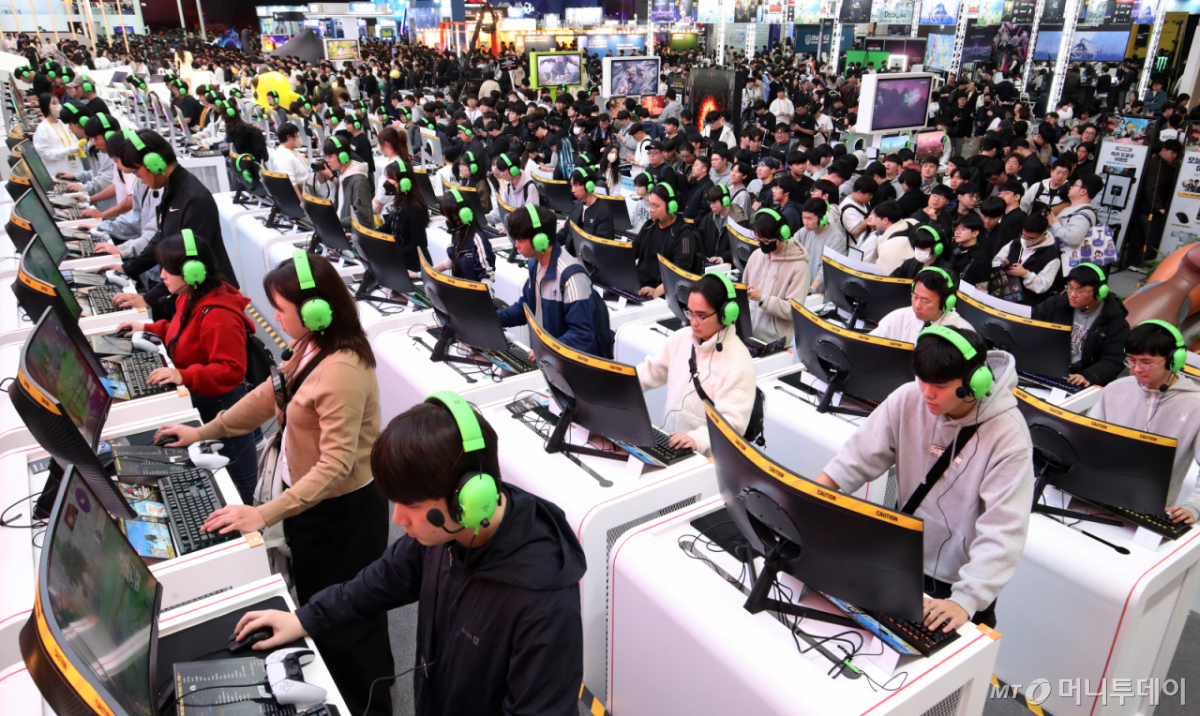
The G-Star organizing committee unusually held a press conference to explain the operational overview and guiding principles of 'G-Star 2026.' This move came amid growing doubts about the event's main sponsor being unclear and concerns over the low number of participating companies, with less than 100 days remaining until the event.
Several notable points emerged during the conference. First, for the first time in G-Star history, a non-game company will serve as the main sponsor. The committee announced that AI story creation platform 'Crack' will take on this role to expand the event's scope beyond a simple game exhibition, aiming to broaden G-Star's horizon into next-generation content areas.
Second, participation by Chinese game companies. The committee confirmed that HoYoverse, NetEase Games, Bilibili Games, and Century Games will participate in the BTC exhibition space. Additionally, the in-house content 'G-CON' will feature director Lee Byung-hun, film director Jang Hang-jun, writer Lee Dong-geon of 'The Cellular Girl,' and writer Lee Nak-jun of 'Severe Trauma Center.' This reflects efforts to transcend the boundaries of games in the AI era.
On this day, the committee attempted to dismiss various allegations and crisis rumors by attributing them to expansion efforts. While it is encouraging that they are seeking new paths without yielding to crisis narratives, their responses regarding the most critical issues—such as the absence of global major game companies and declining participation rates among domestic game firms—remain difficult to understand. Major domestic game companies including Nexon, Netmarble, NC, Kakao Games, and Krafton are currently expected not to participate in this year's G-Star.
In response to criticisms that major domestic game companies will not participate, the committee stated, "Currently, there are simply not many large-scale new titles that major domestic game companies can showcase." However, according to second-quarter earnings announcements from major domestic game companies, several new titles are scheduled for release in the second half of the year. Key game companies such as Nexon, Netmarble, NC, and NHN have confirmed their participation in the Tokyo Game Show in September instead of G-Star.
Regarding the large-scale participation of Chinese game companies, sighs are heard that G-Star has become a foothold for Chinese game companies' expansion into Asia rather than serving as a gateway for domestic game companies to enter overseas markets. From the perspective of Chinese game companies, since South Korea is one of the key markets in Asia, participating in G-Star yields significant effects. Moreover, in the current situation where major domestic game companies are absent, they can expect even greater attention, making it beneficial for them.
While voices within the game industry call for a comprehensive review of timing, format, and venue, the committee stated, "The host city is selected through a local government bidding process. Since local governments participate in the bidding, the G-Star secretariat does not have a structure to collaborate separately with specific cities or conduct sales efforts specifically for hosting." A game industry insider remarked, "Even with active sales efforts, it would still fall short; hearing such idle talk only makes things worse."
At Gamescom, the world's largest game exhibition held in Germany this August, German President Frank-Walter Steinmeier will attend. While G-Star promotes itself as one of the world's four major game exhibitions, its standing is vastly different from that of an event lacking trust even among domestic game companies. As the game industry has moved from the shadows into the light compared to the past, the committee must also take greater responsibility and present a clear vision.

 in TECH

