

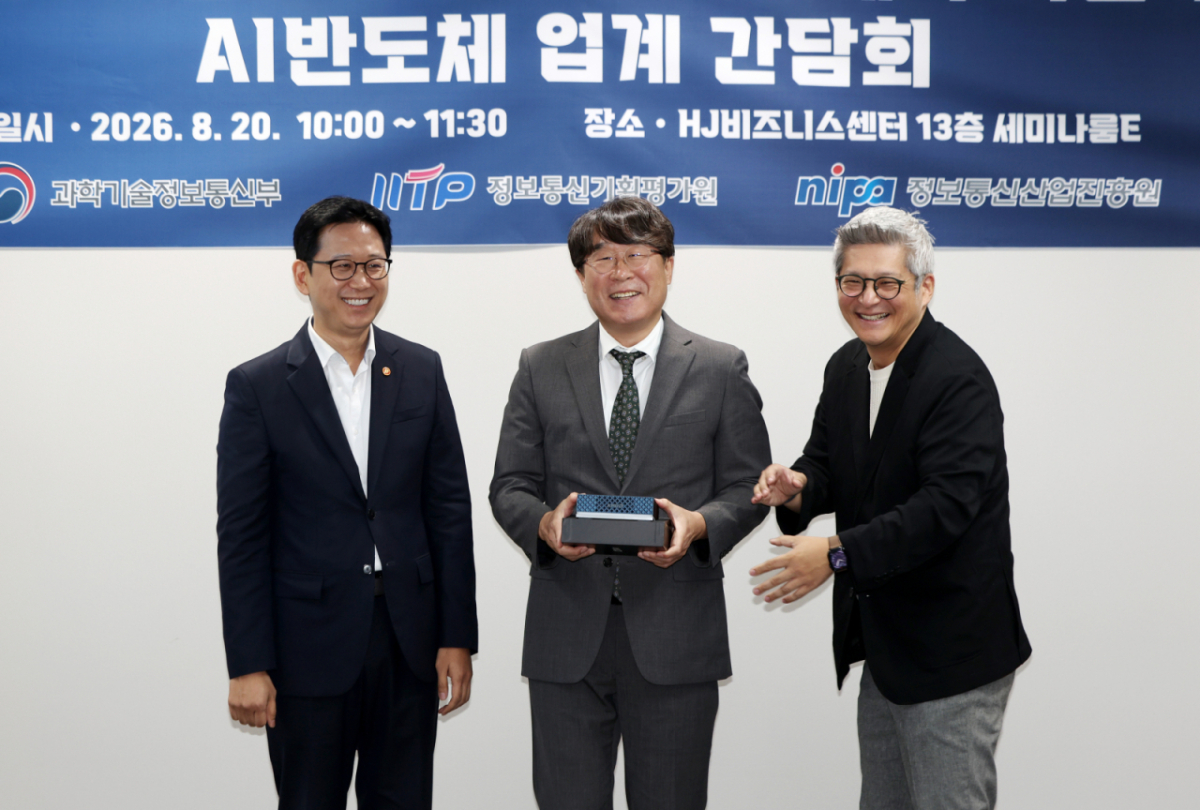
The government will build an open AI (artificial intelligence) computing ecosystem with AMD. This aims to reduce reliance on the GPU (graphics processing unit) ecosystem dominated by NVIDIA and jointly explore markets for domestic NPU (neural processing unit) with AMD. AMD plans to establish Asia's first AI technology center in Korea within this year and is also considering deploying its next-generation AI integrated platform "Helios" by 2027.
The Ministry of Science and ICT held a roundtable on building an open AI computing infrastructure ecosystem at Seoul Gwanghwamun HJ Business Center on the 20th, attended by Deputy Prime Minister Bae Keong-hun, AMD Korea executives, and representatives from domestic AI semiconductor and software industries. As a follow-up to the memorandum of understanding (MOU) signed between the Ministry of Science and ICT and AMD last month, AMD unveiled concrete implementation plans on this day.
The core focus is the development and demonstration of an open heterogeneous AI architecture connecting domestic NPU with AMD CPU and GPU. Recently, the AI industry has shifted its central axis from "learning," where AI is trained, to "inference," where trained AI is applied in services to derive answers. While AI semiconductors excel in both learning and inference, the focus is shifting from heavy and expensive GPUs to lightweight, cost-effective NPUs and CPUs specialized for inference. Additionally, heterogeneous AI architectures that allow various semiconductors to be plugged in like blocks are gaining attention.
The Ministry of Science and ICT, AMD, and domestic NPU developers have agreed to pursue a "diamond strategy" involving heterogeneous AI architecture solution companies. Public research institutes will first conduct demonstrations, then expand successful domestic cases globally.
Moon Kyung-seon, Senior Executive at AMD Korea, stated, "This is the first case where AMD collaborates on developing and demonstrating heterogeneous architectures including NPUs from specific countries outside the United States," adding, "The ultimate goal is to create a strong success story in Korea and expand it into a standard architecture with global competitiveness."
AMD will establish "AI CoE (Center of Excellence)," Asia's first AI technology center, in Korea within this year. The location remains undecided. AMD will initially deploy resident engineers and project managers (PMs), expanding personnel by the end of 2027. Computing resources will be provided in GPU-as-a-Service (GPUaaS) form until then, with plans to deploy one set of "Helios" in 2027 once conditions are met.
Collaboration will also extend to government research institutions. This year, the effectiveness of AMD GPUs and the open software platform "ROCm" will be verified alongside entities such as the National Science AI Research Institute, with support for national science AI projects starting next year.
An AI Business Operation Committee (SAIC) will also be established to oversee both parties' cooperation. The committee will be co-chaired by a senior vice president from AMD's headquarters and representatives from the Ministry of Science and ICT. The first online meeting is scheduled for late September, followed by an in-person meeting in November.
Deputy Prime Minister Bae emphasized, "It is important to achieve tangible results beyond indicators or numbers, ensuring models are effectively used across industries and daily life," adding, "We will open markets through public initiatives and create opportunities not only for Korea but also jointly for the global market."

 in TECH
