

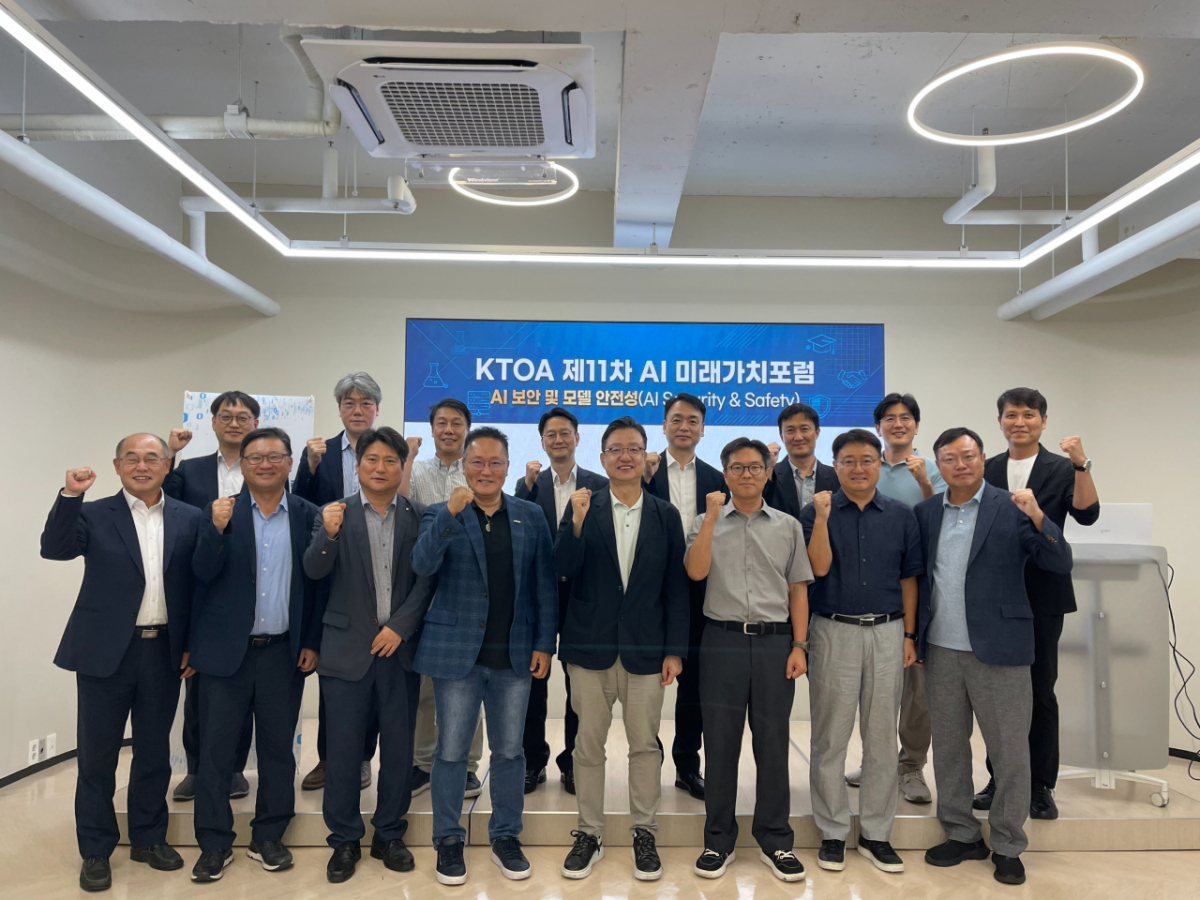
The Korea Telecommunications Operators Association (KTOA) examined emerging security threats and model safety issues in the frontier AI era and discussed response measures for the telecommunications industry. As AI spreads across all industries, participants agreed on the need to strengthen communication infrastructure security and establish a public-private cooperation system that ensures both technological innovation and safety.
KTOA announced that it held the '11th AI Future Value Forum' on the 20th at its building in Seoul's Gangnam-gu, with the theme of 'AI Security & Safety'.
The AI Future Value Forum is an industry-academia-government consultation body involving major domestic telecommunications operators, academics, legal experts, and research institutional investors. Lee Seong-yeop, a professor at Korea University's Department of Technology Management, serves as the forum chairperson. The forum operates to explore directions for sustainable development of South Korea's AI ecosystem and improvements in rational policies and systems.
This forum addressed key issues including security threats posed by frontier AI and AI Safety (safety) that have gained importance alongside technological advancements. Discussions covered new security vulnerabilities arising from the spread of LLMs (Large Language Models) and AI agents, measures to ensure data privacy, responses to international standards, and strategies to secure trustworthiness across all AI services.
Lee Sang-geun, a professor at Korea University's Graduate School of Information Security, presented on 'AI Security in the Frontier AI Era: New Threats and Response Strategies'. Professor Lee highlighted advanced security vulnerabilities that may emerge in LLM and AI agent environments and proposed technical countermeasures to enhance model trustworthiness.
Kim Chang-oh, Group Head (CPO) of KT's Information Security Division, presented on 'Data Privacy Protection and AI Security for AX (AI Transformation) Platform Companies: Challenges and International Standards'. The group head introduced strategies for protecting personal information and data throughout the entire data lifecycle, including management of AI inference attributes, as well as approaches to address global security and privacy standards.
Following the presentations, a plenary discussion led by forum chairperson Lee Seong-yeop saw industry-academia-government experts discuss the telecommunications sector's role and policy challenges in securing AI security and safety. Attendees emphasized that successful establishment of the AI Daejeon ecosystem requires ensuring technology safety and trustworthiness first, and stressed the need to establish rational regulations and legal-institutional foundations suited to the frontier AI era.
Professor Lee stated, "As AI technology spreads across all industries, AI security and safety are no longer optional but a matter of survival." He added, "The government and industry must cooperate to further strengthen public-private governance that balances technological innovation with security and safety."
KTOA Vice President Song Jae-seong said, "To build a trustworthy AI ecosystem, securing the security of communication infrastructure—the core of the national AI highway—is essential." He also announced, "Based on expert opinions discussed at this forum, we will support member companies in pursuing safe and sustainable AI business strategies."

 in TECH
