

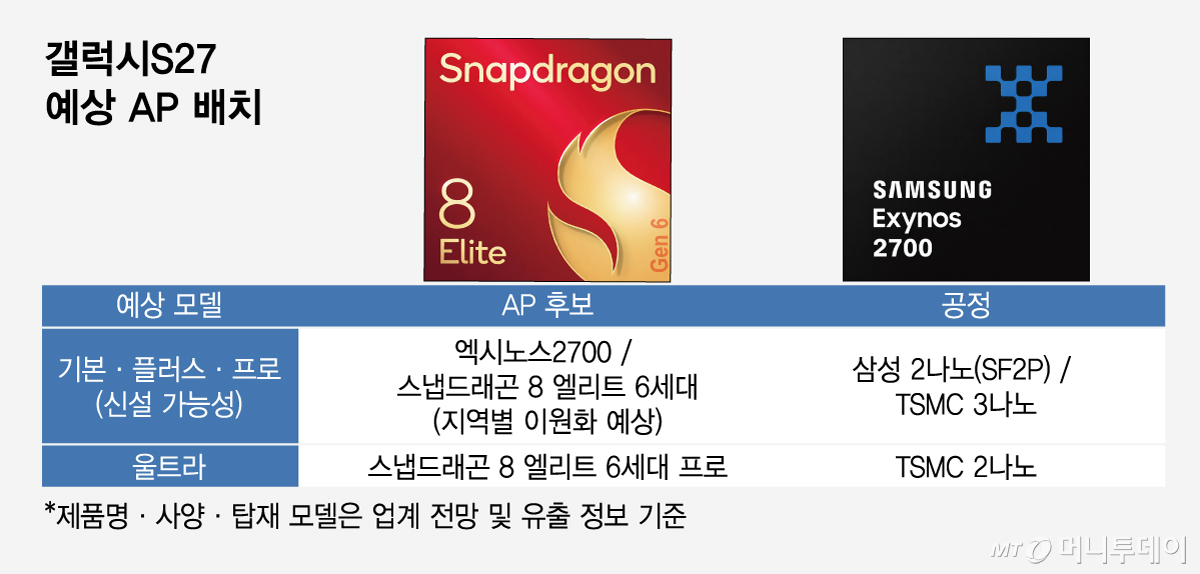
Samsung Electronics is facing increasing complexity in selecting the mobile application processor (AP), the brain of smartphones, for its upcoming 'Galaxy S27' series next year. As Qualcomm segments its next-generation flagship chip into two variants, Samsung Electronics is also reportedly pushing to expand the use of its own AP, 'Exynos'.
According to IT industry sources on the 23rd, Qualcomm recently posted a teaser video featuring two chips ahead of the 'Snapdragon Summit 2026' scheduled for next month 22nd in Hawaii, U.S., with the slogan "When Two Changes the Game."
Industry observers expect the two products to be named 'Snapdragon 8 Elite Gen 6' and a higher-end 'Pro' variant. Leaked information suggests the Pro model will use TSMC's 2-nanometer process and Adreno 850 GPU, while the standard version will adopt a 3-nanometer process. This strategy is seen as an attempt to simultaneously target both the top-tier market requiring peak performance and the general flagship market where cost considerations are critical by launching two chip variants.
Samsung Electronics is also reportedly planning to expand the scope of Exynos adoption in the Galaxy S27 series. Including the potentially new 'Pro' model, it is expected that the standard, Plus, and Pro models will feature both 'Exynos2700' and standard Snapdragon chips depending on the region, while the Ultra model may exclusively use the Pro variant. The Exynos2700 is currently under development based on Samsung Foundry's second-generation 2-nanometer process (SF2P).
The competitiveness of Exynos2700 remains a variable. In recent internal benchmarks by Samsung Electronics, Exynos2700 showed CPU multi-core performance 19% higher than Snapdragon 8 Elite Gen 6 and 9.5% higher than the Pro model. Additionally, GPU performance in a low-power environment of 2.5W exceeded the Pro model by 22%. However, given Exynos's past exclusion from flagship devices due to overheating and yield issues, whether these internal figures will translate into Yangsan product performance remains the key question.
Cost incentives are also growing. Samsung Electronics spent 7.4383 trillion won in the first half of this year purchasing APs from Qualcomm and MediaTek, accounting for 17.9% of total raw material costs for its DX (Device Experience) division. Compounded by rising memory prices, the MX and Network Business Units responsible for smartphones recorded an operating loss of 700 billion won in the second quarter, marking their first quarterly deficit since the third quarter of 2009 after approximately 17 years.
Overseas IT media outlets also speculate that the Pro model could reach a price of around $300 (approximately 420,000 won). If Exynos2700 proves its competitiveness in actual products, Samsung Electronics can reduce reliance on Qualcomm, alleviate cost burdens, and secure system LSI and foundry volumes.

 in TECH
