

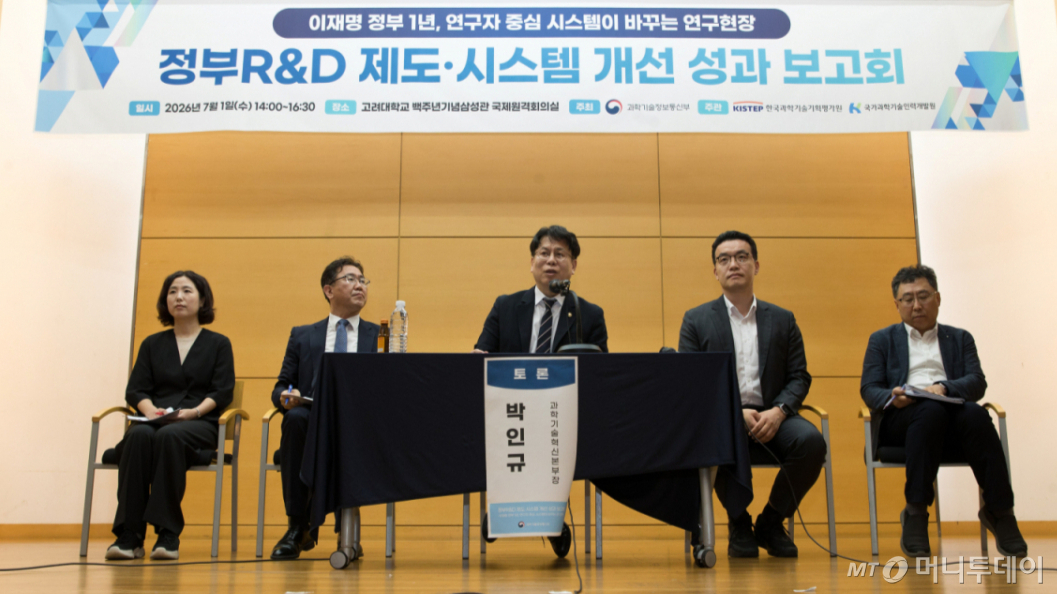
The national R&D (research and development) evaluation system will shift from a blanket "grade-based" system to an incentive system. The "Moving Target" system, which allows researchers to adjust goals in line with technological developments even after research begins, will also be fully implemented next year.
The Ministry of Science and ICT announced on the 31st that it notified relevant ministries including the Ministry of Trade, Industry and Energy, the Ministry of SMEs and Startups, and the Ministry of Climate, Energy and Environment of the "2026 National R&D Administrative System Improvement Plan."
This improvement plan was established after deliberation and approval at the 8th National Council for Science and Technology Advisory Meeting on the 26th to maximize the autonomy of researchers conducting national R&D and improve the efficiency of research administration.
The project evaluation system will change from an existing result-oriented grade-based and point-based system to one that selects excellent projects and provides incentives. Even if goals are not fully met, research that is recognized for creating outstanding data and knowledge through trial and error can be selected as an excellent project. These researchers will receive incentives such as opportunities for follow-up research and government awards.
Conversely, projects with insincere performance processes, such as violations of laws and regulations, failure to fulfill agreement obligations, or research misconduct, will be classified as "inappropriate projects" and subject to strong penalties including recovery of research funds and restrictions on project participation. The Ministry of Science and ICT plans to establish the project evaluation system by October.
The Moving Target system, which allows researchers to flexibly change goals during research progress, will also be fully implemented next year. Processing procedures for rapidly changing research goals will be significantly shortened, and cross-ministry guidelines for approval will be presented in a negative manner of "everything is allowed except what is prohibited."
The time limit for introducing research facilities and equipment, which previously had to be completed by two months before the "stage end date," will be relaxed to "a certain period before the overall project end date" as set by the Bank of Korea. In addition, if procedures are delayed between the end of one stage and the start of the next, the remaining balance of direct costs from the previous stage will be automatically carried over to the next stage. Essential labor costs can also be executed immediately even before stage evaluation results are finalized.
Furthermore, research allowances will not be excessively concentrated on a single researcher. In addition to the current "total amount repayment" rule that limits research allowances for one person to no more than 20% of total labor costs and the "distribution cap" that limits them to no more than 70% of the total research allowance amount, a new individual cap standard of "within 100% of the allocated personal labor cost per project" will be added.
In addition, to unify research fund settlement standards that vary by ministry and accounting firm, the Ministry plans to distribute a "Cross-Ministry Standard Settlement Guide" and a "Collection of Recognized and Non-Recognized Research Fund Cases." Additionally, if the agreement period for the first year or final year is less than six months, separate annual reports will no longer be required; instead, they can be integrated into the following year's annual report.
The Ministry of Science and ICT will begin follow-up measures next month, including revisions to relevant laws and regulations such as the "Enforcement Decree of the National R&D Innovation Act." The reformed research system is planned to be applied starting next year.

 in TECH
