

[For more diverse corporate information on the start-up featured in this article, visit the Unicorn Factory big data platform ‘Data Lab’.]
Methods of foreign currency outflow using trade transactions, such as receiving export payments in virtual assets or through hawala (illegal money transfer), are becoming increasingly sophisticated. In fact, the Korea Customs Service detected 792 cases of illegal foreign exchange transactions in the first half of this year, amounting to 7.2 trillion won.
In this process, financial institutions can also face repercussions. This is because if a financial institution fails to comply with anti-money laundering (AML) or economic sanctions controls, it may be subject to massive fines. In fact, the New York branch of Bank A in Korea paid a total of $86 million (approximately 110 billion won) to U.S. authorities in 2020 due to deficiencies in its anti-money laundering program operations, among other issues. The New York branch of Bank B also received a sanction of $11 million (approximately 15 billion won) for the same issue in 2017.
The problem is that while international financial regulations are tightening, information to verify the authenticity of trade transactions remains fragmented across individual banks and institutional investors, limiting the ability of individual financial institutions to screen out suspicious transactions in advance using only their own data.
There are cases where export companies submit export documents to one bank to receive funds, then resubmit the same documents to another bank, or cancel an export declaration after receiving a loan from a bank based on that declaration, thereby siphoning money overseas at prices significantly inflated beyond normal levels.
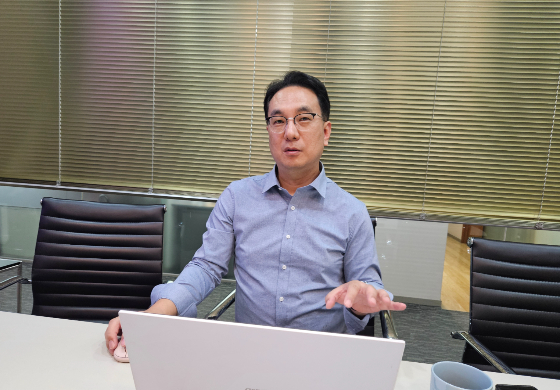
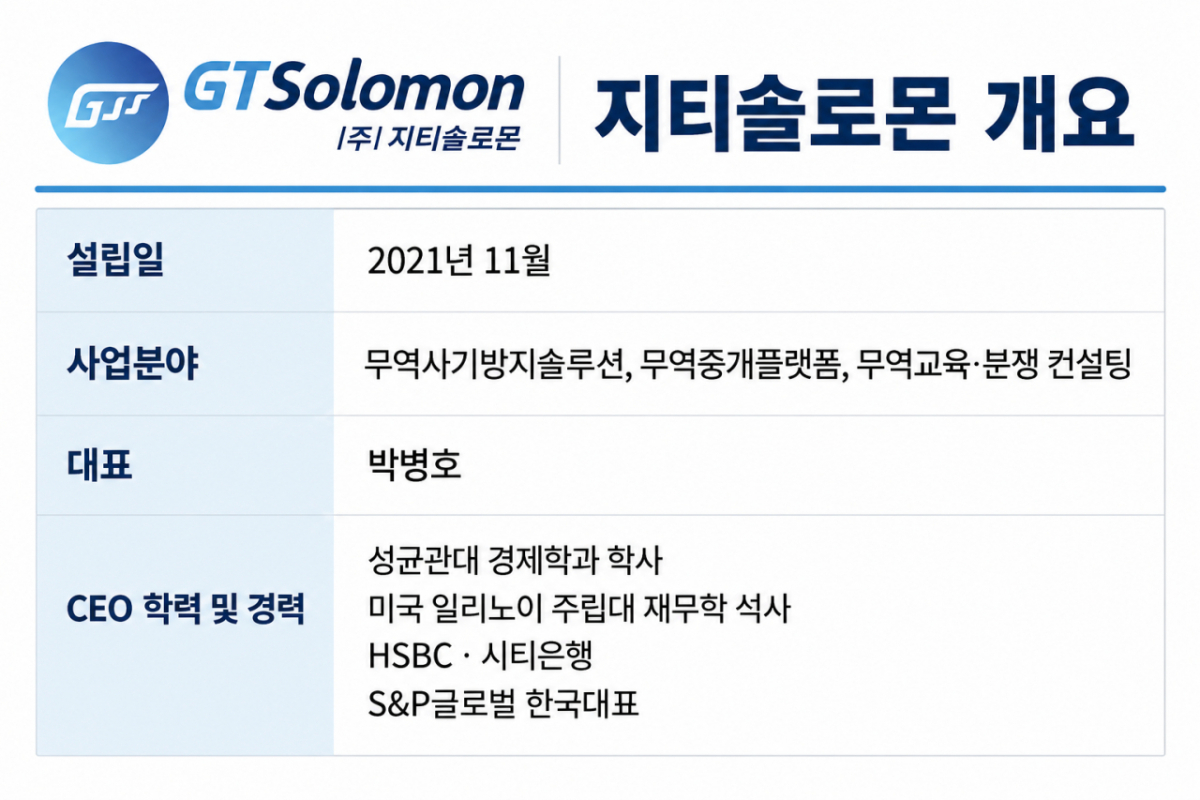
GT Solomon is a start-up aiming to fill such blind spots in trade finance with data. CEO Park Byeong-ho, who leads GT Solomon, established in 2021, is a financial and credit rating expert who has served as the Korea representative of S&P Global Ratings and worked at HSBC and Citibank Korea, among others. After gaining experience in trade transactions and credit rating work at financial institutions, he felt the need to systematically screen out trade fraud and money laundering, leading him to start the business.
Detecting abnormal trade and foreign exchange transactions using customs big data
Currently, GT Solomon’s core business is a solution for detecting abnormal trade and foreign exchange transactions. It is the first in Korea to utilize statistics on individual items by leveraging Korea Customs Service customs clearance big data.
The company secures Korea Customs Service customs data through cooperation with the Korea Trade-Investment Promotion Agency. Using this, it checks for duplicate use of commercial invoice numbers, transport document numbers, and import/export declaration certificate numbers submitted to banks, as well as abnormal import/export prices for identical companies and items, and whether import/export declaration amounts have been modified.
Furthermore, the solution can prevent cases in advance where companies obtain duplicate loans from multiple banks using export documents. Banks using GT Solomon’s solution can verify not only the authenticity of the documents but also whether those documents have already been utilized.
Unlike Ariba, a service provided by U.S. company SAP that simply provides corporate information, GT Solomon’s differentiator is that it utilizes actual customs data to provide much more specific and detailed information. In particular, using SAP Ariba’s authenticity verification service requires the simultaneous use of an ERP (Enterprise Resource Planning) system.
GT Solomon’s solution has been used by KB Kookmin Bank since November 2023, and the company is currently conducting a Proof of Concept (PoC) with NH NongHyup Bank. The business model is subscription-based, where banks and public institutional investors pay annual fees. The company plans to expand its customer base to commercial and regional banks, as well as policy financial institutions such as the Korea Trade Insurance Corporation and the Korea Credit Guarantee Fund.
Park stated, “If caught under the Anti-Money Laundering Act, punitive fines are imposed, reaching levels of hundreds or thousands of billions of won,” adding, “From the perspective of financial institutional investors, they can demonstrate that they used such a system to block illegal transactions in advance or took best protective measures.”
“Expanding business through securitization of export receivables for mid-sized and SME (small and medium-sized enterprise) companies”
GT Solomon plans to enter the asset securitization field through the digitalization of trade documents and automated letter of credit review in the future. Although digital finance is spreading, a significant number of documents in the trade sector, such as bills of lading (BL), commercial invoices, and certificates of origin, still circulate in paper or fax/scan file formats. Formats vary by company, requiring manual verification and input of content by people.
GT Solomon has developed a solution that uses AI and OCR technology to automatically classify document types and extract necessary information into data when files are uploaded. The document recognition rate presented by the company is 97%. It also provides a function to automatically cross-check extracted information against international sanctions lists. Currently, two commercial banks are considering adoption.
The company is also targeting the securitization market for export receivables of mid-sized and SME (small and medium-sized enterprise) companies. It plans to provide a service that verifies overseas accounts receivable from mid-sized and SMEs, which are currently difficult to securitize, using customs data, and supports the securitization of export receivables based on this verification. The company aims to begin development in the first half of next year and launch the service by early 2028.
Park emphasized, “We aim to build infrastructure that connects everything from the start of a transaction to finance, going beyond a solution for finding trade fraud,” adding, “The data secured to find abnormal transactions will lead to document automation, which in turn will connect to funding for export companies, growing into a ‘trade finance data hub.’”
[MoneyToday start-up media platform Unicorn Factory]

 in FUTURE

