

Kakao has become the "data center mentor" to the National Pension Service. The collaboration, which began through B2C (business-to-consumer) services, has now expanded into AI infrastructure projects. This partnership with the National Pension Service is expected to become a representative case of Kakao's previously stated AI infrastructure strategy Jeon Ryak-ui (CEO).
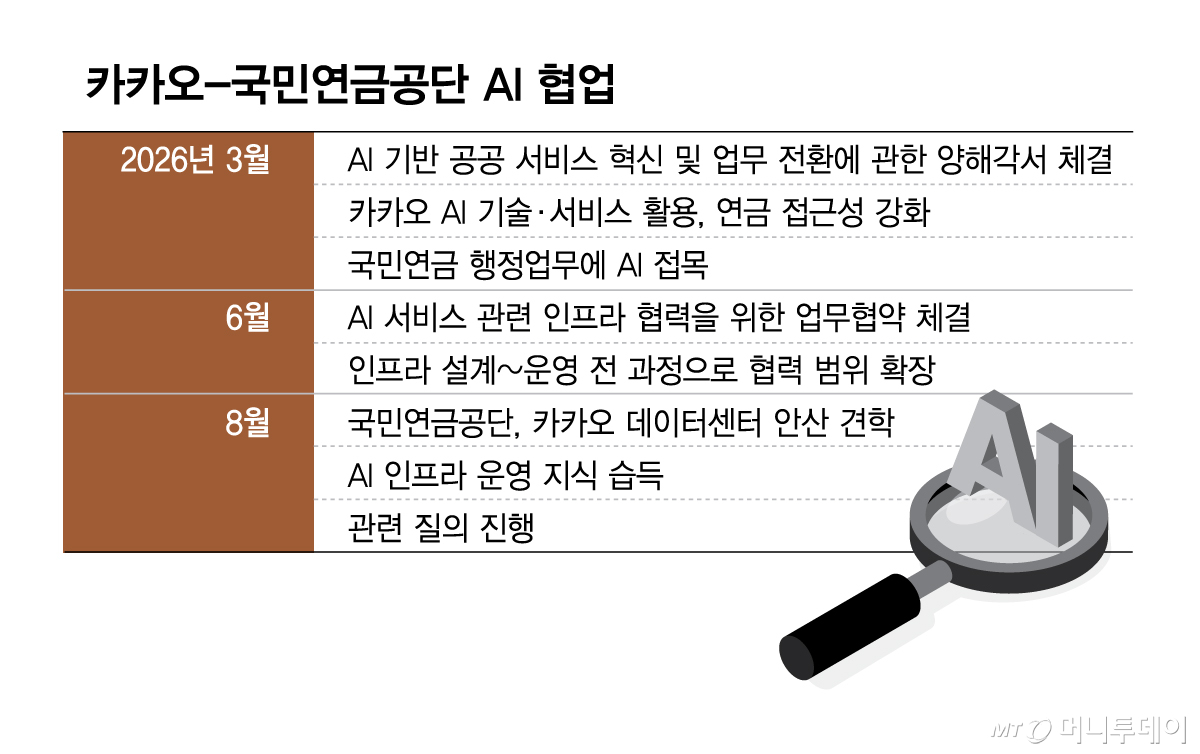
According to the National Pension Service on the 31st, a senior official from the service visited "Kakao Data Center Ansan" in Ansan, Gyeonggi Province, on the 7th. The visit was aimed at inspecting high-performance GPU servers such as B300 and H100, along with dedicated containment systems (facilities that separate cool air from hot air), to acquire knowledge for stably operating AI infrastructure.
The National Pension Service visited UPS (uninterruptible power supply) battery rooms, GPU server racks, and cooling facilities to review: △how to operate cooling and HVAC systems; △temperatures inside GPU server racks and AI server zones; △methods to prepare for and respond to sudden spikes in power usage; △response procedures in case of power outages or HVAC system failures; and △the status of building and operating DR (disaster recovery) and backup systems.
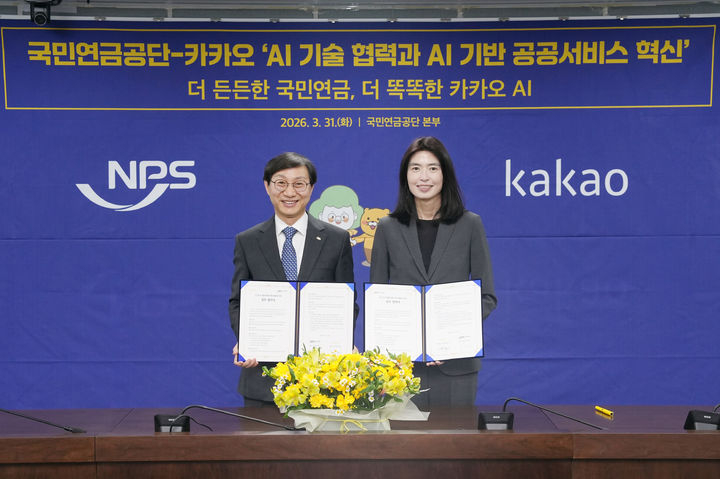
The collaboration between the National Pension Service and Kakao began with public-facing AI services. In March, both parties signed a "Memorandum of Understanding on Innovation and Transformation of Public Services through AI." The core of the agreement was to create an environment where pension services could be easily accessed using Kakao's AI technologies and services, and to integrate AI into the National Pension Service's administrative operations.
The collaboration expanded to AI infrastructure in June. The National Pension Service signed a "Business Agreement on Infrastructure Cooperation for AI Services" with Kakao Enterprise, Kakao's AI infrastructure subsidiary. The two will collaborate on: △construction of GPU servers and related technical support; △utilization of the Kakao Cloud AI platform; △creation of test and demonstration environments for AI models; and △institutional and administrative support based on expertise in the public sector.
Industry experts have evaluated this as a representative case showcasing Kakao's future AI infrastructure strategy. As Jeong Sin-a (CEO) stated during the second-quarter conference call, Kakao is focusing its efforts on developing B2C AI services rather than undertaking AI infrastructure projects that require massive initial investment. Instead, its subsidiary Kakao Enterprise will continue to offer an AI infrastructure business model in which it supports customers' GPU purchases and takes responsibility for construction, operation, and management.
A prime example is "HYBE Lead GPUaaS (GPU-as-a-Service)." HYBE Lead GPUaaS provides services ranging from supporting customer GPU purchases to data center space, power, cooling, network, software installation, and integrated management. Unlike traditional GPUaaS models that lend GPUs owned by the provider, this model requires customers to purchase their own GPUs. Lee Jae-han, CEO of Kakao Enterprise who assumed office on the 6th, explained in December last year when he was head of the Cloud Business Division that "HYBE Lead GPUaaS is a realistic and powerful solution that simultaneously secures the 'flexibility' of cloud computing and the 'cost-effectiveness' of ownership."
This approach has the advantage of reducing initial capital burdens, as customers bear risks such as declining GPU prices, generational shifts, and idle resource generation. However, a drawback is that revenue ceilings are correspondingly lower. An industry official stated, "Lower investment costs allow for reduced risk exposure, but profits inevitably decrease as well." He added, "The industry interprets Kakao's focus on B2C businesses as a sign that the company feels burdened by initial investments in AI infrastructure."

 in TECH

