

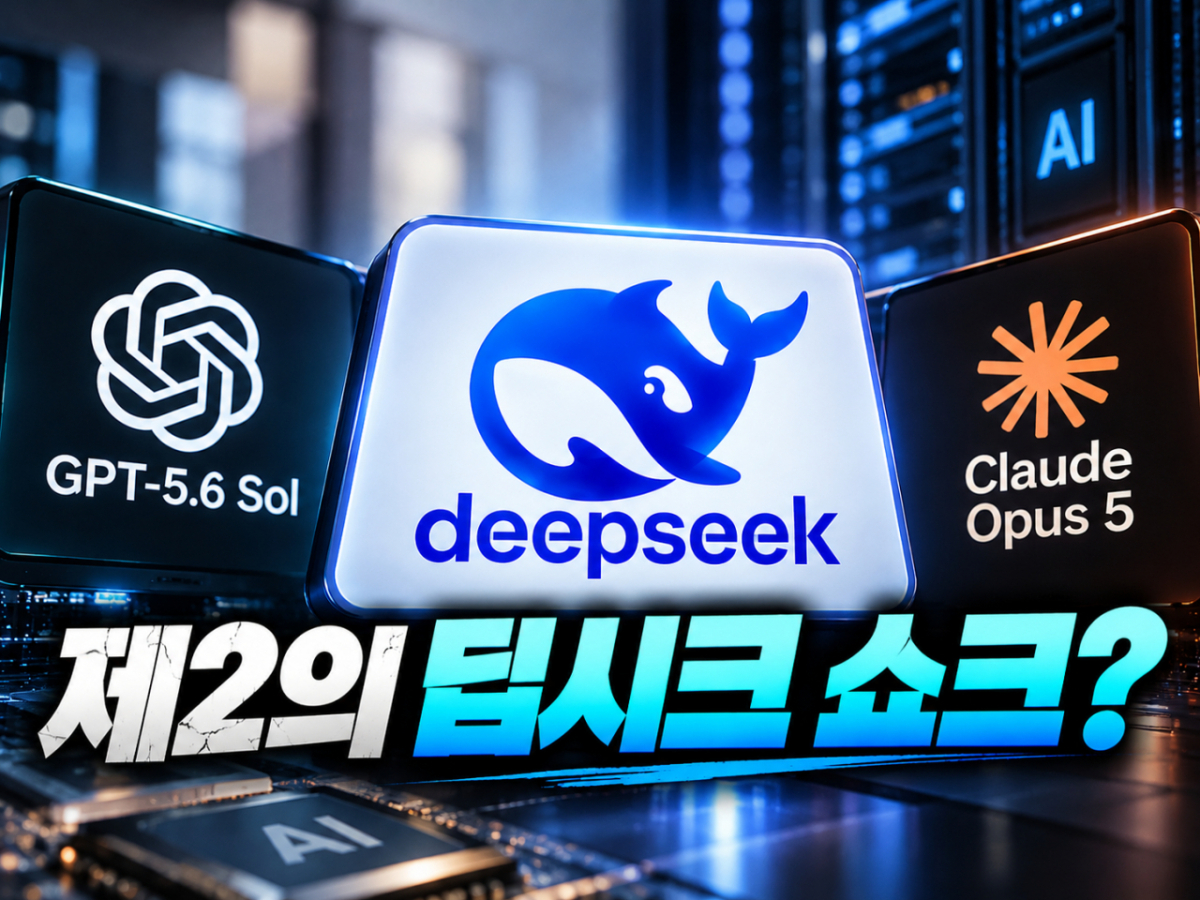
DeepSeek, the Chinese artificial intelligence (AI) company that shook global stock markets last year, unveiled a new product that outperforms major U.S. AI models in some performance evaluations while charging up to one-fortieth of the usage fees. Attention is now turning to whether this will once again raise questions about the massive AI investment costs of U.S. Big Tech companies.
DeepSeek announced on the 17th that it has launched the AI model 'DeepSeek V4.1-Flash-1017.' An improved version of its September model, it features enhanced coding and AI agent performance. The company has released the model weights under an MIT license and opened up search and web collection APIs.
In DeepSeek's internal evaluation, the new product outperformed both OpenAI's GPT-5.6 Sol and Anthropic's Claude Opus 5 in four out of 11 categories. It recorded a score of 77.0 on the coding evaluation 'DeepSWE v1.1.' However, it is difficult to view this as an overall performance advantage, and external verification is needed.
Its price competitiveness stands out. The API output fee per 1 million tokens during off-peak hours is $0.6 for DeepSeek, $20 for GPT-5.6 Sol, and $25 for Claude Opus 5. DeepSeek's price is approximately one-forty-second of Claude's. In its internal evaluation, the cost per coding task also decreased by 60%, from $0.5 to $0.2.
Thomas Wolf, co-founder and Chief Science Officer (CSO) of Hugging Face, stated on X, "It is truly funny that DeepSeek calls it a 'small-scale update' after raising its Terminal Bench performance from 31.2 to 42.3 points," adding, "I am curious whether this figure will be maintained outside of the internal evaluation environment."
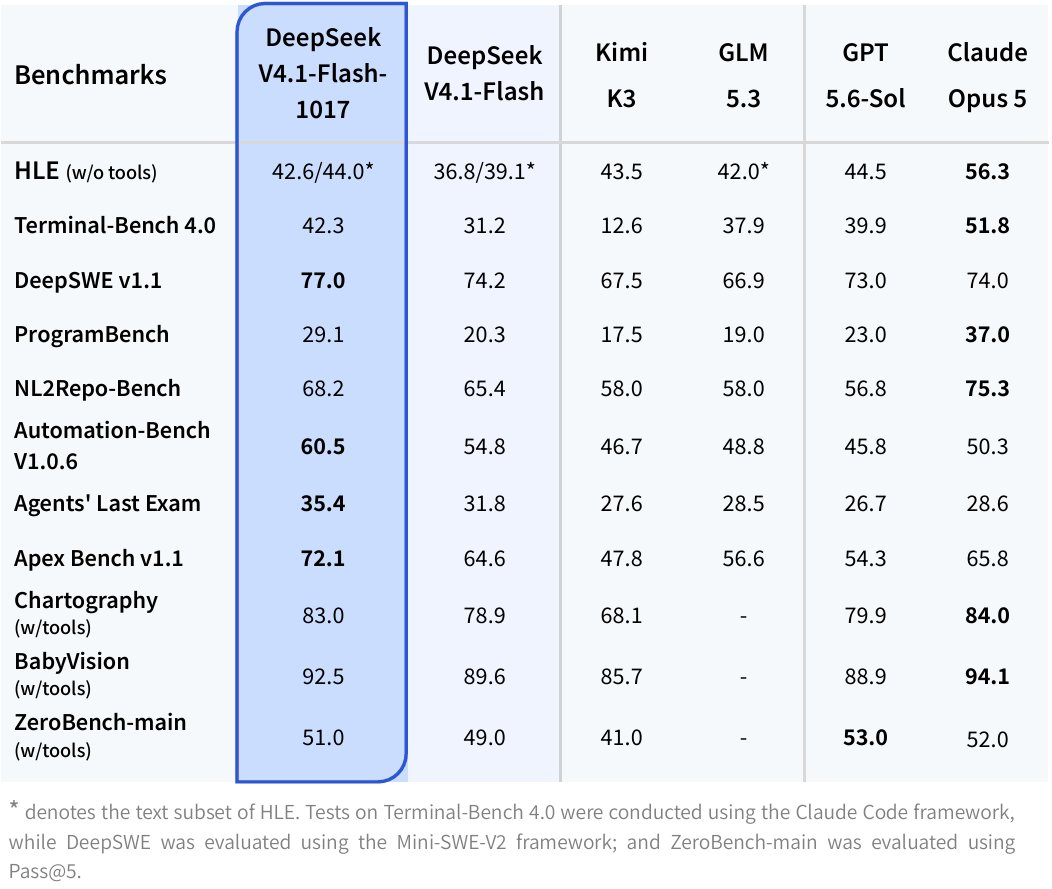
AI researcher Nathan Lambert also noted, "Although it has a minor version number and date attached, the magnitude of performance improvement is significant," adding, "It may prove to be a stronger model than GLM 5.3, even with built-in vision capabilities. Has the king of open weights returned?" Open weights refers to a method where the trained weights of an AI model are made public, allowing anyone to download and utilize them.
DeepSeek shook the stock market last year. Following the release of its reasoning model R1, Nvidia's stock price plunged by approximately 17% in a single day, evaporating roughly $589 billion in market capitalization. This raised questions about the necessity of large-scale AI infrastructure investments by U.S. Big Tech companies.
Concerns over the profitability of AI investments had already emerged in the U.S. stock market prior to DeepSeek's new product announcement. The NASDAQ index fell by approximately 2.1% on the 16th. Since the new product was announced over the weekend, market reactions have not yet been confirmed. However, the spread of low-cost AI could reignite debates about the investment profitability of U.S. Big Tech companies. Attention is also focused on Samsung Electronics and SK Hynix, which supply High Bandwidth Memory (HBM).
On the other hand, there is also 'Jevons' Paradox,' which suggests that lower AI usage fees could actually increase demand and computational volume. This means that low-cost AI does not necessarily lead directly to a decrease in semiconductor demand.
This also poses challenges for South Korea's AI development strategy. The Ministry of Science and ICT is promoting its Frontier AI project with the goal of reaching a level comparable to China's top-tier AI models. However, before the project has fully ramped up, DeepSeek has already surpassed major U.S. models in some evaluations. This means that while South Korea is chasing China, the benchmark for competition continues to rise. The key will be whether it can secure both technological development speed and cost competitiveness.

 in TECH

