

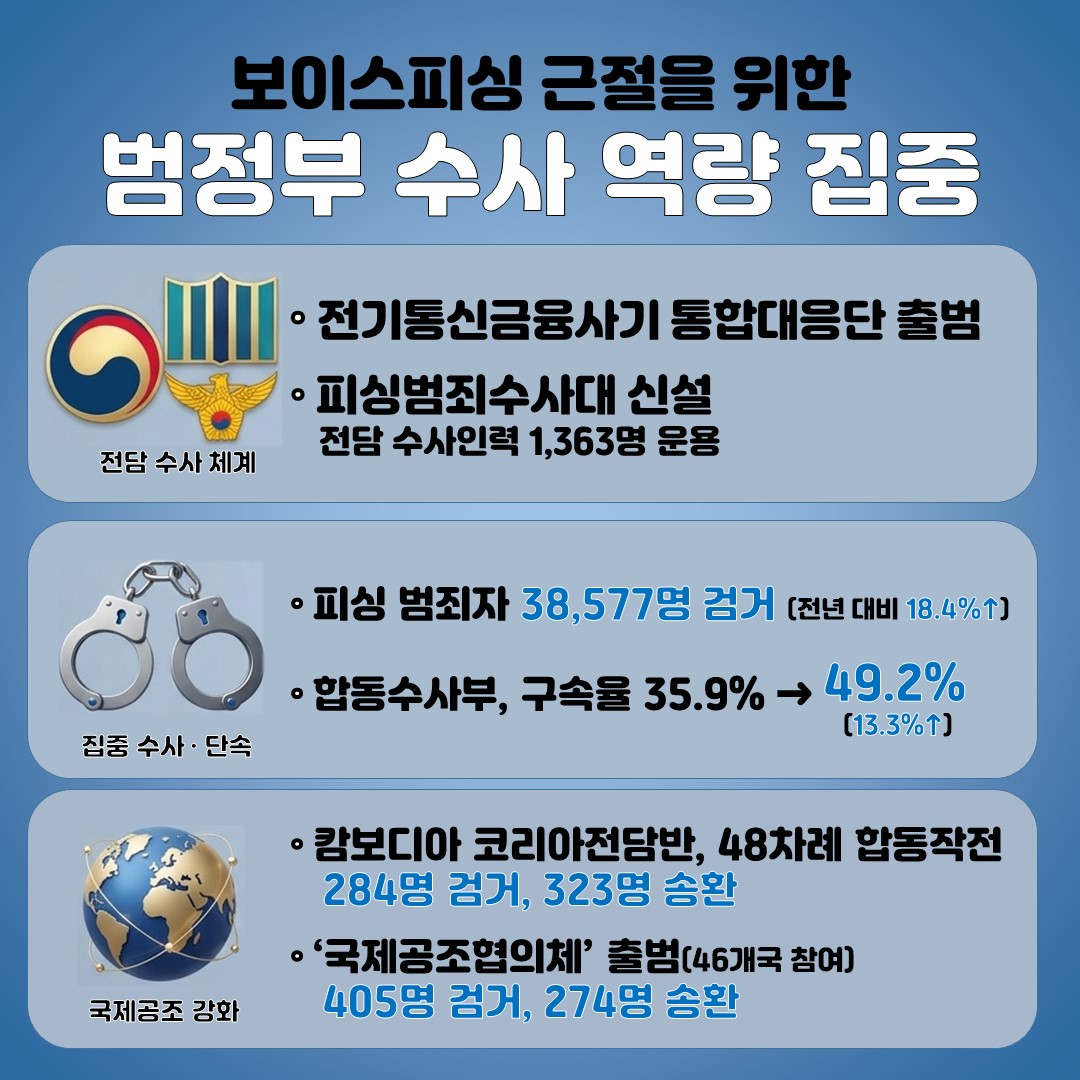
The number of voice phishing cases and the amount of losses have decreased for 10 consecutive months compared to the same period last year. As the government strengthened preventive measures such as AI (artificial intelligence)-based detection of suspicious calls and emergency blocking of crime-related phone numbers, the surge in voice phishing crimes seen last year has reversed into a downward trend.
On the 2nd, the government held a meeting of the 'Government-wide Task Force (TF) for Countering Voice Phishing' at the Government Seoul Office, chaired by Im Gi-geun, Minister of the Prime Minister's Office for Policy Coordination, and announced these results.
From October last year to July this year, the number of voice phishing cases totaled 12,554, a 39.9% decrease from 20,900 in the same period last year, while losses dropped from 1.1137 trillion won to 632.4 billion won, a 43.2% reduction. Both the number of cases and the amount of losses have declined for 10 consecutive months compared to the same period last year. In particular, in July alone, cases fell by 61.7% and losses plummeted by 74.9% compared to the same month last year.
The government analyzed that this outcome was influenced by shifting from a reactive approach of responding after crimes were detected to a proactive system that blocks attempts at the crime initiation stage using AI and communication technologies.
The National Police Agency, the Korea Internet & Security Agency (KISA), three major telecommunications companies, and Samsung Electronics have been operating an 'emergency blocking system' since November last year that suspends the sending and receiving of phone numbers used in voice phishing for seven days. Previously, it took an average of 2 to 3 days to suspend the use of crime-related phone numbers, but this was shortened to within 10 minutes after the introduction of emergency blocking. To date, 115,088 phone numbers have been blocked.
Preventive systems utilizing AI have also been expanded. Since December last year, the Ministry of Science and ICT has provided basic functionality in Samsung Electronics devices and telephone apps from the three major telecom operators to detect and warn of suspicious voice phishing calls in real time. Measures also include blocking access to malicious URLs and automatically blocking the installation of malicious apps on Android phones.
The Financial Services Commission established an AI platform for sharing voice phishing information among financial institutions, telecommunications companies, and law enforcement authorities. From October last year through the end of July this year, 463,000 pieces of suspicious information were shared, preventing 66.36 billion won in fraudulent fund transfers beforehand.
Measures to counter new types of scam crimes are also being strengthened. The Financial Intelligence Unit (FIU) operates a system that allows it to suspend transactions on suspicious accounts misused for investment reading rooms, romance scams, and no-show frauds. Of the 6,914 reports filed from June 30 to August 21, transactions in 5,018 cases were suspended. The National Police Agency also blocked over 53,000 SNS accounts misused in crimes this year.
Im Gi-geun, Minister of the Prime Minister's Office for Policy Coordination, stated, "The achievements gained through the voice phishing TF over the past year are a model case of inter-ministerial collaboration and proactive administration," and added, "Countering voice phishing is an important task to protect citizens' lives, so please respond with heightened vigilance in line with reforms to the criminal justice system."

 in TECH
