

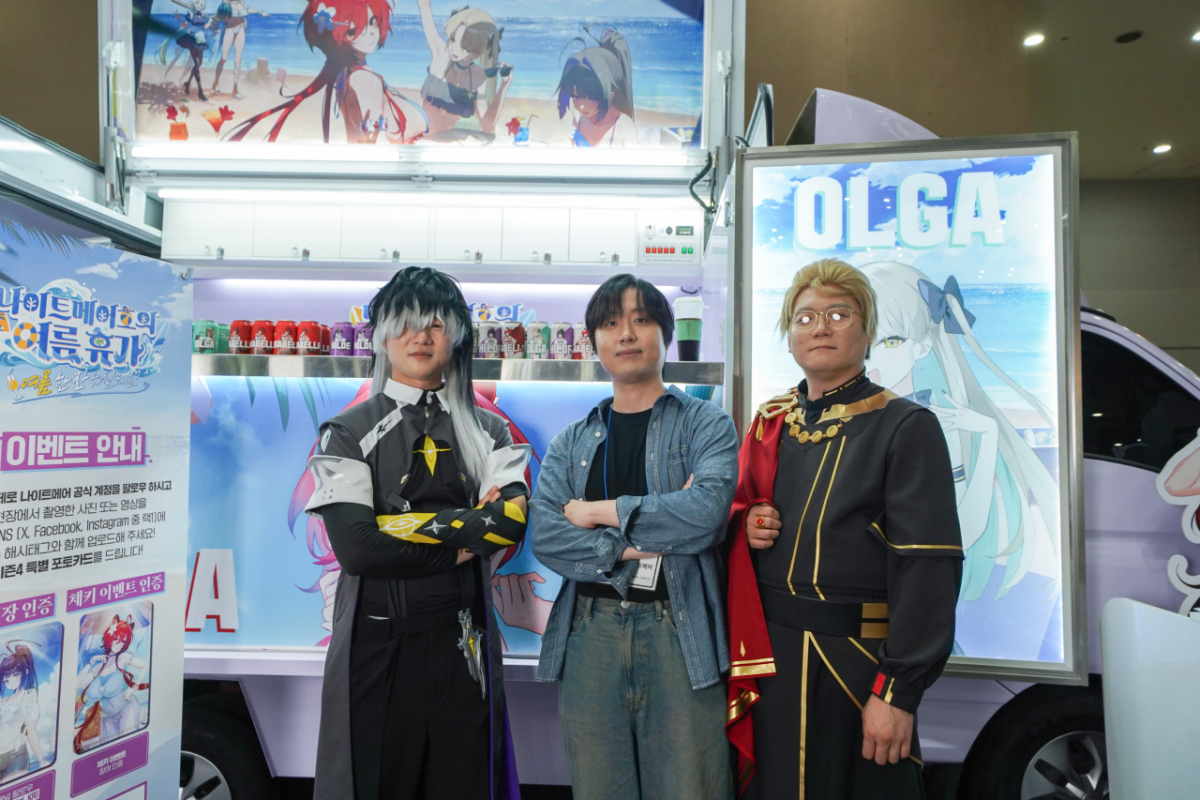
On the 15th last month at the KINTEX in Ilsan, the development team of Smilegate's "Chaos Zero Nightmare" (CaZena) made a surprise appearance at Comic World 335. Choi Seung-hyun, the Live Director, appeared cosplaying as the game character "Judas," while Kyung Min-gyu, Content Ma Ke-ting (Team Lead), appeared cosplaying as "Councilor Lumil."
The reason the developers chose to cosplay was due to a request from users. While hosting a CaZena live broadcast, comments arose suggesting that the two resembled their in-game characters, which led to requests for them to actually perform the cosplay. At the Comic World venue, the developers personally handed out beverages themed around CaZena's concept and welcomed fans.
In June, at the Misa Water Treatment Plant in Hanam, Gyeonggi Province, Nexon's "KeyboToss Run" event was held. Kim Yong-ha, Chief Producer, along with the development team of "Blue Archive," attended. They did not simply appear on stage to greet attendees and leave; instead, they ran the full 5-kilometer course alongside participants. To complete the run, they had been splitting their time for weeks in advance to practice.
Recently, unlike in the past, game development teams in the industry are increasing their points of contact with users. Beyond traditional developer notes or YouTube live broadcasts, development teams are now directly attending various offline events such as pop-up stores and game shows, expanding their face-to-face interactions. Advances in technology have also made it easier for developers and users to meet compared to before.
NC is the company most frequently cited as having changed the most within the gaming industry. While operating major hit IPs like Lineage, NC rarely engaged in direct communication with users unless the issue was of significant importance. However, since launching "Aion 2" last year, NC has strengthened its communication efforts by conducting 16 developer live broadcasts over a 100-day period. At the time, an NC representative stated, "In the past, we would only engage in communication when an issue reached a priority level of around 10, but now we go live even for issues at level 2."
The expansion of user contact points began first in Western markets, which are primarily focused on PC and console games. AAA-level games require substantial time and personnel to develop; if they fail commercially, the impact on the game company is relatively greater compared to other titles. As a result, a culture has taken root where user feedback is actively incorporated from the development process onward to reduce the risk of failure. Recently, representatives from game companies that received approval from the Chinese government and are proceeding with localization through local publishers expressed surprise at seeing beta tests conducted dozens or even hundreds of times with thousands or tens of thousands of users prior to launch.
The trend of domestic game companies moving away from secrecy and increasing their engagement with users is encouraging. Game companies that actively incorporate user feedback and collaborate on development direction, rather than simply telling users to wait while they create masterpieces on their own, will ultimately receive better results. This is an era where developers must view users not merely as consumers but as a key part of the development team and walk alongside them.

 in TECH

