

The results of corporate AI adoption are becoming concrete. These include cases where automation of order entry, consultation records, and document organization has led to handling more workloads and expanding the scope of duties, thereby reducing repetitive tasks.
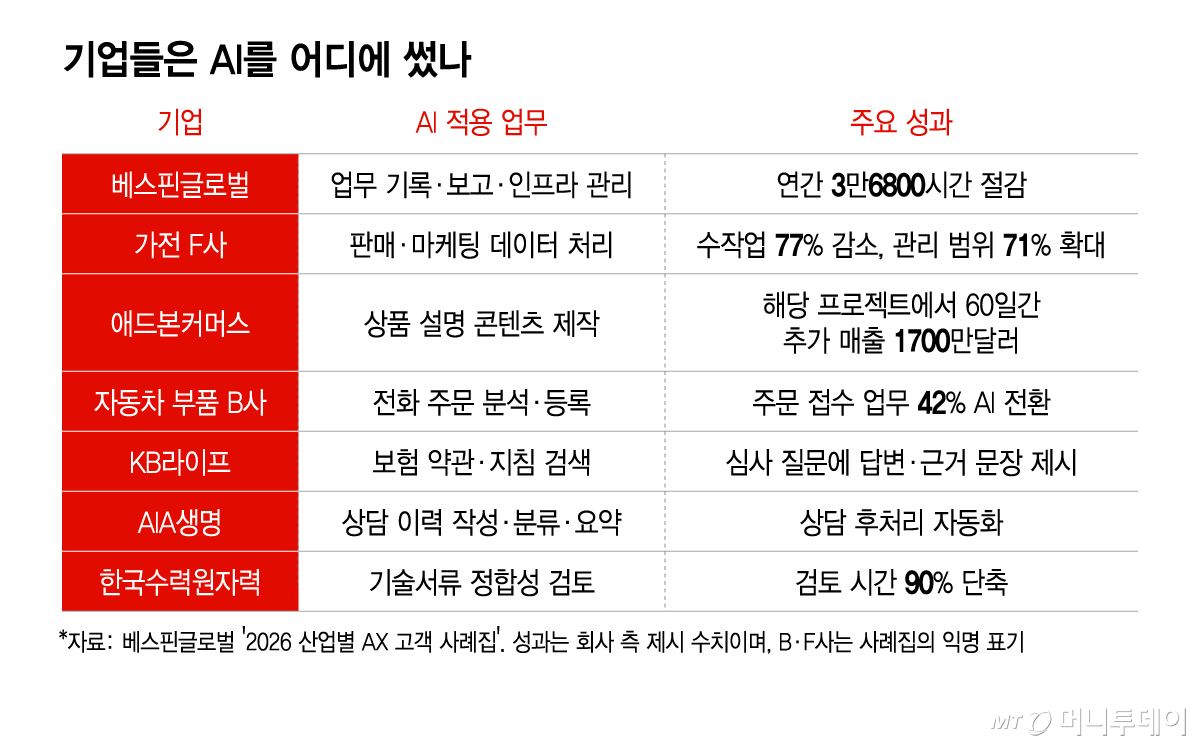
According to the "2026 Industry-Specific AX Customer Case Collection" released by Bespin Global on the 20th, the company applied 511 AI agents to its internal operations, saving an annual total of 36,800 hours. It stated that it reduced the time spent writing daily work reports by 97% by automatically collecting and summarizing conversation and task records for submission. This case collection categorizes and includes a total of 34 AI transformation cases by industry, comprising global leading examples, 14 domestic real-world projects including KB Life, Woori Financial Group, Korea Hydro & Nuclear Power, and the Korea Forest Service, as well as Bespin Global's own enterprise-wide AX application cases.
Home appliance company F, a client of Bespin Global, transformed the process of manually managing sales and campaign data scattered across different countries and distributors. The company consolidated the data in one location and automated 12 processing steps. As a result, manual work was reduced by 77%, while the scope of marketing management expanded by 71%.
Adbon Commerce struggled to meet surging demand due to its reliance on manual production of product detail pages. In response, it built an operational environment that uses generative AI to create product descriptions and process large-scale content. This project generated an additional $170 thousand won in sales over a 60-day period.
Automotive parts company B automated the task of manually transcribing phone orders. The AI extracts order information from calls containing slang and dialects and registers them into the headquarters system based on a list of approximately 170,000 types of parts. The AI transformation rate for the workload of order intake personnel was 42%.
In the financial sector, the burden of searching for and recording information has decreased. KB Life supports reviewers who previously had to directly verify thousands of pages of insurance terms and product guidelines with AI search. It provides answers to questions while also presenting supporting sentences. AIA Life automated the creation, classification, and summarization of consultation histories after customer interactions.
In the public sector, AI has been utilized for document review and information retrieval. Korea Hydro & Nuclear Power reduced the time spent reviewing the consistency of technical documents by 90%. The Korea Agro-Fisheries & Food Trade Corporation (aT) enabled three specialized AI agents focused on markets, regulations, and statistics to collaborate in finding and answering export-related information.
The common thread among the presented cases is that they organized data and connected it to actual work processes. Searching terms requires data capable of reading complex documents and tables. Order automation must also go beyond understanding call content to connect with parts lists and order systems.
It is pointed out that when companies select tasks for AI application, they should first examine "what tasks are being hindered by manual labor" rather than "what new tasks can be performed." Only after reducing repetitive tasks and having additional demand to process can it lead to business expansion. It is explained that after adoption, processing volume, quality, and costs must be evaluated together.
Han Sun-ho, Vice President (CAIO) of Bespin Global, stated, "We planned this collection to compile specific results and methodologies of AI transformation by industry into a single volume, allowing companies considering AI adoption to immediately refer to application plans suitable for their own industries." He added, "It will allow one to grasp at a glance where domestic companies' real-world cases stand within the performance trends of global leading enterprises."

 in TECH
