

Even if the government spends 3.85 trillion won to secure the latest GPUs, they will be useless if there is no place to plug them in. Vera Rubin cannot be directly installed into existing data centers. It is expected that preparing to "receive" the equipment according to the supply schedule will determine the success or failure of the investment.
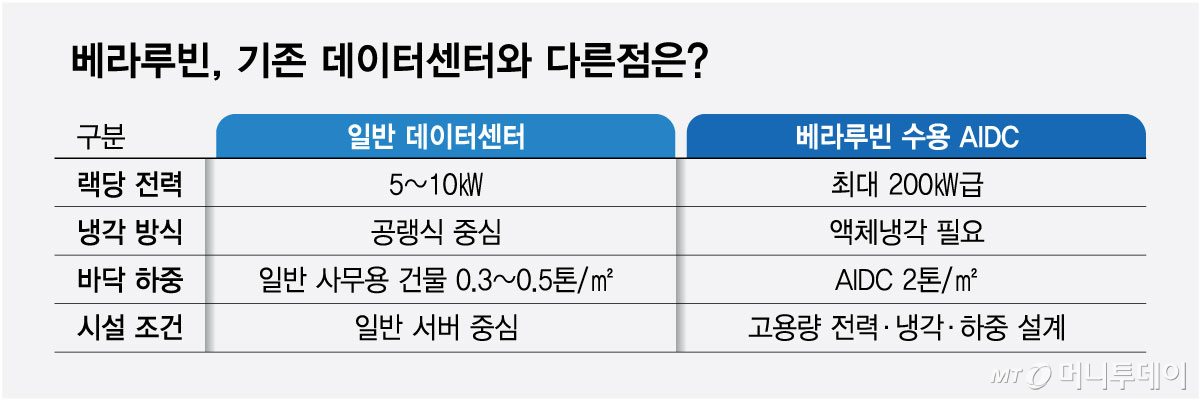
According to industry sources on the 6th, the Vera Rubin NVL72 being introduced by the government is a product that bundles 72 Rubin GPUs and 36 Vera CPUs along with communication, power, and cooling devices into a single server rack. One steel cabinet the size of a refrigerator essentially functions as one supercomputer. The price for concentrating performance in one unit is electricity. A single rack consumes 200kW of power. This exceeds 20 times the power per rack (5–10kW) in general data centers, and based on the contracted power per household (3kW), a single cabinet consumes as much power as approximately 60 ordinary households use simultaneously.
High electricity consumption generates significant heat. While data centers have traditionally cooled servers by blowing in cold air, at this density, the rate of heat removal via air cannot keep up with heat generation. Therefore, liquid cooling facilities that circulate coolant through pipes directly onto chips are essential. With added cooling piping and coolant on the server, a single rack weighs several tons. Since building floors must support this weight, simply replacing equipment in existing server rooms is not feasible. This means power systems, cooling infrastructure, and building structures must all be redesigned simultaneously.
Newly constructed AIDCs (AI data centers) are already incorporating these conditions from the start. LG Uplus's Paju AIDC, being built with Vera Rubin acceptance in mind, will have a total power reception capacity of 200MW upon completion—the largest in the Seoul metropolitan area—and is designed to support a floor load of 2 tons per square meter. This exceeds four times that of general office buildings (0.3–0.5 tons). SK Telecom is also moving forward with plans to build AIDCs capable of accommodating next-generation high-performance servers.
Existing data centers are not entirely excluded. An industry executive explained, "By adjusting the layout, such as widening the spacing between equipment, it is possible to accommodate Vera Rubin in existing facilities." They added, "Since liquid cooling is already an established technology, securing power and cooling capacity at individual facilities is more important than developing new technologies."
The installation location does not necessarily need to be in the Seoul metropolitan area. Researchers do not sit directly in front of the equipment; once initial installation and connection work are completed, they access it remotely via the cloud from anywhere. This means placing the equipment in regions with surplus power and accessing it from Seoul will not hinder research. It has not yet been decided which facilities will host the Vera Rubin units secured by the government.
The equipment will not arrive all at once but will be delivered in batches according to NVIDIA's supply situation. If the data center is not ready when the equipment arrives, racks worth hundreds of billions of won will have to wait in warehouses. Conversely, if construction is completed but equipment delivery is delayed, the facilities will remain idle. Precise coordination between delivery schedules and operational readiness is thus the final condition for the 3.85 trillion won investment.
Lee Jeong-heon, a Democratic Party of Korea lawmaker, stated, "In the AI war that determines the nation's survival, the government has made bold and proactive decisions to seize the initiative." He added, "We will spare no policy or budgetary support at the party level to ensure that Vera Rubin adoption leads to a groundbreaking leap for South Korea's AI industry and secures future growth drivers."

 in TECH
