

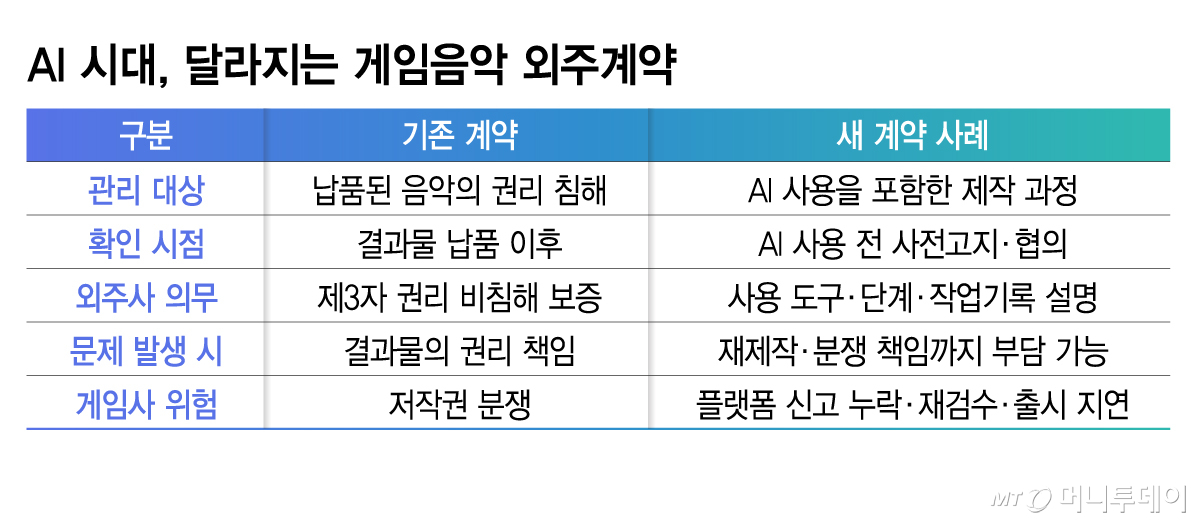
If an outsourced composer creating game music uses generative AI, this is no longer a private matter. If a game publisher receives such work without knowing, it creates loopholes in platform reporting and copyright verification. A movement to manage this risk from the production stage rather than after delivery has now appeared in contracts.
According to the game industry on the 7th, a recent music outsourcing contract for a game project included a condition requiring prior consultation with the client if generative AI is used. It also stipulates that the outsourcing company will bear responsibility if copyright issues arise from AI-generated results. While not using AI has long been an unwritten rule in the game music industry, explicit inclusion of such terms in contracts remains rare.
Existing contracts required outsourced composers to guarantee that delivered music was a "purely original work that does not infringe on third-party rights." The focus was on whether the final product had issues rather than what tools were used. New conditions shift the management point from the final product to the production process. This is because without prior disclosure, it becomes difficult to determine AI usage by examining only the final audio. If game publishers are informed in advance about AI use, they can decide whether to accept the result, require human re-creation, or conduct additional rights verification.
Global distribution platform Steam's policies are driving this change. Steam classifies art, code, and sound created with AI tools during development as "pre-generated AI content" and requires developers to explain their usage. Answers submitted to Steam are cross-checked against the game build before release. If an outsourced composer fails to disclose AI use, the game publisher ends up bearing responsibility for AI usage on the platform without knowing the production methods. If problems surface just before release, schedules are delayed due to music replacement and re-recording. If discovered after launch, losses become even greater. The issue could escalate into copyright disputes, potentially leading to sales suspensions.
This is not yet an industry standard. Two major game companies, who requested anonymity, confirmed they have not included AI prohibition or prior notification clauses in their music outsourcing contracts. However, both shared a principle with outsourcing partners of not using AI-generated results. A representative from Game Company A stated, "If an outsourced composer uses AI, there is no reason to outsource at all since we can do it ourselves." They added, "We outsource because specific composers' unique styles and the ability to make project-tailored modifications are needed."
When unwritten rules become contractual obligations, what composers must submit changes. Beyond music files, they must now explain which AI tools were used at which stages, how much was reflected in the final product, and whether work records and original files were preserved. The scope of liability is also a contentious issue. If individual composers bear risks arising from AI services with undisclosed training data, creators with weaker negotiating power face unpredictable dangers.
The new conditions added to outsourcing contracts do not mean game publishers have "banned AI." Rather, they reflect that outsourced composers' working methods now disrupt platform reporting (e.g., Steam) and release schedules, prompting publishers to begin viewing the need to track and manage AI usage as a right-risk issue.

 in TECH
