

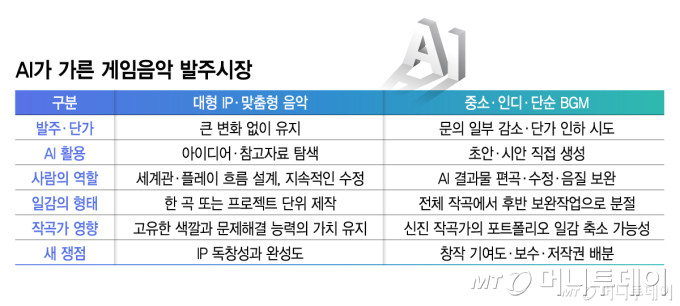
While generative AI has not yet replaced the entire game music market, smaller and generic tasks are already being shaken up. Large intellectual property (IP) projects remain conservative toward AI, but signs of efforts to lower unit prices using AI are emerging in small-to-medium-sized and indie games, as well as in simple background music.
Jin Myeong-yong, a music director at JLMuse who has created game, drama, and animation music for over 20 years, said on the 7th that "major IPs or large-scale projects continue to maintain their pricing and commissioning methods without significant changes." In contrast, inquiries from small-to-medium and indie projects have partially declined. Some developers are now requesting that AI first create the music, with only the insufficient parts being supplemented by human composers. Director Jin added, "For music where quality and brand originality are crucial, sophisticated creation is required, which actually increases its importance." He also noted, "In simple consumption-type BGM, there is a palpable trend of attempting to replace it with AI or reduce unit prices."
In the past, composers handled everything from concept development to composition, arrangement, and mixing for an entire song. Recently, commissioning companies often create drafts using AI first, leaving composers to handle only later-stage tasks such as arrangement, revisions, and sound quality improvements. The process of "producing one song" has been split between AI-generated drafts and human corrections. This makes it increasingly difficult to determine appropriate compensation. If a person significantly revises an AI-generated melody, the boundary between new composition and arrangement becomes blurred. It also remains ambiguous who holds what portion of the copyright.
Composers just entering the market suffer more than established musicians. As small projects and generic BGMs decline, the pathway for emerging composers to build portfolios and advance to large-scale projects narrows. Rather than replacing top-tier composers, AI is effectively removing the growth ladder at the lower end of the market.
Unlike general music that plays in a fixed sequence, game music must adapt to user choices and situations. It requires designing repetitive sections and flow patterns tailored to combat, movement, dialogue, and scene transitions, with multiple revisions throughout development. Director Jin stated, "What game companies seek is not just a single music file. They look for partners who can interpret the project's purpose, maintain continuous communication, and solve problems." This highlights the distinction between merely creating an impressive song and designing how music functions within a game.
AI-generated music supply has surged in the global music market. According to French music platform Descript, approximately 90,000 songs are registered daily on average, with some days in June this year seeing AI-generated music exceed 50% of new uploads. However, among these 90,000 songs, actual streaming accounts for only 1–3%. While creation has become easier, it remains difficult to produce music that users actually choose to listen to.
Director Jin views AI not as a machine that produces finished products but as a tool that quickly generates ideas and reference materials. Musicians will increasingly take on the role of selecting elements from AI-generated outputs that fit their projects and reassembling them within existing production systems. He remarked, "Future competition will not be against AI itself, but against other creators who know how to effectively use AI as an assistant."

 in TECH
