

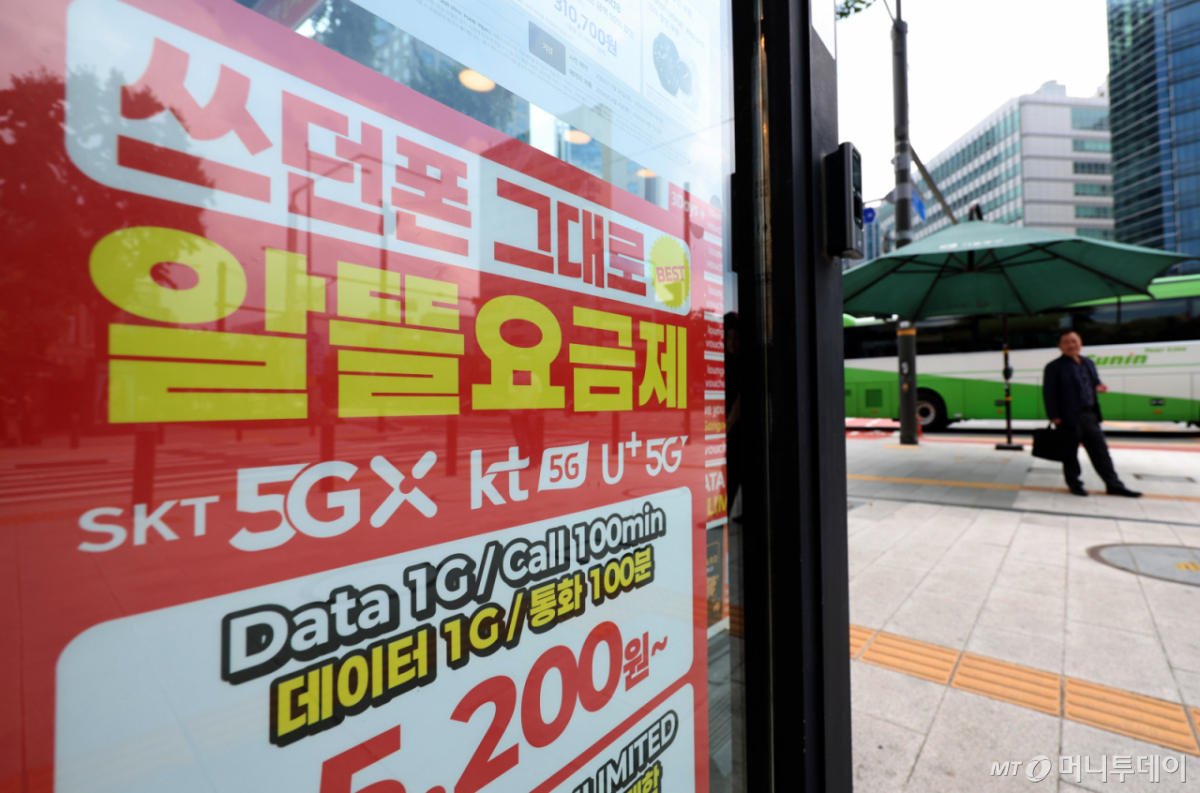
The budget mobile (MVNO) market, with over 100 thousand won subscribers, can be said to have entered a stable phase in terms of overall scale. However, questions remain as to whether the qualitative growth of the market is catching up with its size.
Industry insiders and outsiders diagnose that the market's substance has not been strengthened because it has been stuck in the stereotype that 'budget mobile = cheap tariffs,' leading only to cutthroat tariff competition. As an era of high-data consumption centered on multimedia and AI (artificial intelligence) approaches, there are calls to encourage competition focused on specialized products alongside price competition.
According to a 'Competition Assessment of the Telecommunications Market' report released by the Korea Communications Policy Institute at the end of last year, as of the end of 2024, the market share based on retail sales revenue for the budget mobile market increased by 0.9 percentage points (points) year-on-year to 8.4%. During the same period, the market share based on total subscribers expanded by 1.1 percentage points year-on-year to 20%. This means that while the proportion of subscribers in the overall mobile telecommunications market is significant, the revenue share accounts for less than half.
Regarding this, the Korea Communications Policy Institute analyzed that "in the case of budget mobile services, ARPU (average revenue per user) is low compared to 5G (fifth-generation) mobile lines due to a high proportion of IoT (Internet of Things) communications and 4G lines, resulting in retail sales market share being considerably lower than total subscriber market share."
The slow qualitative growth of the budget mobile market is also evident in performance reports. In 2024, the entire industry recorded an operating loss of 25.8 billion won, turning into a deficit. The Ministry of Science and ICT stated last July upon announcing the Budget Mobile 2.0 policy that "more than half, or 35 companies, are small-scale with 100,000 subscribers or fewer, and 12 operators have 10,000 subscribers or less," adding that "27 operators reported operating losses." Industry experts diagnose that the focus on cutthroat competition through low-price plans like 0-won tariffs and promotions has prevented the establishment of proper revenue models.
To break the cutthroat competitive structure of the budget mobile market, advice suggests that market competition must be reorganized around specialized tariff plans. Currently, government policy on budget mobile services focuses on inducing lower tariffs through reduced wholesale rates for radio waves; however, there are calls to consider policy support that can provide incentives to operators offering specialized tariffs.
Just as the early budget mobile market secured a large number of MZ generation (Millennial and Gen Z) subscribers with low-priced tariffs, it is advised to secure differentiation by driving out various specialized services that can meet the needs of small-scale users, such as multimedia content, OTT (online services), senior citizen tariffs, and customized products for foreigners and travelers.
There are also opinions suggesting that regulations on budget mobile operators affiliated with telecommunications subsidiaries and financial companies should be reviewed to create space for 'pure' small and medium-sized operators to operate in the market. Additionally, support for financially weak companies relying on policy measures such as wholesale rate reductions or usage fee exemptions should be re-evaluated to establish a self-sustaining foundation for the industry.
A telecommunications industry official stated, "Mobile phones have already evolved beyond voice calls and message transmission into tools for consuming various contents such as multimedia and OTT (online video services)." They added, "Operators must move beyond simply leasing communication networks for resale and be able to provide specialized services tailored to specific customer segments and areas."

 in TECH
