


The MVNO (MVNO) market, introduced in 2010 with the aim of reducing household communication costs, is facing a crisis.
According to the Ministry of Science and ICT on the 8th, as of 2024, 27 out of 59 total MVNO operators (46%) recorded operating losses, and six companies are preparing to close down. This means more than half of the industry is in a precarious situation. As of 2024, total industry revenue reached 2.7 trillion won, while operating losses amounted to 25.8 billion won.
Just one year after recording an operating profit of 29.6 billion won in 2023, the sector turned into a loss. While price competition achieved cost savings that consumers could feel, MVNO operators, whose only weapon is 'low prices,' have long been suffering from side effects such as deteriorating profitability. Although the government promised measures under this year's 'MVNO 2.0' plan, including the Data Safety Option (QoS, 400Kbps) and reductions in wholesale rates, it remains uncertain whether the bloodletting competition that has continued for over a decade will stop.
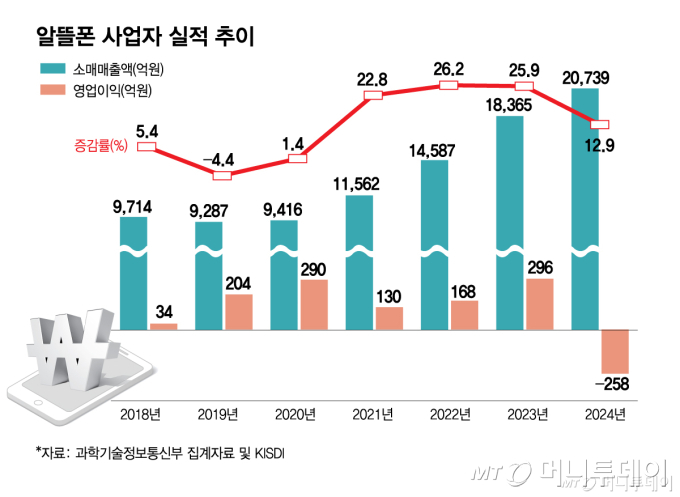
The main cause of management deterioration is identified as bloodletting competition, such as ultra-low-price promotional plans like '0 won per month' or 'plans in the 1,000 won range.' Currently, there are up to eight types of zero-won plans on the market. This is the result of operators focusing on marketing, such as inflating subscriber numbers for short-term gains, rather than securing long-term profitability.
To save the market, the government recently introduced 'MVNO 2.0' measures, promising to introduce QoS and reduce wholesale rates for spectrum usage fees. However, experts consistently point out that normalization will be difficult without a fundamental structural change among operators.
Shin Min-soo, a professor at Hanyang University, stated, "The problem would be solved if existing operators became independent MVNO (Full MVNO) operators by building their own facilities and creating differentiated plans. However, since major carriers are not earning profits from MVNOs either, the investment motivation of existing MVNO operators is declining." He added, "New entrants such as banks need to come in to drive market development, and MVNO operators must undergo changes."

 in TECH

