

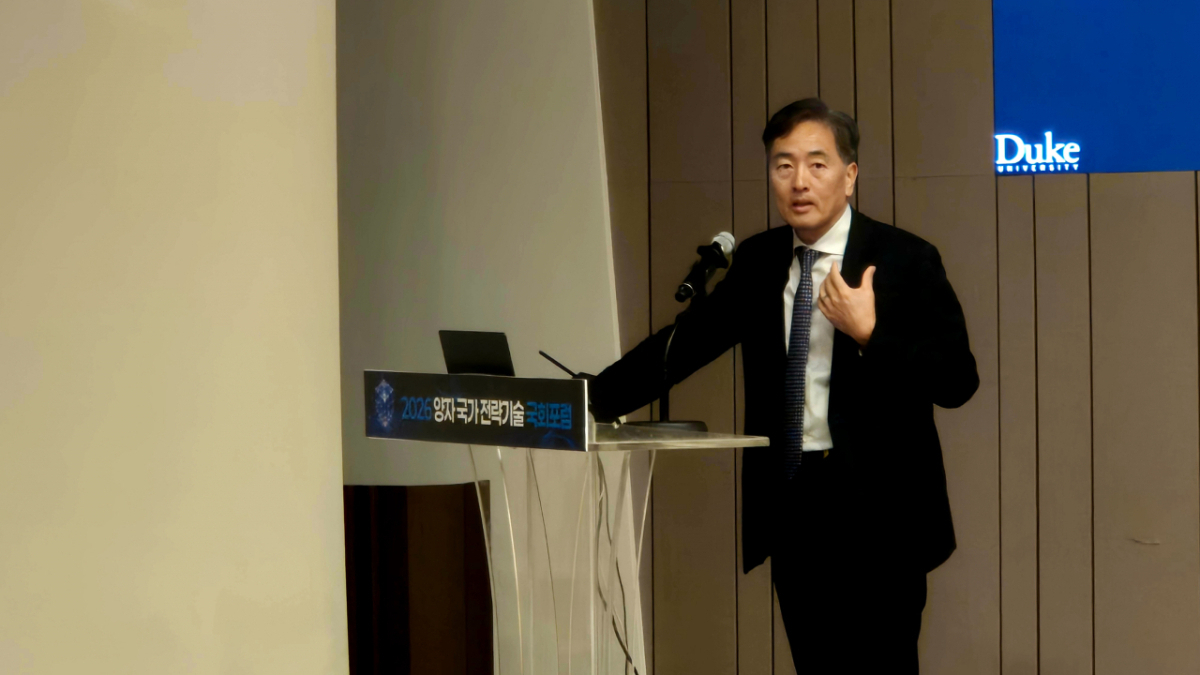
"The convergence of quantum computers and AI (artificial intelligence) is a vision if successful, but fraud if it fails. Nevertheless, we must boldly take this risk."
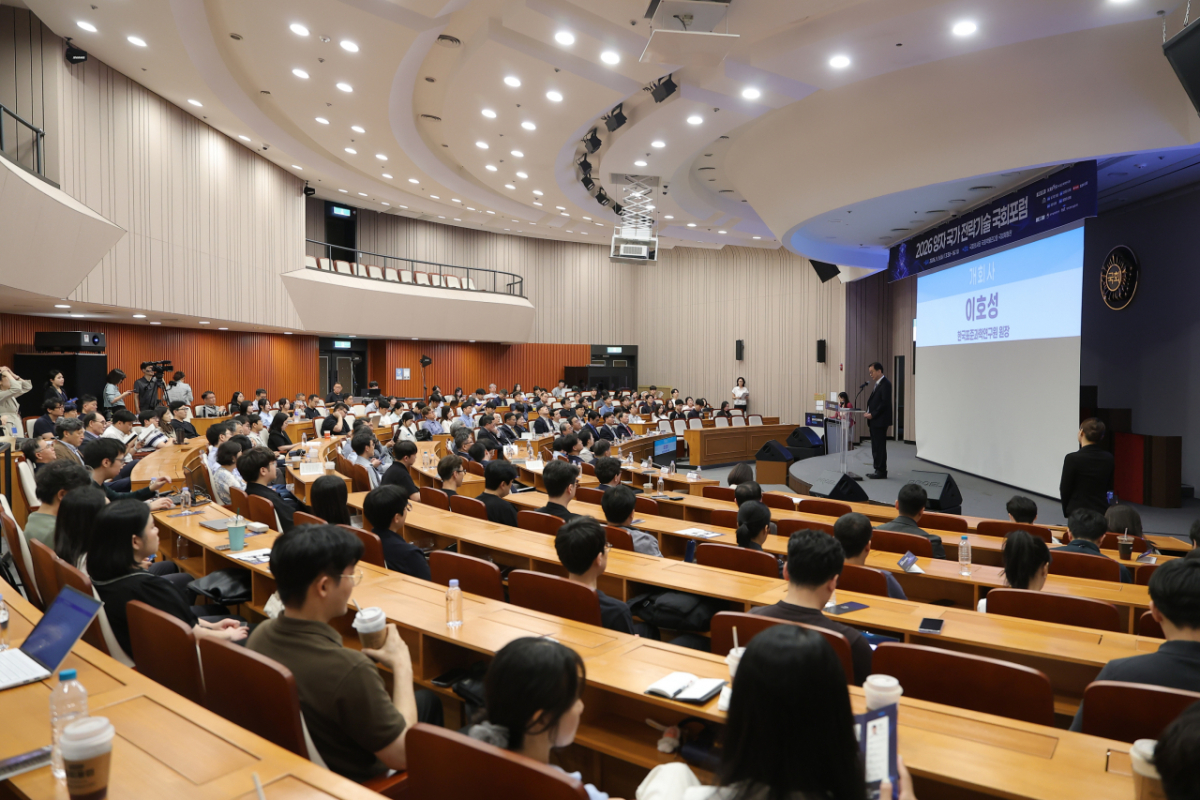
Kim Jeong-sang, co-founder of IonQ and professor at Duke University in the United States, made these remarks on the 9th as a keynote speaker at the '2026 Quantum National Strategic Technology National Assembly Forum' held at the Seoul Yeouido National Assembly Museum under the auspices of the Korea Research Institute of Standards and Science.
Professor Kim holds the position of Distinguished Professor in both Electrical and Computer Engineering and Physics at Duke University in the United States. In 2015, he co-founded IonQ, a quantum computing company, with Professor Chris Monroe of the University of Maryland in the United States.
Professor Kim emphasized that integration with quantum computers is necessary to overcome the limitations of current large language models (LLMs) and AI, which consume massive amounts of electricity to process large-scale data. Unlike classical computers, quantum computers perform multi-dimensional parallel processing by utilizing quantum physical properties such as 'superposition' and 'entanglement.' He explained, "When analyzing high-dimensional patterns and complex neural network structures, this approach can dramatically improve energy consumption efficiency and rapidly resolve correlations between parameters."
The problem is that quantum computers capable of commercial-level performance have not yet emerged. This is why quantum computing is still referred to as a 'future technology.' Professor Kim stated that "a moment requiring a 'disruptive opportunity' has arrived." Citing past examples such as the invention of the transistor at Bell Labs and Intel's development of CPUs, he noted, "Just as new scientific discoveries led to the combination of integrated circuits and mass production technologies, breaking through to create massive mainframes, quantum technology is also entering domains that will shatter the ceilings of existing industries by starting as low-quality niche technologies."
He continued, "Just as explorers crossed the Atlantic Ocean to discover a new continent, we need bold moves that completely transcend the horizons of existing knowledge. To enable the quantum science community to challenge goals without fear of failure, national-level research funding and industrial infrastructure must serve as a safety net," he suggested.
On this day, U.S. Department of State Technology Policy Director Eugene Bae, who also delivered a keynote speech alongside Professor Kim, stated, "Quantum technology is maturing beyond the research lab stage into the application phase, and we are now standing at the threshold of a quantum revolution. The United States is making every effort to advance its quantum capabilities."
In fact, the Donald Trump administration issued an executive order in June titled 'Ushering in the Next Frontier of Quantum Innovation.' The core of this initiative involves deploying quantum computers capable of practical use in scientific research at Department of Energy (DOE) facilities and integrating them with AI models and supercomputer systems. The U.S. Department of Commerce (DOC), Department of Defense (DOD), and the Defense Advanced Research Projects Agency (DARPA) are also actively investing.
Notably, in May, the U.S. Department of Commerce launched an investment of approximately $2 billion (2.6 trillion won) aimed at establishing quantum foundries and resolving technical bottlenecks across various quantum platforms, pursuant to the 'CHIPS and Science Act.' However, this support is not provided as a grant; instead, the government will acquire equity stakes in beneficiary companies at a later date.
Director Bae stated, "We intend to comprehensively support the entire quantum ecosystem without designating any specific technical approach as the winner." He added, "However, this alone does not constitute a complete picture. There is a need for talent and idea sharing among nations that share values, as well as R&D cooperation." He then expressed hope that Korea would join this endeavor.
Meanwhile, South Korea is advancing the 'Quantum Science and Technology Flagship Project' centered around the Korea Research Institute of Standards and Science. The goal is to develop a 100-qubit error-corrected superconducting quantum computer by 2029 and a 1,000-qubit error-corrected neutral-atom-based quantum computer by 2032.
Lee Ho-seong Pyo Jun-yeon (Director) stated, "As the convergence of quantum technology and AI accelerates, national-level preemptive technological strategies have become increasingly important. We will strive to enhance our quantum technology competitiveness and secure leadership in this field."

 in TECH

