

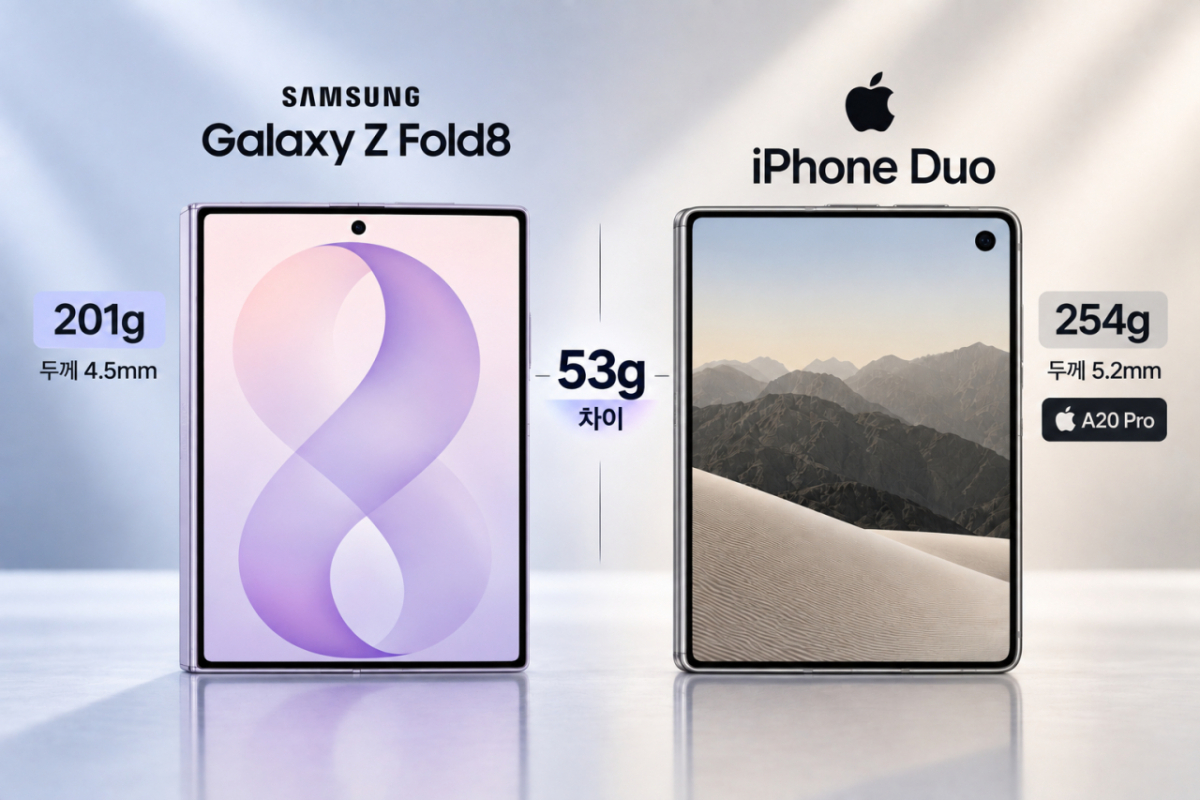
With Apple's first foldable phone, the "iPhone Duo," unveiled, differences from Samsung Electronics' "Galaxy Z Fold8" have also emerged. While both devices feature similar screen sizes of approximately 7.6 inches, the Galaxy Z Fold8 is 53 grams lighter and folds to a thickness of just 1.6 mm. In contrast, Apple has differentiated itself in application processor (AP) competition by equipping the iPhone Duo with its latest "A20 Pro," built on a cutting-edge 2-nanometer process.
According to reports from Apple and Samsung Electronics on the 10th, the iPhone Duo weighs 254 grams, making it 53 grams heavier than the Galaxy Z Fold8 (201 grams). When unfolded, the iPhone Duo measures 5.2 mm in thickness, and when folded, it reaches 11.3 mm—both 0.7 mm and 1.6 mm thicker, respectively, compared to the Galaxy Z Fold8 (4.5 mm unfolded, 9.7 mm folded). In terms of weight alone, the iPhone Duo is even 1 gram heavier than the Galaxy Z Fold5, which was released in 2023 and weighed 253 grams.
There is a significant price disparity between South Korea and the United States. In South Korea, the base price for the 256GB model of the iPhone Duo is 3.29 million won, while the Galaxy Z Fold8 is priced at 2.2781 million won—a difference of 1.0119 million won. The iPhone Duo is also more than 1 million won more expensive for both the 512GB and 1TB models. In contrast, in the United States, the price difference between the 256GB versions is only about $99 ($1,999 vs. $1,899.99), and the gap remains around $99 for the 512GB and 1TB variants. This means that the relative price burden of the iPhone Duo is significantly lower in the U.S. than in South Korea.
The iPhone Duo also features a more advanced application processor (AP). Apple has equipped the iPhone Duo with the newly unveiled 2-nanometer A20 Pro, whereas the Galaxy Z Fold8 uses the "Galaxy Snapdragon 8 Elite Gen 5," which was released last year. With Qualcomm set to unveil its next-generation flagship chip this month, the iPhone Duo currently holds an advantage in terms of having a newer AP at the time of release.
Differences also exist in camera design. The Galaxy Z Fold8 includes a 10-megapixel camera on its inner display, resulting in a visible camera hole. In contrast, the iPhone Duo employs an under-display camera (UDC) technology to conceal the camera beneath the screen. While this eliminates the visual distraction of a camera hole during content viewing, it may be less effective than conventional cameras in securing image quality due to structural limitations.
Regarding water and dust resistance, the iPhone Duo supports IP68 certification, while the Galaxy Z Fold8 offers only IP48 protection.
With Apple's entry into the foldable phone market, competition has now evolved into a full-scale showdown between Samsung Electronics and Apple. While Samsung Electronics leverages years of refinement in lightweight and slim designs across eight generations, Apple counters with its latest A20 Pro AP and UDC technology. Particularly in the United States, where the price difference between the two devices is merely around $100, a key point of interest will be how deeply Apple can penetrate the foldable market, which has long been dominated by Samsung Electronics.

 in TECH
