

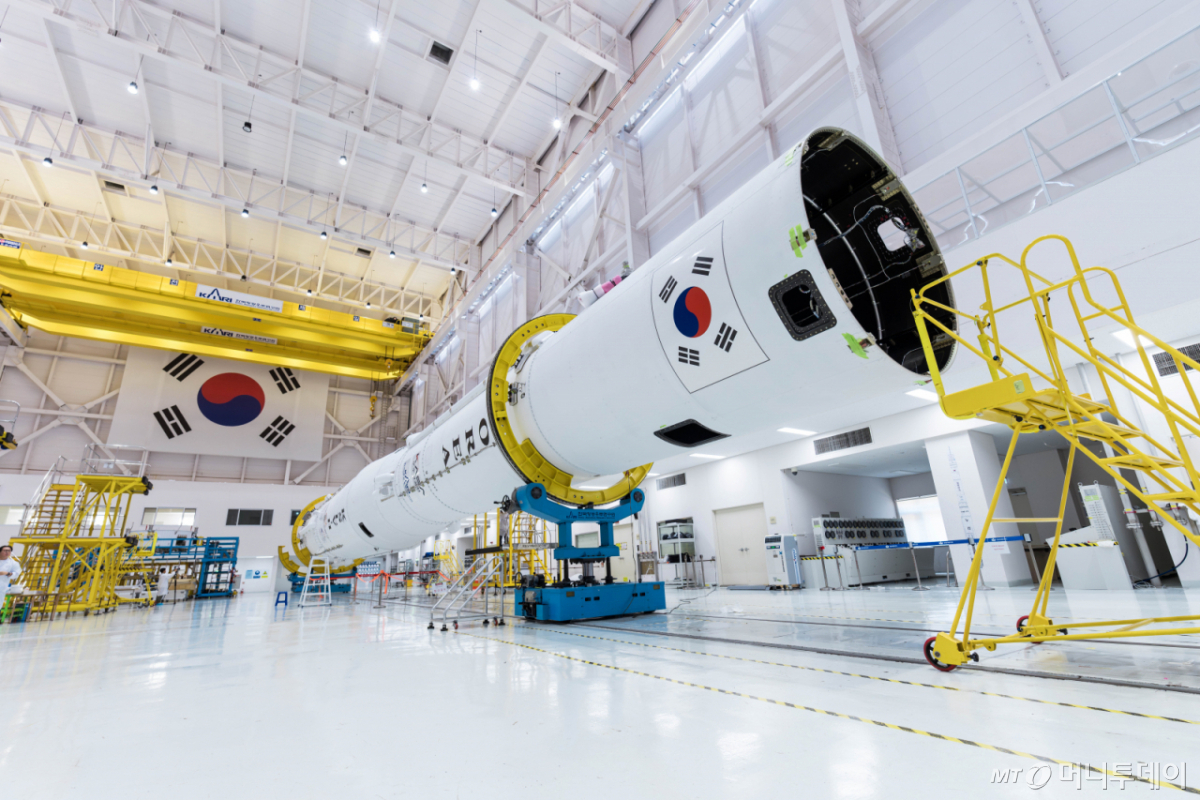
The expected launch scenario for 'Nuri', Korea's domestic launch vehicle, scheduled to launch next month on the 7th, has been revealed.
According to the Space Administration and the Korea Aerospace Research Institute (KARI) on the 15th, the fifth Nuri-rocket launch will take place at Naro Space Center in Goheung, South Jeolla Province, between 12:23 p.m. and 1:23 p.m. on October 7. The exact launch time will be confirmed considering weather conditions and other factors on the day of launch.
After liftoff from Naro Space Center, Nuri-rocket No. 5 will fly south along a launch azimuth of 170° to ensure safe flight during the first and second stage thrust phases.
Approximately 2 minutes and 3 seconds after launch, the rocket's first stage will be jettisoned; at 3 minutes and 53 seconds, fairing separation will occur; and about 4 minutes and 28 seconds later, an attempt will be made to separate the second stage. The predicted splashdown points for the first stage, fairing, and second stage are estimated to be approximately 396 km, 1,587 km, and 2,667 km from the launch site, respectively, in international waters.
Upon reaching an altitude of about 575 km, the first satellite ejection will begin. The first satellite to be deployed into orbit is the primary payload, Mini Satellite Constellation No. 2. The expected ejection time is approximately 13 minutes and 30 seconds after launch. There are five mini constellation satellites in total, which are scheduled to separate one by one at intervals of 35 to 40 seconds. Accordingly, the completion of all five mini constellation satellite ejections will occur about 16 minutes after launch. To prevent collisions between satellites during separation, a 'separation sequence' that controls the attitude of the rocket's upper stage will be applied.
Following this, the deployment of secondary payloads will also begin. Nuri-rocket No. 5 carries 10 CubeSats developed by domestic industry-academia-research institutions. The CubeSats will be deployed two at a time with 10-second intervals. Once all CubeSats are separated, collision avoidance maneuvers will be performed to prevent collisions between the rocket's upper stage and the satellites.
After successfully completing satellite ejection, the 'autopilot' system will be terminated. This occurs approximately 19 minutes and 45 seconds after launch. Terminating the autopilot means that the rocket's third stage will cease all maneuver controls according to the pre-planned flight sequence. After this point, the third stage will drift through space.
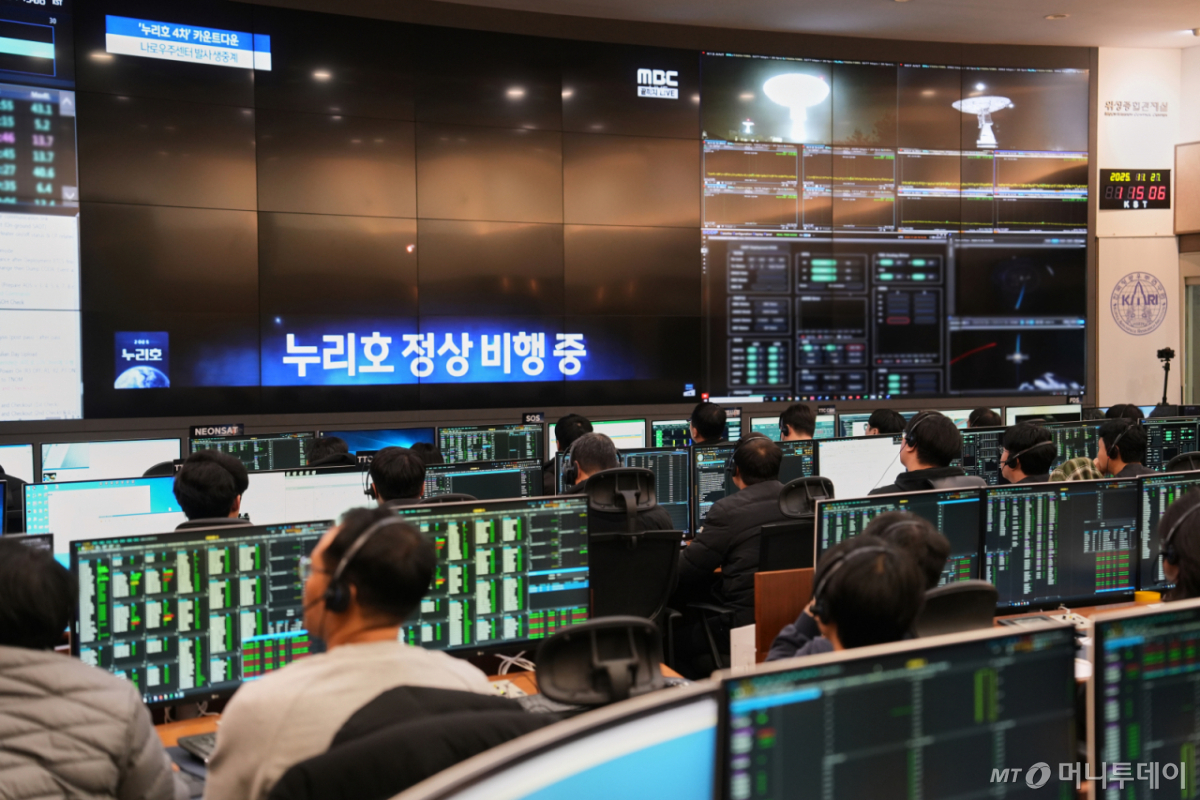
Starting from the fifth launch, the scope and authority of Hanwha Aerospace, the system integration company for Nuri, will expand.
For this launch, approximately 40 personnel from Hanwha Aerospace will participate, an increase of about 10 compared to the fourth launch. Of the 22nd consoles in the Launch Control Center (LCC), 20 consoles will be operated by 23 Hanwha Aerospace employees, among whom 18 will directly operate the consoles. Operating a console means becoming the 'decision-making entity' that issues direct control commands throughout the entire process from launch preparation to ignition.
During the fourth launch, console operations were handled by KARI. Starting with the fifth launch, KARI will step back and assume a management and oversight role.
Park Jong-chan, head of the Korea Aerospace Research Institute's Domestic Launch Vehicle Altitude Improvement Project Team leading the fifth Nuri-rocket launch, stated, "Hanwha Aerospace is gradually building up its launch capabilities," and explained, "Starting from the fifth launch, Hanwha Aerospace will participate as the primary operator, covering more than 75% of the permitted scope."

 in TECH

