

"What happens if researchers recommended by both the Discovery Committee and institutional investors overlap?"
"What criteria should be used to evaluate academic excellence?"
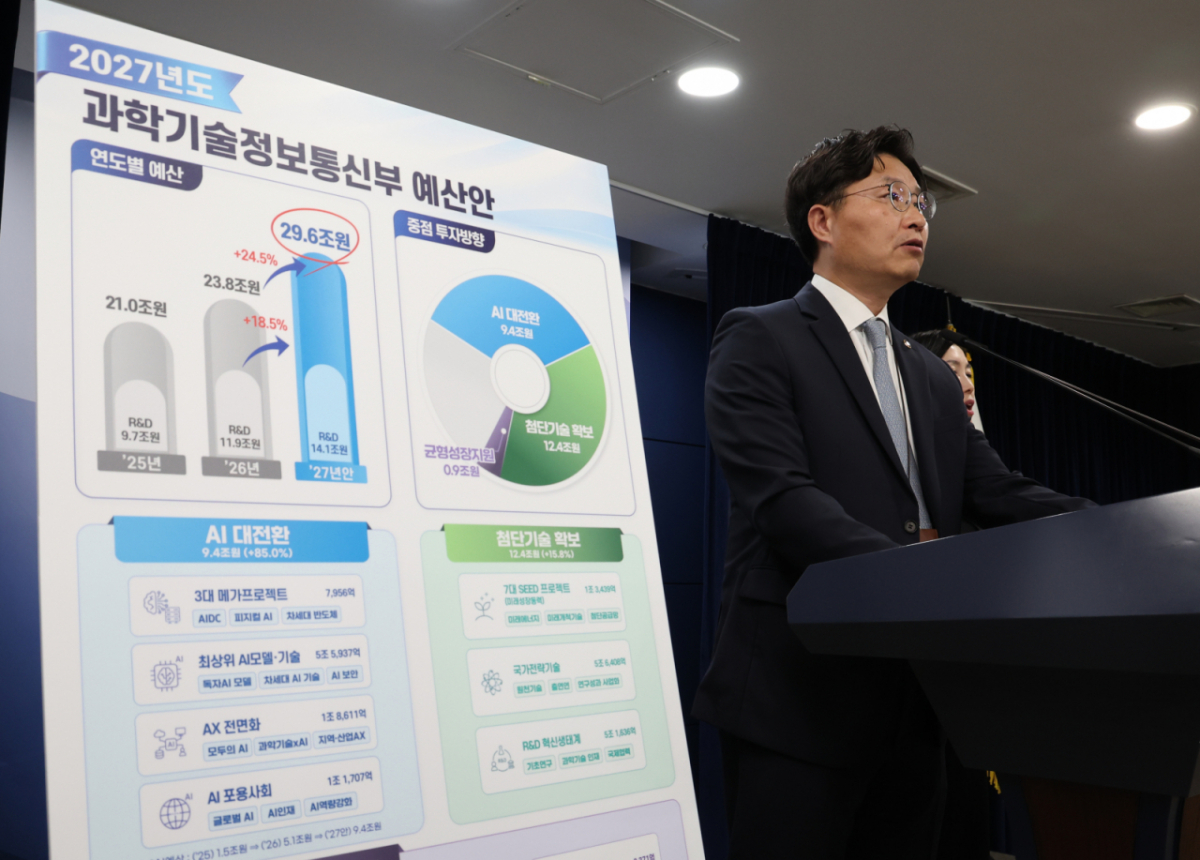
Ahead of the first-ever selection of "National Science and Technology Researchers" at the end of this year, attendees at the "2026 Leader-Level National Science and Technology Researcher Program Briefing" held in Myeong-dong, Seoul, on the 16th raised these questions.
The Ministry of Science and ICT will select 20 "Leader-Level National Science and Technology Researchers" by December. This system honors outstanding scientists and engineers as national core assets. Eligible candidates must hold South Korean citizenship, be under 55 years old, and conduct research or technology innovation activities within the country across academia, industry, and government institutions.
The first step involves recommendations from affiliated institutional investors. Universities, government-funded research institutions, and companies may recommend up to three researchers who have achieved remarkable results in fields classified under the "16th National Science and Technology Standard Classification System" by early October. Recommended candidates must submit representative achievements, including their resumes, papers, and patents, by October 12. Final selection will be made after review by a committee of experts.
Separately from institutional investor recommendations, the Ministry of Science and ICT recently established a "Discovery Committee." The committee plans to identify and recommend a small number of individuals based on academic data. According to the Korea Research Foundation, the Discovery Committee is focusing on three out of the 16th science and technology fields defined by the National Science and Technology Standard Classification System. These 16 fields include: Mathematics, Physics, Chemistry, Earth Sciences, Life Sciences, Agriculture/Forestry/Fisheries/Food, Health/Medicine, Mechanical Engineering, Materials, Chemical Engineering, Electrical/Electronics, Information/Communication, Energy/Resources, Nuclear Power, Environment, and Construction/Transportation. However, the ministry has not disclosed which three fields are being prioritized.
Academia emphasizes "academic excellence," while industry focuses on "industrial impact"… Evaluation criteria differ
At the event, some participants expressed concern that the three priority fields should be communicated to institutional investors in advance. With both internal selection processes within institutional investors and the Discovery Committee's activities occurring simultaneously, there are worries about potential overlaps in candidates. A representative from one institutional investor stated, "Since each institution can nominate up to three candidates, they may be trying to secure additional reserve candidates."
A Ministry of Science and ICT official responded, "While it is true that the Discovery Committee focuses on three specific fields, we cannot predict which fields will ultimately produce selected candidates. Moreover, the number of researchers selected by the Discovery Committee is expected to be no more than 10." The official added, "If a candidate receives overlapping recommendations, their chances of selection may actually increase, so there is no need for institutional investors to factor in the Discovery Committee's activities during their own selection process."
The official also noted that evaluation criteria differ between candidates from academia and industry. Researchers affiliated with universities will be primarily evaluated based on "academic excellence," while those from government-funded research institutions or industry will be assessed mainly on "technological innovation" and "contributions to industry and the economy."
Participants at the event also called for clearer explanations to ensure fairness and credibility in judging "academic excellence" and "industrial impact." A Ministry of Science and ICT official replied, "We will comprehensively consider five key areas: research achievements, global industrial impact, public welfare contributions, and future growth potential. However, detailed indicators will be applied flexibly according to the characteristics of academia, industry, and government collaboration."
Additionally, officials emphasized caution regarding any "moral flaws" in candidates. A Ministry official stated, "Even minor ethical or moral shortcomings should disqualify a candidate from recommendation. Since these researchers are honored as national assets, any future ethical or moral issues could lead to the revocation of their designation."

 in TECH

