

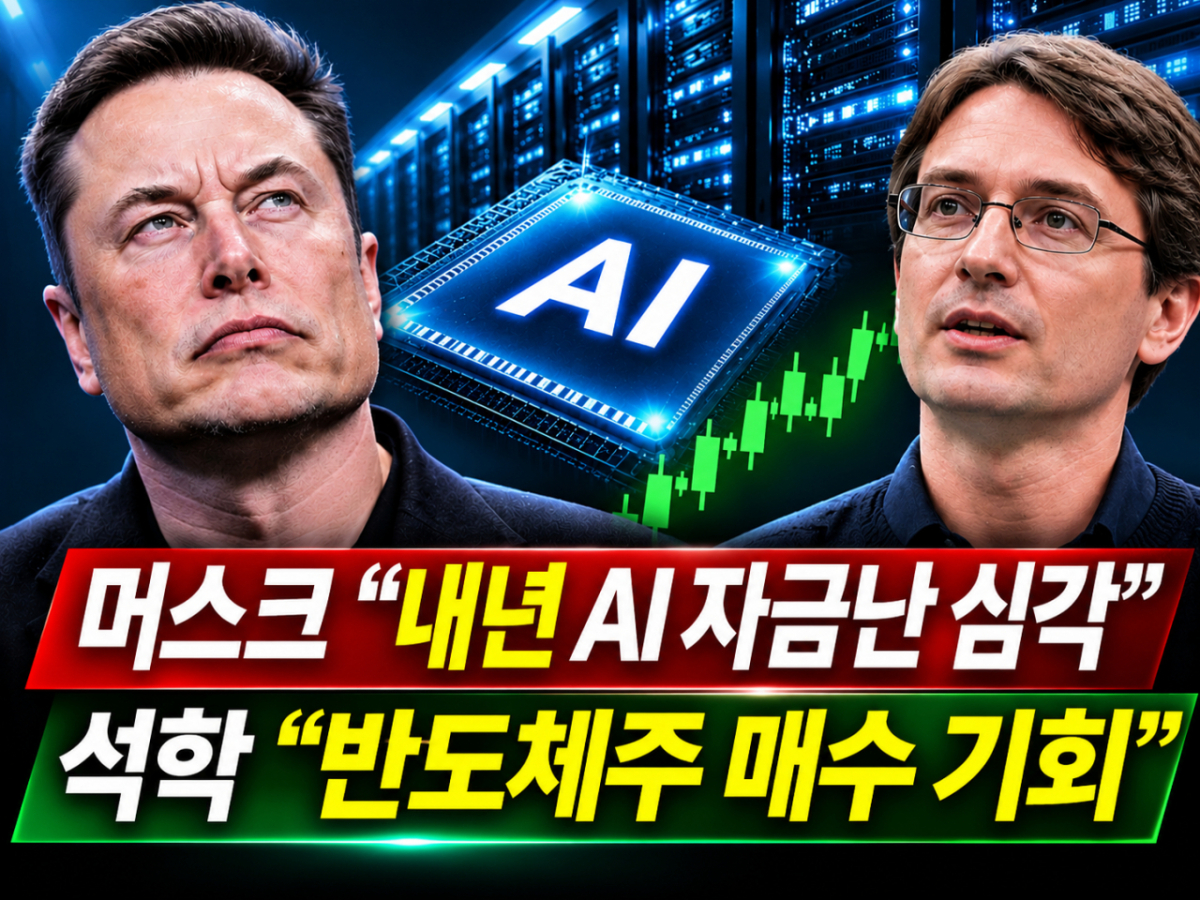
Elon Musk, CEO of Tesla and SpaceX, warned that the AI industry could face a severe funding crunch next year. He stated that even after investing massive amounts of capital in building AI data centers, if actual revenue generation is delayed, an additional several hundred billion dollars may be required.
According to industry sources on the 23rd, Musk expressed this view by replying to a post by world-renowned AI researcher Francois Chollet, who had evaluated semiconductor stocks as a rare buying opportunity, on the social media platform X the previous day.
Musk stated, “Operating, cooling, and keeping computing resources of this scale running stably is unbelievably difficult,” adding, “The cash shortage problem will become enormously serious next year.”
He continued, “Even if there are only a few months of cumulative delays across the entire industry in getting stable operations that generate revenue after paying for computing resources, an additional several hundred billion dollars in working capital will be needed,” asking, “Where will that money come from?”
Previously, the semiconductor stock investment analysis account 'Trade Whisperer' shared data showing that the forward price-to-earnings ratios (PER) of SanDisk, SK hynix, and Micron were 2.18x, 2.55x, and 2.82x, respectively. These levels are significantly lower than those of NVIDIA (7.56x), Qualcomm (12.41x), and TSMC (13.81x).
In response, Chollet, the founder of the deep learning framework 'Keras,' argued, “You must either believe that AI infrastructure construction is complete, that AI was just a fleeting fad, and that computing demand has peaked, or view this as a rare buying opportunity.”
Musk’s warning is closely linked to the funding risks faced by neocloud companies that lend AI computing resources. Companies like CoreWeave and Nebius secure large-scale GPUs (graphics processing units) to build data centers and then provide computing services to customers. However, even after purchasing GPUs, they must complete power, cooling facilities, and network construction before they can generate actual revenue. If operations are delayed, revenue generation is postponed while the burden of debt interest and operating costs continues.
Recently, concerns about funding in the AI infrastructure industry have grown further following the resignation of NVIDIA’s former CEO Jensen Huang. NVIDIA has supported the expansion of AI infrastructure by providing investment and financial support to neocloud companies. However, since Huang’s departure, the new management has announced a policy to review investments and guarantees more strictly, raising the possibility that financial support may be reduced.
Unlike big tech companies such as Microsoft and Google, neocloud companies have a relatively high dependence on external funding. Even if AI demand surges, delays in data center operations could increase the financial burden. This means that while expanded AI investment is an opportunity for semiconductor companies, it could lead to a liquidity crisis for infrastructure construction firms.

 in TECH
