

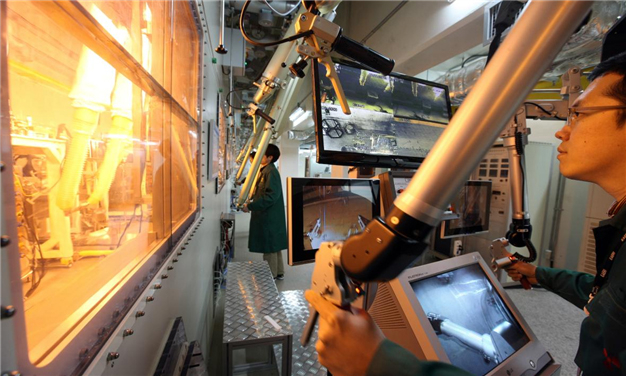
As final negotiations on investment in the US are underway, the US has proposed that South Korea invest in a spent nuclear fuel business, bringing 'pyroprocessing' technology back into focus.
Nuclear fuel is not a substance that completely burns away and disappears after being used in reactor power generation. It simply reaches a state where a chain reaction can no longer be stably maintained; about 90% of key nuclides such as uranium and plutonium remain. Such fuel assemblies are called 'spent nuclear fuel.'
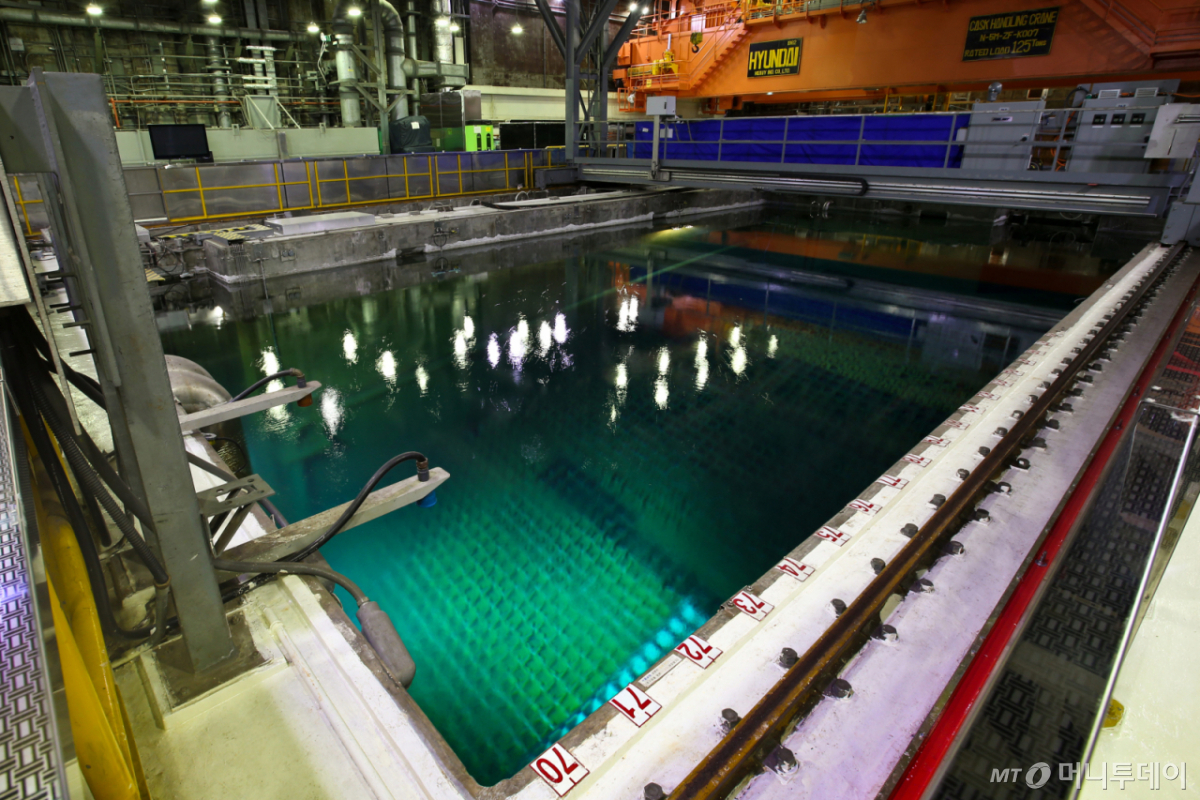
Because the nuclides remain active, spent nuclear fuel emits lethal radiation. This is why spent nuclear fuel removed from reactors must be submerged in deep water pools for at least five years. During this period, decay heat is dissipated and radiation is shielded.
Once the spent nuclear fuel has cooled sufficiently, it is removed from water, placed in sealed containers, and transferred to dry storage facilities. This is a common method of storing spent nuclear fuel.
On the other hand, uranium and plutonium remaining in spent nuclear fuel can also be viewed as 'potential resources.' This refers to 'spent nuclear fuel reprocessing technology,' which extracts only the needed resources from nuclear fuel, reprocesses them, and puts them back into use.
Pyroprocessing is a representative example. It involves placing spent nuclear fuel in high-temperature molten salt (molten salt) at 500–600°C or higher and controlling voltage to adsorb only desired substances.
In Korea, KAERI has led pyroprocessing research for about 30 years since 1997. According to KAERI, this approach links pyroprocessing with sodium-cooled fast reactors (SFR), aiming to reduce the volume and toxicity of spent nuclear fuel generated at domestic nuclear power plants by 2083.
Given that close cooperation has been maintained with the US during this period, it is also connected to the current discussions on investment in the US. Under the Korea-US Nuclear Cooperation Agreement and the US-led non-proliferation policy, reprocessing technologies that directly utilize spent nuclear fuel are heavily restricted in South Korea.
However, after signing a research agreement on pyroprocessing with the US in 2011, the two countries carried out the 'Korea-US Joint Fuel Cycle Research' (JFCS) for 10 years, accumulating practical data. It is understood that simulated nuclear fuel tests were conducted at KAERI's 'PRIDE' facility, while actual spent nuclear fuel experiments were carried out in the US.
The result of this effort was the 'JFCS 10-Year Report' released in 2021. It confirmed that the pyro-SFR linked system has potential as a spent nuclear fuel management technology with technical feasibility, safety, and non-proliferation capabilities. However, there are still limitations in building policies related to spent nuclear fuel reprocessing technology based on this. This is because US approval is required under the nuclear cooperation agreement.
However, following the Ministry of Science and ICT's recent announcement at the scienceGi Sul-gwan-gye (Minister)meeting that it will pursue nuclear fuel supply through pyroprocessing in preparation for uncertainties in high-purity uranium supply, cooperation with the US has become increasingly important.
Meanwhile, it is reported that during the current investment negotiations with the US, the US proposed that South Korea invest in a local pyroprocessing project to process thousands of tons (t) of spent nuclear fuel within the United States.

 in TECH

