

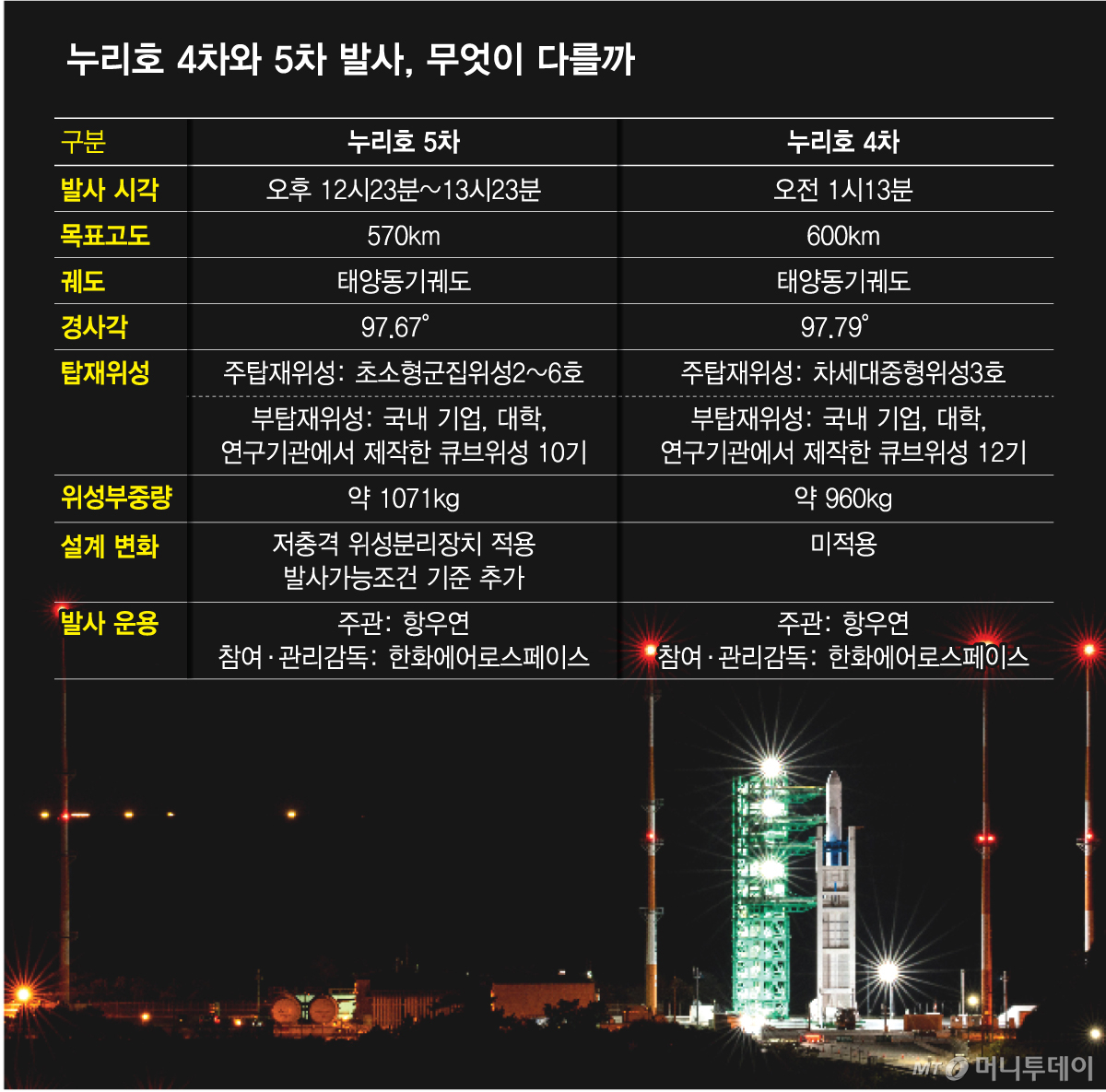
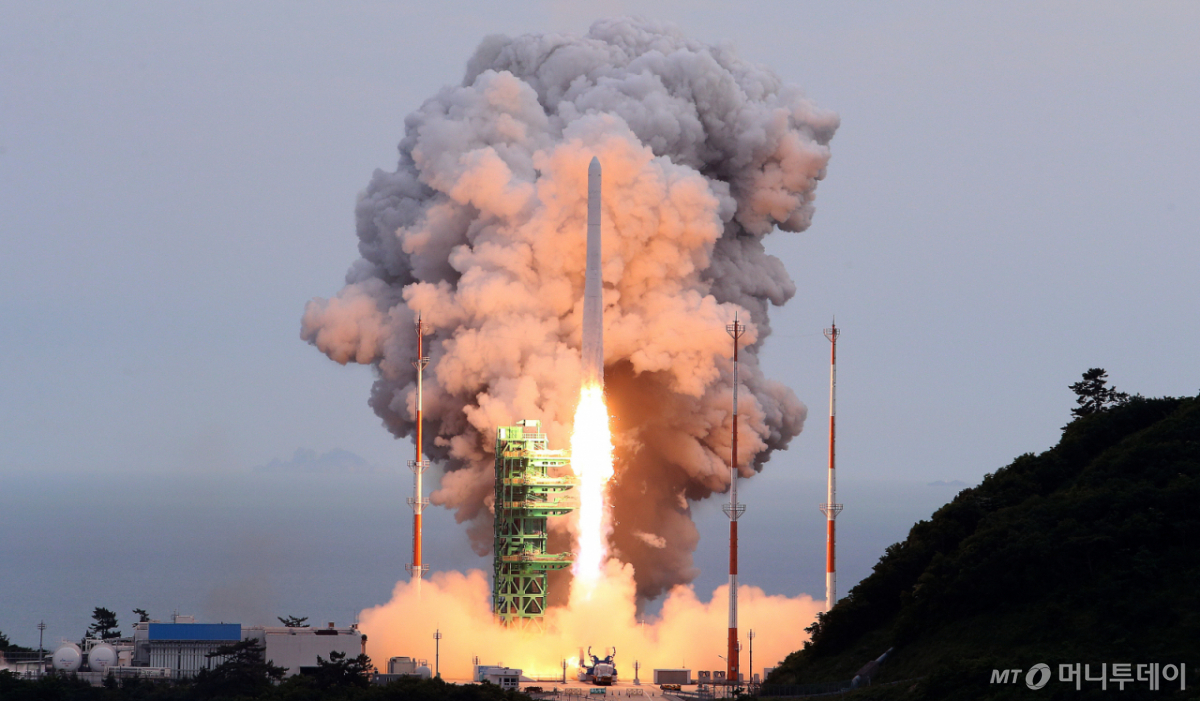
The scheduled fifth launch of the Nuri rocket next month on October 7 is expected to be visible in broad daylight. Its weight has increased by approximately 100 kilograms compared to the fourth launch, and its design has become more precise.
The fifth launch of the 'Korean-type launch vehicle' Nuri will take place at Launch Pad 2 of the Naro Space Center in Goheung, South Jeolla Province, between 12:23 p.m. and 1:23 p.m. on October 7. While the exact launch time will be confirmed on the day of launch, with the scheduled window narrowed to afternoon hours, observers are expected to witness the rocket ascending in bright daylight during this mission. In contrast, the fourth launch conducted on November 27 occurred at 1:13 a.m., after midnight.
The target altitude is a sun-synchronous orbit at 570 kilometers above Earth. This altitude was set considering the deployment points for the primary payload—two to six microsatellite cluster satellites—and ten cube satellites serving as secondary payloads. During the fourth launch, the target was a sun-synchronous orbit at an altitude of 600 kilometers.
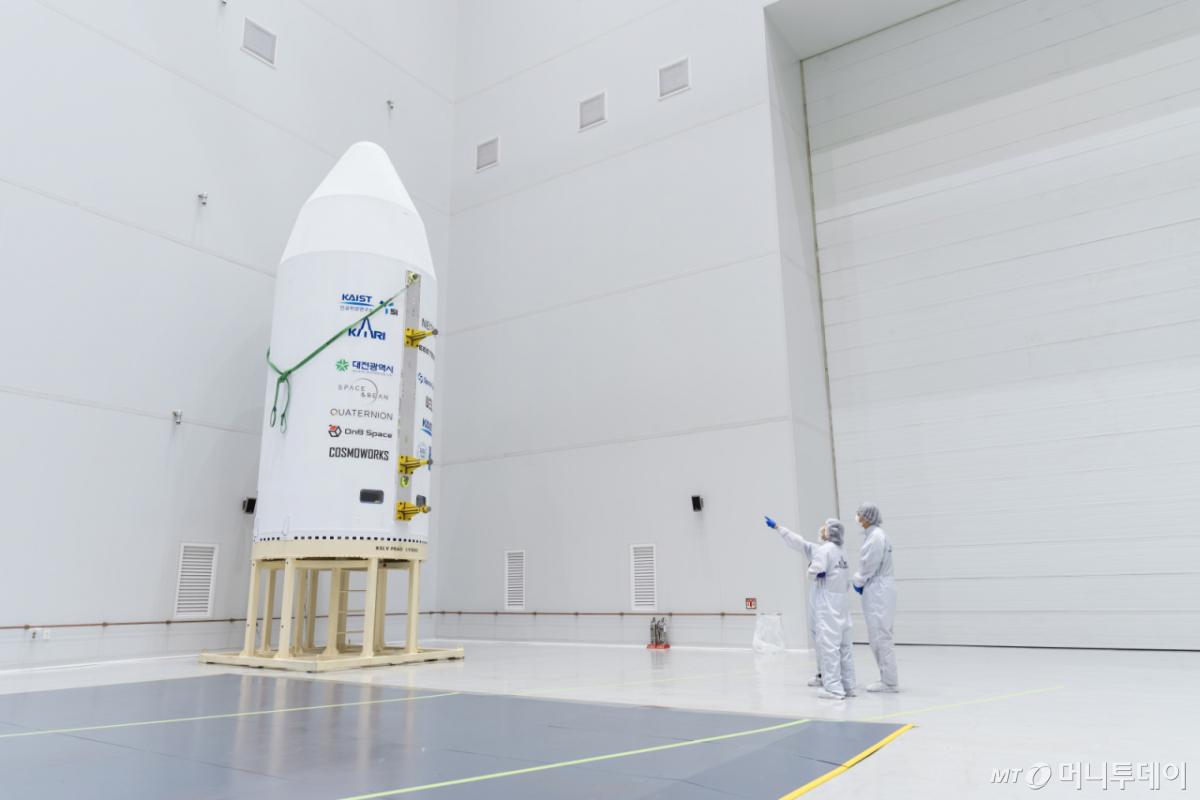
The weight of the satellite section has increased by approximately 111 kilograms compared to the fourth launch. Although two additional secondary payloads were included in this mission, the most significant increase came from the satellite deployment system and adapter weights, which rose by about 100 kilograms relative to the fourth launch. This change occurred because the payload section design was modified starting with the fifth launch.
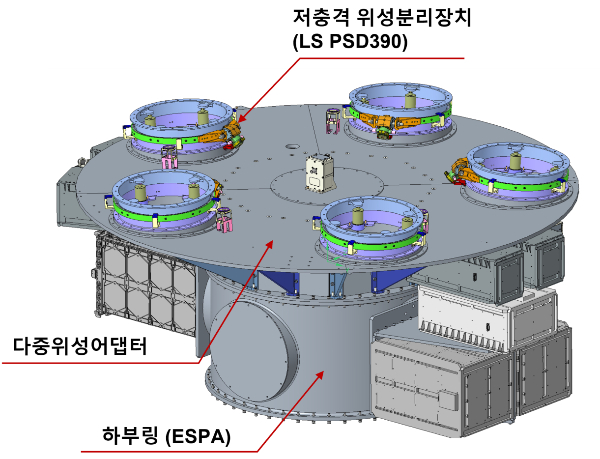
The Nuri rocket's fifth-stage payload section now incorporates a 'lower ring' (ESPA: Evolved Secondary Payload Adapter). The lower ring is a cylindrical ring structure that serves as an adapter capable of mounting and separating multiple cube satellites. Park Jong-chan, head of KARI's Korean-type Launch Vehicle Altitude Enhancement Project Team, explained, "With the addition of the lower ring, the overall weight of the Nuri rocket's fifth-stage payload section has increased, while other components such as the satellite weights themselves remain unchanged from previous versions."
Additionally, the Nuri rocket's fifth launch will feature a newly introduced 'low-shock satellite separation device.' This mechanism reduces the impact force applied when satellites separate from the launch vehicle. It wraps around the satellite like a belt and rapidly rotates at the moment of deployment to gently release the satellite.
The available launch window has also been narrowed compared to previous missions. Launch times are determined considering weather conditions and the risk of collision with space objects, including factors such as avoidance distance and time gaps relative to nearby crewed spacecraft. Starting from the fifth launch, additional conditions were added to the existing requirement of maintaining a minimum proximity distance of 200 kilometers: △a proximity distance of at least 200 kilometers in the direction of travel and at least 50 kilometers perpendicular to that direction; △a collision probability threshold of ≤ 0.0001%. As a result, previously broad time periods deemed 'unlaunchable' have been reduced, effectively increasing the actual duration during which launches can be attempted.
Hanwha Aerospace, the system integrator for the Nuri rocket, will assume an expanded scope of participation and authority in the fifth launch. Approximately 40 personnel from Hanwha Aerospace are expected to participate in the fifth launch, an increase of about 10 compared to the fourth launch. Of the 22nd consoles at the Launch Control Center (LCC), 23 employees from Hanwha Aerospace will be involved across 20 consoles, with 18 of them directly operating the consoles. This signifies that they will become the 'decision-making entities' issuing direct control commands throughout the entire process from launch preparation to ignition.
During the fourth launch, KARI led all console operations. Starting with the fifth launch, KARI will step back slightly to assume a management and oversight role. Park, the team head, stated, "In the fifth launch, Hanwha Aerospace's participation ratio in operations will exceed 75% within the allowable range."

 in TECH


