

[For more diverse corporate information on the startups mentioned in this article, visit the Unicorn Factory Big Data Platform 'Data Lab.]
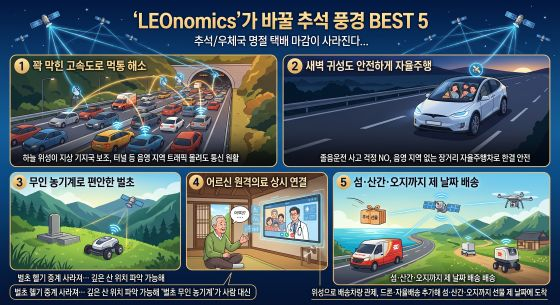
#One day before Chuseok, office worker A from Seoul orders a Hanwoo gift set to send to their hometown. In the past, parcel acceptance would have already closed, and delivery might only arrive after the holiday ended. However, in a few years, this scene could change. As logistics centers in mountainous and island regions, local delivery vehicles, advanced drones, and delivery robots connect in real time via low Earth orbit satellite networks, AI (artificial intelligence) will analyze order volume, vehicle locations, road congestion, and weather conditions to identify the fastest and most efficient delivery routes. If ship operations are delayed or mountain roads are blocked, routes can be adjusted in real time, and drones or autonomous delivery robots can be deployed as needed. Especially in island and mountainous areas with insufficient communication infrastructure, if logistics data flows seamlessly via satellite networks, the current uniform holiday parcel deadlines like 'must send by [XX region] by [date]' may gradually change. It could become possible for Hanwoo ordered from Seoul on Chuseok morning to appear on the family dinner table that same afternoon.
#A father heading deep into the mountains to clear graves thought he knew the path well but suddenly lost his way. Although the battery in his phone remains charged, ground base station signals are unavailable. Yet, a 'Satellite Connected' indicator appears on the screen. The smartphone connects directly to low Earth orbit satellites and transmits its current location along with a simple distress signal to family or rescue institutions. Low Earth orbit networks have short distances to satellites, enabling data exchange with relatively low latency, making them ideal for emergency texts and location transmission. Thanks to this, situations where rescue requests are delayed due to 'communication blackouts' during repeated mountain accidents every Chuseok could decrease.
Thus, 'LEOnomics' (LEOnomics·Low Earth Orbit Economy), which connects the entire globe by placing satellites in the sky, is becoming a reality. By densely deploying satellites at altitudes of approximately 300–1,500 km in low Earth orbit (LEO), areas unreachable by existing ground communication networks—such as oceans, mountains, and deserts—can be connected. Holidays like Chuseok, when large numbers of people travel and gifts are exchanged between families, serve as the most visible stage for these changes in daily life.
During holidays, highway congestion and communication quality issues often coincide. Signals weaken on mountain roads and outskirts, and data speeds slow when people crowd specific areas. The technology that emerges in such cases is 'Direct to Cell.' This method allows ordinary smartphones to communicate directly with satellites without requiring a separate satellite antenna.
Satellites act like mobile base stations floating in the sky, filling gaps in ground networks. Rather than completely replacing ground base stations with full satellite communication, this creates a 'HYBE-led communication network' that combines ground and satellite networks. For autonomous vehicles, even in communication blackout zones, vehicle location and road information can be exchanged, enhancing stability for control centers and emergency communications.
Not everyone can gather at their hometown during Chuseok. For crew members on deep-sea fishing vessels, overseas workers, and those stationed in remote mountainous or isolated areas, holidays are often days of regret for being unable to spend time with family.
Low Earth orbit satellite communication connects terminals with rapidly moving satellites instead of optical cables, enabling internet access not only on land but also in distant seas. It can be used for voice calls, video calls, vessel control, and real-time data transmission.
In future Chuseoks, crew members on deep-sea fishing vessels may view ancestral rites dishes via satellite terminals onboard their ships and engage in real-time conversations with family. Operational data such as vessel location, weather conditions, and engine status can also be transmitted in real time to land-based control centers via satellite networks.
In rural or island areas where ground networks are weak, IoT data can be relayed by satellite networks acting as backhaul (the segment connecting base stations to the internet network). Satellite communication is evolving into a 'sky communication network' that connects not only people but also people and things.
During Chuseok holidays, more people move at once than usual. Many travel to their hometowns via mountain roads or visit remote areas for grave visits. The problem arises when autumn weather deteriorates due to typhoons or heavy rains. Roads may be cut off, power outages may occur, and communication facilities could be damaged by wildfires or landslides.
One reason satellite communication is gaining attention is precisely in such situations. Even if ground base stations are flooded or power supply is interrupted, satellites in the sky can operate independently of ground disaster conditions. In areas where communications are cut off, distress signals and location information can be sent via satellite networks, enabling rescue institutions to secure communication links with the field.
Satellite imagery makes holiday safety nets even more robust. If accidents or landslides occur on highways, national roads, or mountainous areas during Chuseok holidays, damage zones can be quickly identified via satellite-captured images, allowing roads to be blocked and rescue personnel to be deployed. As cluster satellite systems capable of repeatedly imaging the same area with multiple satellites are established, the time required to confirm disaster situations will shorten.
In fact, the upcoming 5th Nuri rocket launch scheduled for October 7 will carry a total of 15 satellites, including five mini-cluster satellites and ten CubeSats. Mini-cluster satellites operate as a system where multiple satellites share the same mission to repeatedly observe the Korean Peninsula. They can be utilized not only for disaster monitoring but also for monitoring various land changes such as wildfires, landslides, and floods.
Satellites are no longer expensive equipment floating in space but have become 'lifestyle infrastructure.' In fact, the low Earth orbit satellite market is growing rapidly. Market research firm MarketsandMarkets forecasts that the global low Earth orbit satellite market will grow from $12.6 billion (approximately 17 trillion won) in 2024 to $23.2 billion (32 trillion won) by 2029.
The market is not limited to satellite manufacturing alone. New industries are emerging sequentially, including △inter-satellite laser communication △onboard AI and computing △space-grade semiconductors △electric propulsion systems △anti-jamming communications △quantum cryptography △space traffic management (STM) for managing satellite collisions.
The key lies not in creating 'one good satellite' but in how quickly and affordably the entire space system can be built and operated. This is the approach demonstrated by SpaceX through Starlink: mass-producing satellites, frequently launching them with reusable rockets, and operating them as clusters in orbit to achieve economies of scale.
South Korea has also entered this competition. Cluster satellite development is set to accelerate alongside next month's 5th Nuri rocket launch, and the Space Administration is working to secure next-generation space communication technologies such as low Earth orbit communication satellites. Private companies like Hanwha Aerospace are expanding their participation in launch vehicle projects.
An industry executive stated, "Ultimately, competitiveness in the LEOnomics era depends not only on satellite manufacturing technology but also on how quickly we can build, launch, connect, and transform data into services."
An event to overview this LEOnomics landscape will be held next month. MoneyToday startup media platform 'Unicorn Factory' will host the '2nd K-Space Forum' on the 28th at COEX Hall B in Gangnam-gu, Seoul. This year's forum, themed 'Low Earth Orbit (LEO) Industrial Revolution: Transformation of the Space Ecosystem,' will diagnose paradigm shifts where LEO satellite competition triggered by Starlink is expanding beyond simple communication into earth observation, space manufacturing, and national security domains.
The event consists of five sessions. The first session (keynote) will analyze global LEO market monetization models under the theme 'LEO 2.0: Shifting the Space Industry Landscape.'
In Session 2, 'K-LEO: A Winning Move for Korea's Satellite Communication Network,' the Space Administration will unveil the roadmap for the 'K-LEO' project to build a low Earth orbit satellite communication network that serves as both a core 6G infrastructure and an independent national security asset.
In Session 3, 'LEO Becomes an Industry,' Hanwha Group will present its vision for a low Earth orbit value chain. It will introduce synergies between Hanwha Aerospace, responsible for launch vehicles, and Hanwha Systems, handling satellite systems and communications, while discussing how the LEO ecosystem centered on large corporations can provide sequential growth opportunities for domestic materials, components, and equipment (so-bujang) startups and SMEs (small and medium-sized enterprises).
Session 4 panel discussion 'LEOnomics: The Real Space Economy That Makes Money' will be chaired by Ahn Hyung-jun of the Korea Institute of Science and Technology Policy Evaluation (STEPI) Woo Ju-gong-gong (Team Lead). Panelists include Park Jeong-ho from the Korea Aerospace Research Institute, Lee Kang-soo, CEO of Company K, Park Jae-pil, CEO of Naraspace, and Im Dong-ju, Head of Boryeong Office, to explore survival conditions and opportunities for K-space in technology, venture investment, and global expansion.
The final Session 5 'LEO NEXT' will feature pitching stages for deep-tech startups with unique technologies such as mini-satellite components, satellite data AI analysis, and on-orbit services. Representatives including Gimhae-dong Walker Space CEO and Choi Young-wan of CSO will meet directly with investors and industry stakeholders.
[MoneyToday startup media platform Unicorn Factory]

 in TECH
