

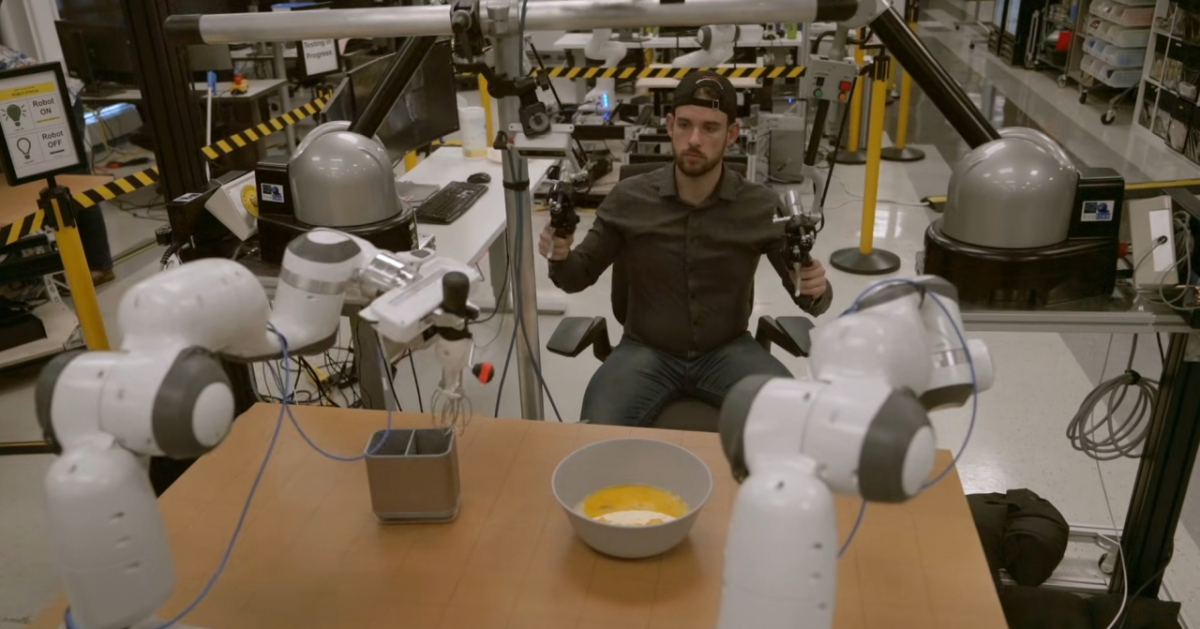
#. Tesla has equipped employees with motion-capture suits and virtual reality headsets to secure data for its 'Optimus' robot. All movement data from the employees were recorded to enable the robot to replicate those motions. Starting in the second half of last year, however, the company changed its approach. Cameras were installed throughout employee work sites to capture videos of workers instructing robots on tasks such as picking up objects or folding T-shirts, allowing the robots to learn more efficiently.
#. A global race is underway to accumulate data for profitable AI—Physical AI. Physical AI refers to artificial intelligence technology that enables robots to understand their surroundings, assess situations, and execute subsequent actions. For example, it involves training robots via data to grip objects with appropriate force—neither so tightly that they break them nor so loosely that they drop them.
#. First, the methods for acquiring Physical AI data are evolving. Initially, data was collected by attaching body cameras to humans and applying the results to robots through trial and error. Recently, however, digital twin and simulation technologies are being used to overcome real-world limitations and safety risks.
#. The most intuitive collection method involves humans wearing body cameras to record their movements while operating robots to gather task data. The latter approach, known as teleoperation (Teleoperation), occurs when a human controls a robot; the robot then observes, grasps, and moves objects in real environments, accumulating data such as video footage, joint movements, positions, and postures.
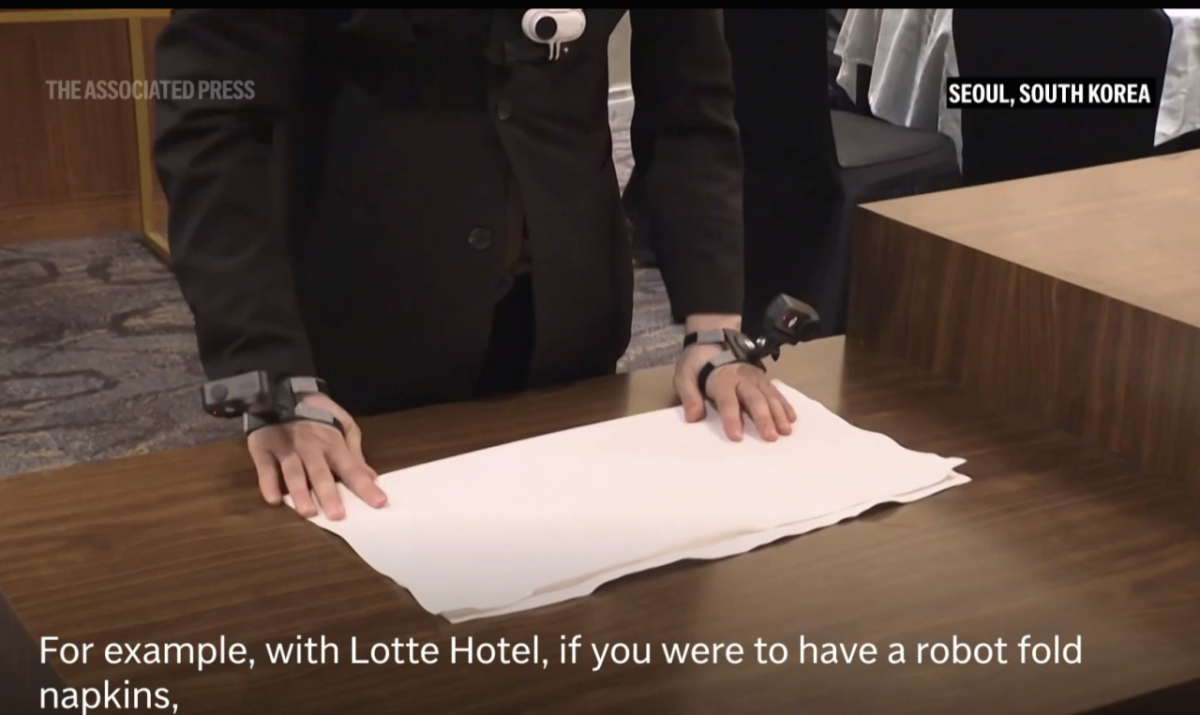
#. Robots can also learn through their own trial and error. By applying reinforcement learning, robots attempt various actions and learn improved behavioral strategies based on rewards received from the outcomes.
#. However, having robots physically move repeatedly to acquire data or undergo trial-and-error processes faces constraints in terms of time, cost, and safety. Therefore, digital twin and simulation technologies are increasingly employed to recreate work environments such as factories and logistics warehouses within virtual spaces.
#. This approach combines human action videos publicly available on platforms like YouTube with actual robot behavior data and simulation data. Robots' learning experiences can be created in virtual environments, or human movements can be converted into data suitable for robot training. In South Korea, NC AI has been selected as a key performer of Physical AI projects to generate such data.
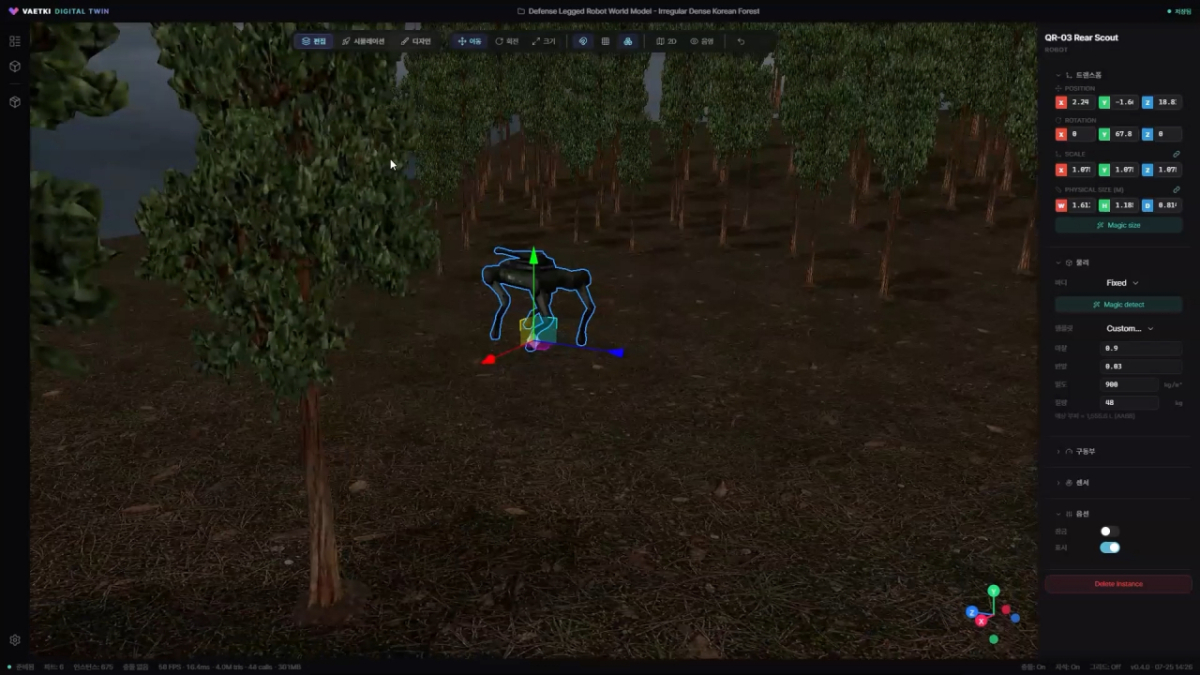
#. In the defense sector, NC AI is collaborating with Hyundai Rotem to develop an integrated Physical AI simulator capable of creating and validating various scenarios for unmanned equipment and robot operations in virtual environments.
#. As part of a national humanoid project involving LG Electronics and others, the company is developing technologies that leverage human movements for robot training. Building on NC AI's accumulated motion data and animation production expertise, it is establishing initial learning datasets for model-based GMT (General Motion Tracking) and constructing a 'human-robot retargeting' pipeline to convert human motions into movements suitable for humanoid robots. Since humans and humanoids differ in joint structures and body proportions, the system transforms human actions into executable robot motions.
#. Meanwhile, while South Korea aims to join the global top three in AI overall, it aspires to lead the world in Physical AI by leveraging its strengths in manufacturing.

 in TECH


