


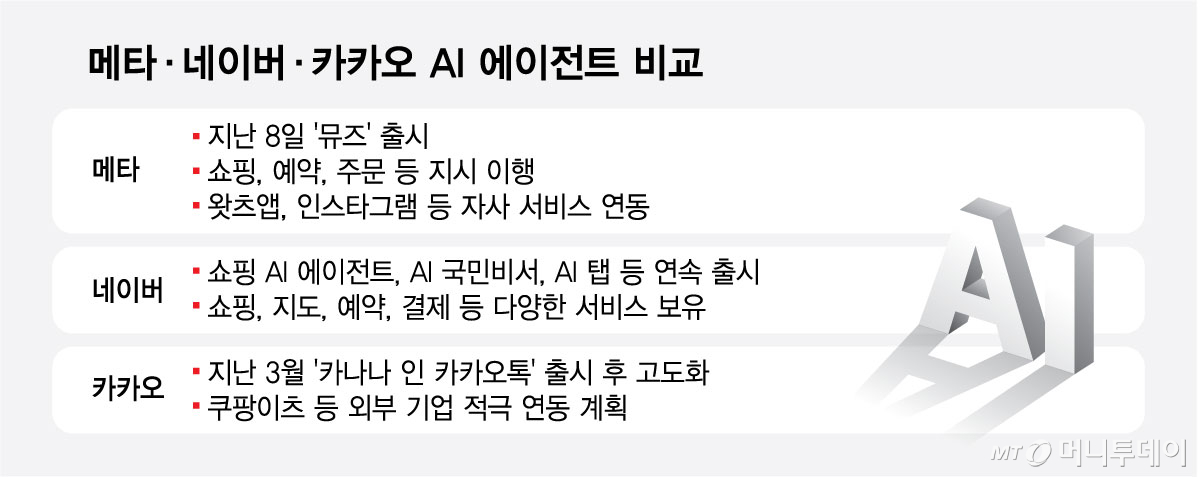
Meta’s AI agent, “Muse,” is enjoying phenomenal popularity. With a single command, it can plan trips and book accommodations. It also finds necessary items and handles ordering and payment. Korea’s leading IT companies, Naver (NAVER) and Kakao, have been given the special directive to “defend their home turf.”
Muse’s strength lies in its “mass appeal.” While AI agents previously released by OpenAI and Anthropic functioned as subordinate employees executing instructed tasks such as program development, document creation, and research, Muse acts as a personal assistant that handles everyday chores like shopping and reservations. It can also reflect users’ preferences and characteristics through integration with Meta’s own services, such as WhatsApp and Instagram.
The industry has expressed concern that if Muse rapidly encroaches on the Korean market, domestic companies will find their room to operate shrinking. The app market, which is split between Google Play and the Apple App Store, serves as an example. While the domestic messenger and portal markets have been guarded by local giants Kakao and Naver, respectively, there has been no competitive domestic service in the app market. As a result, Korean companies have paid up to 30% of their revenue as fees to Google and Apple for over a decade.
In particular, platforms face the risk of losing their point of contact with consumers as AI agents become more advanced. Platforms operate by connecting consumers and suppliers and collecting fees, but there are voices suggesting that AI agents will usurp this role by directly executing consumer instructions. The sharp drop in stock prices of financial firms and travel platforms following Muse’s launch is also attributed to this concern.
Domestic platforms are also rolling out AI agents. Naver has continuously released AI agents, starting with its “Shopping AI Agent” in February last year, followed by the “AI National Secretary” in March, the “AI Tab” in June, and the “Place Agent” on the 17th of this month. The Shopping AI Agent is a feature within the Naver Plus Store app that proactively suggests products based on users’ saved items, shopping carts, and search history.
Kakao’s representative example is “Kanana in KakaoTalk,” which was officially launched in March last year. It is an AI akin to a personal assistant that reads users’ KakaoTalk conversations and initiates dialogue at necessary moments. Kakao aims to develop Kanana in KakaoTalk to implement features similar to Muse. The development status and direction are expected to be revealed at Kakao’s developer conference, “if (Kakao),” scheduled to be held on the 13th and 14th of next month.
The key issue is “ecosystem building.” No matter how intelligent an AI agent is, it cannot complete user instructions into actual actions if external shopping malls or reservation platforms block access. A recent example is Amazon blocking Muse’s access to its site.
Naver and Kakao’s strength lies in the fact that they already possess a wide range of services, including shopping, maps, reservations, payments, and search. In addition, there is potential for collaboration with external companies, much like how Kakao is currently pushing for integration with Coupang Eats on KakaoTalk. Jeong Shin-ah, CEO of Kakao, stated during the Q2 earnings conference call, “Kakao is considering collaborations with various partners to implement services where suggestions and recommendations from agentic AI in high-frequency daily life areas are connected to actual actions.”

 in TECH

